Large Chart Of The World
The first photo is the maker's own. The other shots are illustrative.
Inv. no. NIE-078000
- Maker
- Nienhuis Montessori, since 1929
- Approval
- AMI
- Product size
- 140 × 170 cm
- Primary Material
- Coated fabric
- EAN
- 8719924015091
Final price incl. VAT. Free delivery.
Advice, warranty and returns are handled by us.
Why it costs €207.90
Behind the price of the original are things you can check yourself.
AMI approval
The material is approved by the Association Montessori Internationale (AMI). Nienhuis has made Montessori materials since 1929.
A verifiable original
The EAN 8719924015091 is on the box. It is the maker's number, not ours.
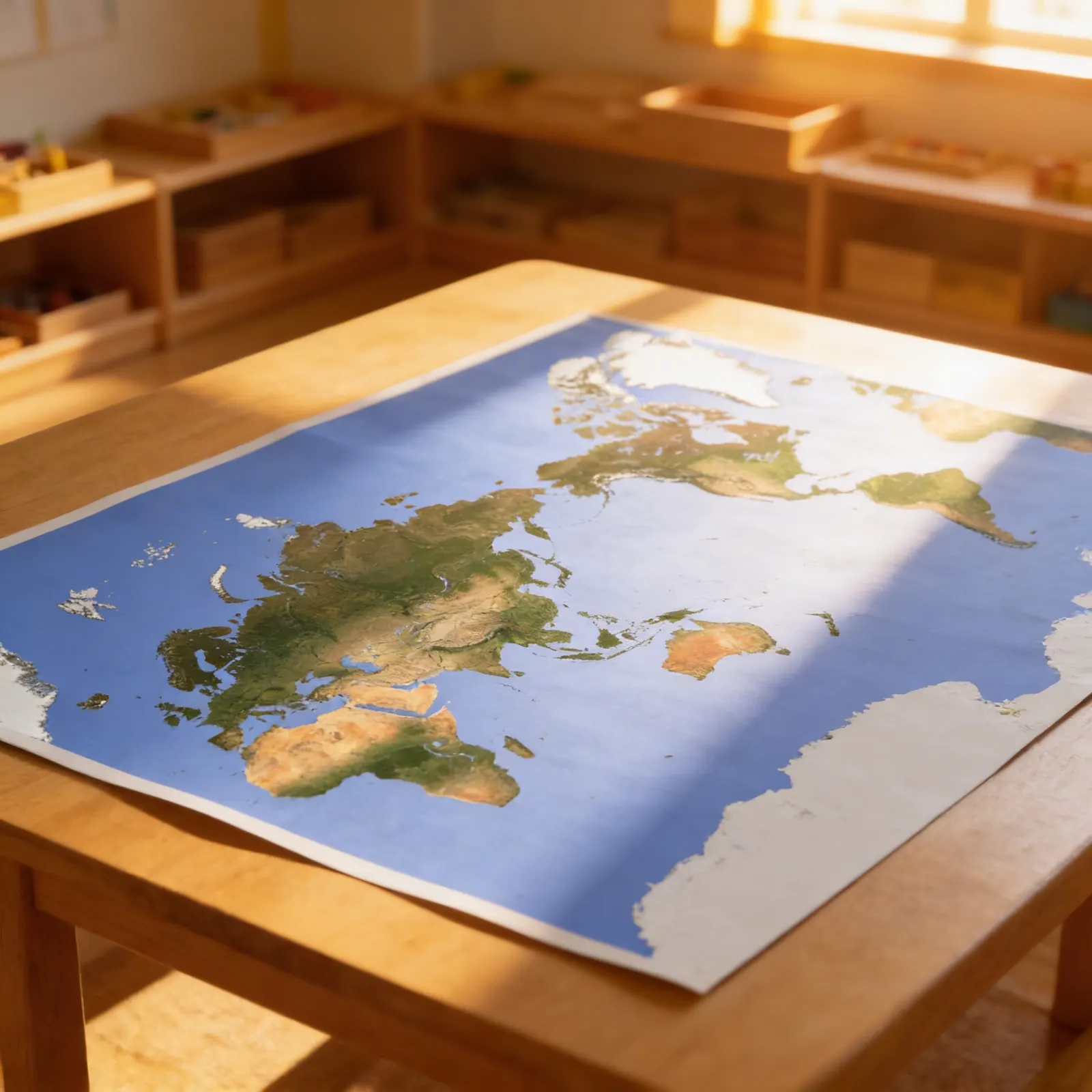
Large Chart Of The World in a child's hands
A world map of coated fabric, 140 x 170 cm, big enough that children sit on it while they work. That is the whole idea: at this scale the map stops being something looked at and becomes a place to be in, and word cards, animals and pictures get laid down on the part of the world they belong to. A child kneeling on the Pacific to reach Australia is learning the size of an ocean in a way no wall map manages. Coated fabric, 140 x 170 cm, for ages 3 to 12.
Global Awareness
The large chart promotes understanding of Earth as an interconnected whole.
Cultural Understanding
Supports fundamental human tendency to explore and understand different regions and peoples of the world.
Language Development
Facilitates vocabulary expansion through naming continents, oceans, and geographical features.
How to present it
Lay the chart out on the floor with enough room around it for children to sit on it comfortably. Have word cards, animal figures or pictures ready that belong to the different parts of the world.
- 1Begin with the Three Period Lesson for continents, pointing to each landmass: 'This is Asia'
- 2Invite children to trace coastlines with their finger across the chart
- 3Connect to children's lives by locating their continent, country, and region
- 4Have children lay word cards, animals or pictures on the part of the world they belong to
3 tips for parents
- Support learning by discussing family heritage locations on a similar map at home
- When reading books about different places, help your child locate them on a globe or map
- Encourage map-drawing of familiar places like your neighborhood or house floor plan

If you are not sure it suits your child, we answer in person.
Norbert Kovalčín, founder of Faborino · write to him
There is no review here yet. We will ask you for one after you buy. Write the first review
What's in the Box
- World Chart: Coated fabric, 140 × 170 cm
Size and material
| Product size | 140 × 170 cm |
| Packaging | 40 × 34 × 6 cm |
| Primary Material | Coated fabric |
| Recommended Age | 3-12 years |
Care
Wipe with damp cloth, dry immediately
Frequently Asked Questions
What makes this world chart suitable for Montessori classrooms?
This chart aligns with Montessori principles by showing children the world concretely: they sit on it and lay word cards, animals or pictures on the continents. The concrete, reality-based approach helps children ages 3-12 develop a true understanding of the world and their place in it.
What is the chart made of, and how big is it?
The chart is made of coated fabric measuring 140 × 170 cm, big enough for children to sit on while they work.
How can teachers integrate this chart into daily lessons?
Teachers can use this chart for cultural studies, continent work, land and water form lessons, and global awareness activities. It serves as a reference for discussing different countries, climates, and geographical features while supporting language development through vocabulary building and storytelling about different world regions.
Product safety
Manufacturer: Nienhuis Montessori, Anders Celsiusstraat 15, 7442 PB Nijverdal, Netherlands
Large Chart Of The World