
Long Division TubePlastic (10)
The first photo is the maker's own. The other shots are illustrative.
Inv. no. NIE-00950002
- Maker
- Nienhuis Montessori, since 1929
- Primary Material
- Clear plastic
- Transparency
- Fully transparent
- EAN
- 8719924005535
Final price incl. VAT. Delivery €5.90, €135.80 to go for free delivery.
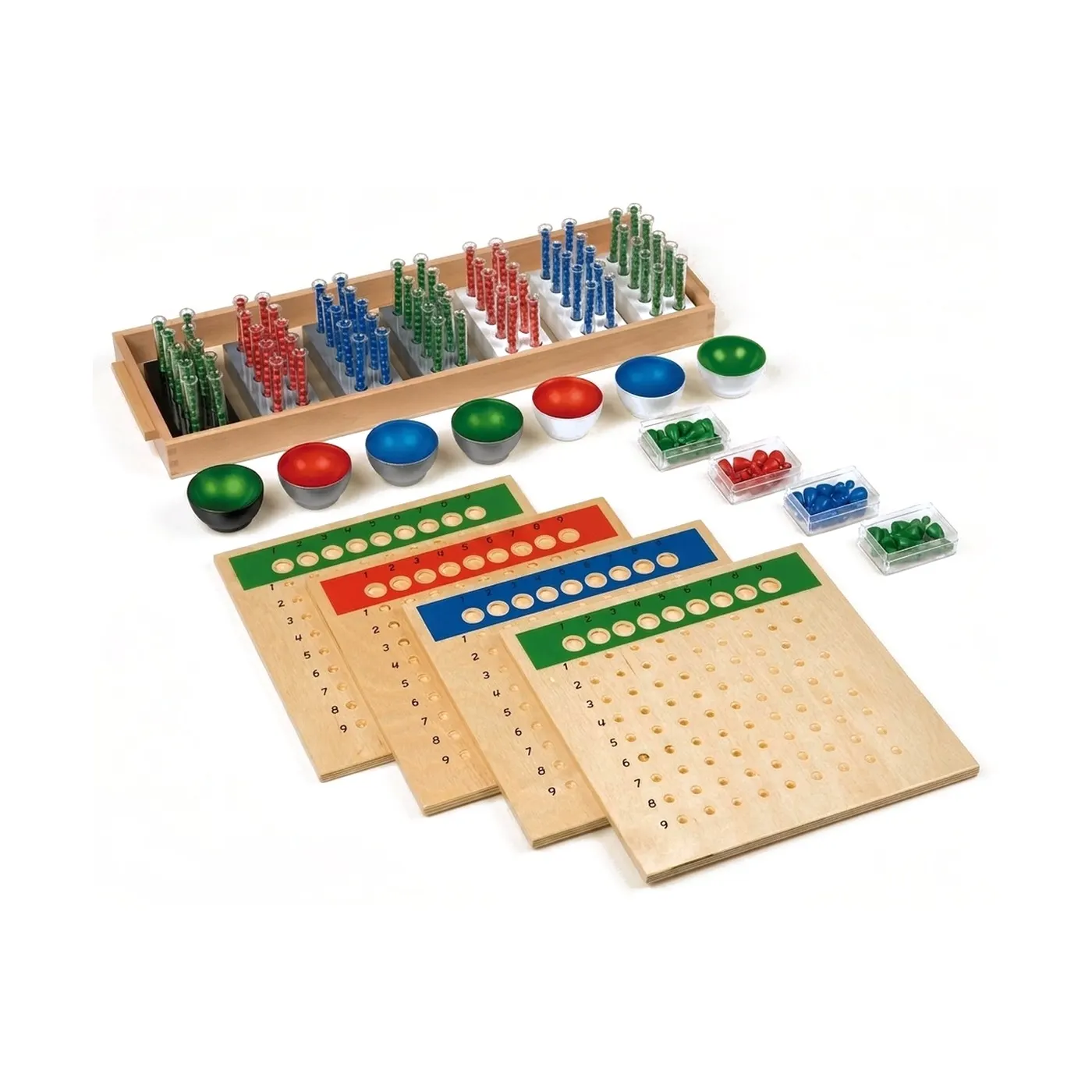 Long Division €311.90
Advice, warranty and returns are handled by us.
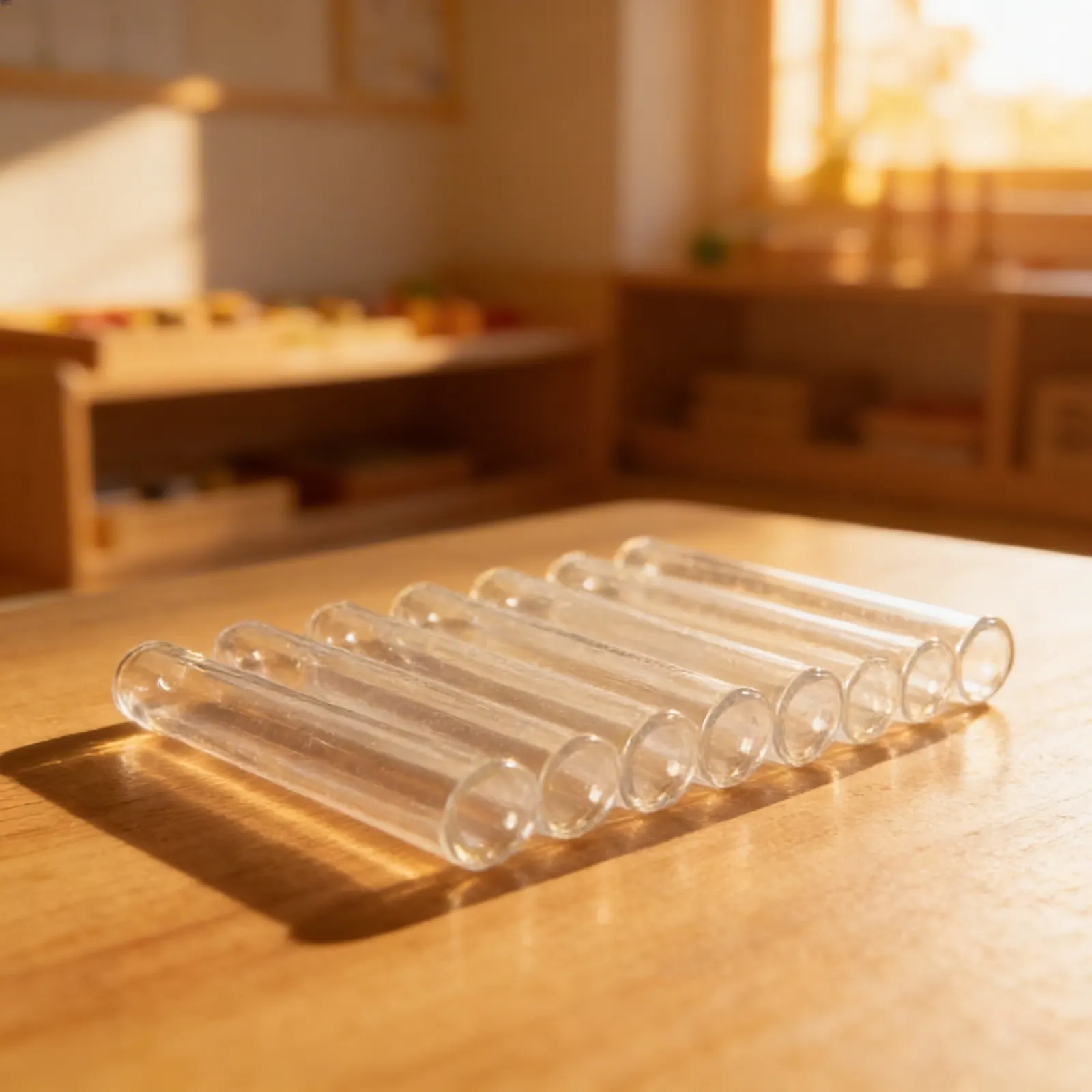
Long Division Tube in a child's hands
For hands-on mathematics, this set of 10 clear test tubes serves as a hands-on material for introducing division concepts to young learners. Children use the tubes as containers to physically divide quantities of small objects like beads or beans, making abstract mathematical concepts concrete and visible. The transparent design allows children to see and compare divided quantities, supporting the Montessori principle of learning through manipulation and observation.
Mathematical Understanding
Introduces division concepts through concrete manipulation, allowing children to physically distribute quantities and see the results.
Visual Discrimination
Transparent tubes enable children to compare divided amounts visually, strengthening their ability to assess equal distribution.
Fine Motor Skills
Handling small objects and placing them carefully into tubes refines hand control and precision movements.
Logical Thinking
Children develop systematic approaches to dividing quantities equally, building foundational problem-solving skills.
How to present it
Place tubes in a wooden holder or arrange in a line. Provide a bowl with 20-30 counting objects (beads, beans, or small stones). Have a small tray for remainders.
- 1Introduce dividing 12 objects among 3 tubes by distributing one object to each tube in rotation
- 2Continue distribution until all objects are placed, checking each tube has equal amounts
- 3Count objects in each tube to verify equal distribution: 'Each tube has 4 objects'
- 4Try 13 objects among 3 tubes, discovering one remainder
3 tips for parents
- Practice division during snack time using small cups as 'tubes' for distributing crackers or grapes
- Let children help divide household items: sorting socks into pairs or distributing napkins at dinner
- Avoid rushing to written division - physical understanding must come first

If you are not sure it suits your child, we answer in person.
Norbert Kovalčín, founder of Faborino · write to him
There is no review here yet. We will ask you for one after you buy. Write the first review
What's in the Box
- Test Tubes: 10 clear plastic tubes with rounded bottoms
Size and material
| Packaging | 12 × 8 × 1 cm |
| Primary Material | Clear plastic |
| Transparency | Fully transparent |
| Recommended Age | 3-6 years |
Care
Wash with mild soap and warm water, air dry completely
Frequently Asked Questions
What materials should I use with these division tubes?
Small, uniform objects like glass beads, beans, or counters work best. Items should be large enough to prevent choking hazards but small enough to fit comfortably in the tubes. Many teachers use colored beads to add visual appeal and support counting.
How do I introduce division concepts to 3-6 year olds using these tubes?
Start with simple equal sharing activities. Give the child a specific number of objects (like 12 beads) and ask them to share equally among 2, 3, or 4 tubes. The transparent design lets children see if each tube has the same amount, making the concept of division visible and concrete.
Are these tubes safe for young children?
Yes, the plastic tubes are designed for classroom use with smooth edges and durable construction. However, always supervise young children, especially with small counting materials, and ensure any objects used are appropriate for the child's age to prevent choking hazards.
What's the difference between these and traditional Montessori division materials?
These tubes offer a simplified, introductory approach to division perfect for younger children. While traditional Montessori division boards are used for more complex operations, these tubes focus on the fundamental concept of equal distribution through hands-on manipulation.
How many tubes come in the set and why 10?
The set includes 10 tubes, allowing children to explore division with various divisors (2, 5, 10) and have extras for comparison activities. This quantity supports both individual work and small group activities while fitting standard Montessori material organization.
Product safety
Manufacturer: Nienhuis Montessori, Anders Celsiusstraat 15, 7442 PB Nijverdal, Netherlands
Long Division Tube