
Love Of LearningSupporting Intrinsic Motivation In Montessori Students
The first photo is the maker's own. The other shots are illustrative.
Inv. no. NIE-542900
- Maker
- Nienhuis Montessori, since 1929
- Cover
- Paperback cardstock
- Pages
- Paper
- EAN
- 8719924028343
Final price incl. VAT. Delivery €5.90, €126.10 to go for free delivery.
Advice, warranty and returns are handled by us.
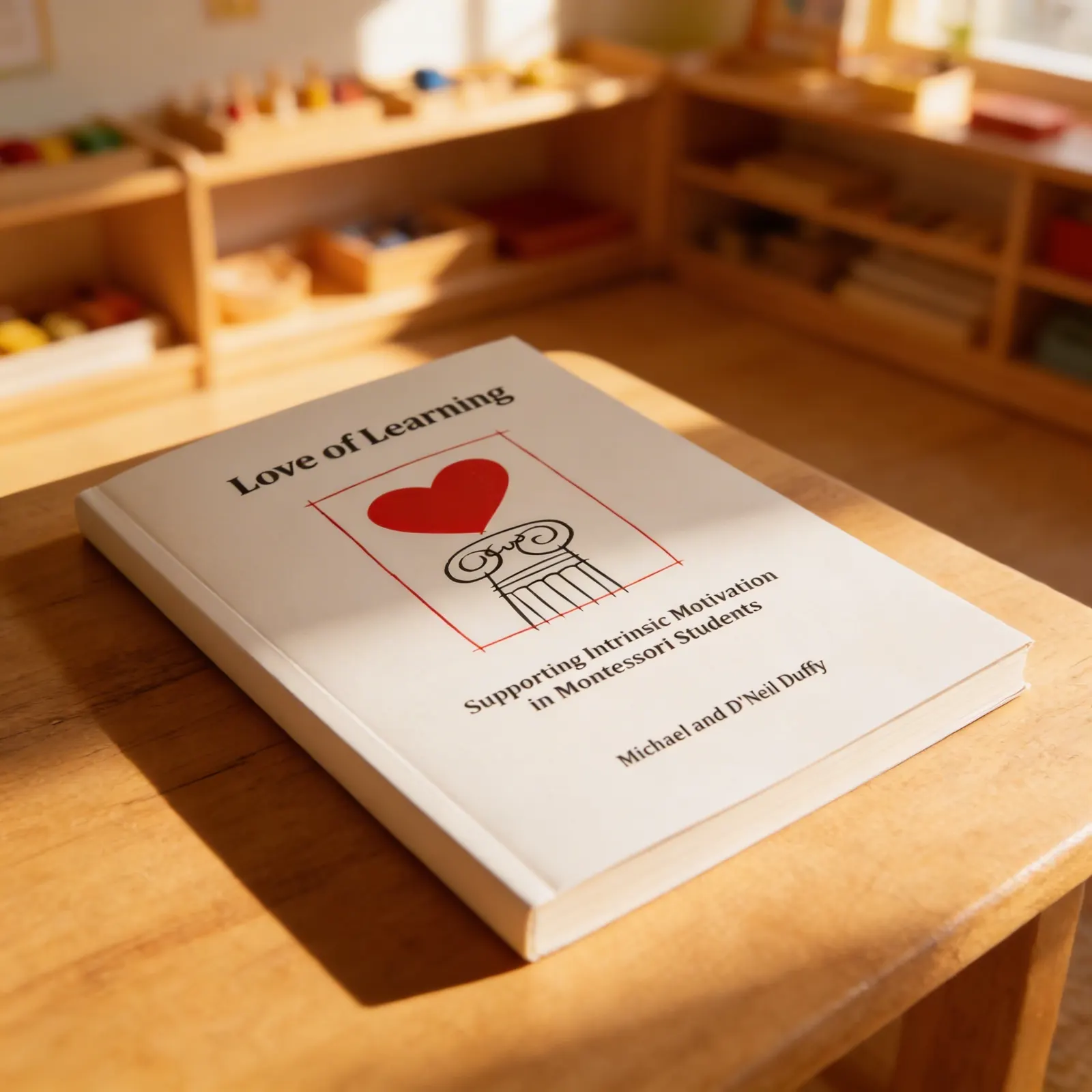
Love Of Learning in a child's hands
Michael and D'Neal Duffy on keeping a student's motivation coming from inside rather than from marks and praise. 144 pages, soft cover, 2012 edition. It is the practical end of a principle everybody agrees with and few can implement: the philosophy is explained, and then the strategies, which is the right order because the strategies make no sense without the argument for why rewards are the problem. Paper and cardstock, for teachers.
Teacher Development
Deepens understanding of intrinsic motivation principles essential to Montessori pedagogy
Classroom Application
Provides practical strategies for creating environments that support self-directed learning
Child-Centered Approach
Helps educators recognize and nurture each child's unique interests and developmental needs
Professional Growth
Enhances ability to observe and respond to children's natural learning rhythms
How to present it
Create a quiet reading space with notebook and pen. Mark chapters relevant to current classroom challenges. Schedule 20-minute daily reading sessions during children's work cycle for real-time observation opportunities.
- 1Begin with Chapter 1 on recognizing intrinsic motivation signals in young children
- 2Read case studies while observing your classroom during work periods
- 3Practice the observation techniques described in Chapter 3
- 4Implement one environment modification suggested in Chapter 5
- 5Document children's responses to environmental changes
3 tips for parents
- Focus on home environment chapters to support what happens at school
- Learn to recognize when your child is internally motivated versus seeking approval
- Practice restraining from unnecessary praise or corrections during concentrated work

If you are not sure it suits your child, we answer in person.
Norbert Kovalčín, founder of Faborino · write to him
There is no review here yet. We will ask you for one after you buy. Write the first review
What's in the Box
- Professional Development Book: Paperback edition
Size and material
| Packaging | 23 × 16 × 1 cm |
| Cover | Paperback cardstock |
| Pages | Paper |
| Recommended Age | Adult educators |
| Reading Time | Varies by chapter |
Care
Keep in dry environment away from direct sunlight
Frequently Asked Questions
What specific topics are covered in this guide about intrinsic motivation?
This guide covers understanding the child's inner drive to learn, creating prepared environments that support self-directed exploration, recognizing sensitive periods for learning, fostering independence without external rewards, and practical strategies for maintaining children's natural curiosity and enthusiasm for discovery.
Is this guide suitable for parents or only trained Montessori teachers?
While written by experienced Montessori practitioners with classroom examples, this guide is valuable for both Montessori teachers and parents. It explains concepts clearly and provides practical applications that can be implemented in both school and home environments to support children's natural love of learning.
How does this guide help with children who seem unmotivated or disinterested in learning?
The guide addresses common obstacles to intrinsic motivation, including over-stimulation, inappropriate materials, and external pressure. It provides strategies for observing children to identify their true interests, removing barriers to engagement, and creating conditions where natural curiosity can flourish again.
Does this book include practical examples and real classroom scenarios?
Yes, the guide includes numerous practical examples from Montessori classrooms, case studies of children discovering their interests, specific material presentations that spark intrinsic motivation, and real-world applications of theoretical concepts to help readers understand and implement the ideas effectively.
What makes this guide different from general books about child motivation?
This guide specifically focuses on the Montessori approach to intrinsic motivation, emphasizing the prepared environment, mixed-age classrooms, uninterrupted work cycles, and freedom of choice. It aligns with Maria Montessori's observations about children's natural tendencies and provides Montessori-specific strategies rather than generic motivation techniques.
Product safety
Manufacturer: Nienhuis Montessori, Anders Celsiusstraat 15, 7442 PB Nijverdal, Netherlands
Love Of Learning