
Metal Squares9 Plates
The first photo is the maker's own. The other shots are illustrative.
Inv. no. NIE-011500
- Maker
- Nienhuis Montessori, since 1929
- Approval
- AMI
- Construction
- Metal frames
- Finish
- Painted surface with green borders and red centers
- EAN
- 8719924006631
Final price incl. VAT. Free delivery.
Advice, warranty and returns are handled by us.
Why it costs €408.90
Behind the price of the original are things you can check yourself.
AMI approval
The material is approved by the Association Montessori Internationale (AMI). Nienhuis has made Montessori materials since 1929.
A verifiable original
The EAN 8719924006631 is on the box. It is the maker's number, not ours.
Metal Squares in a child's hands
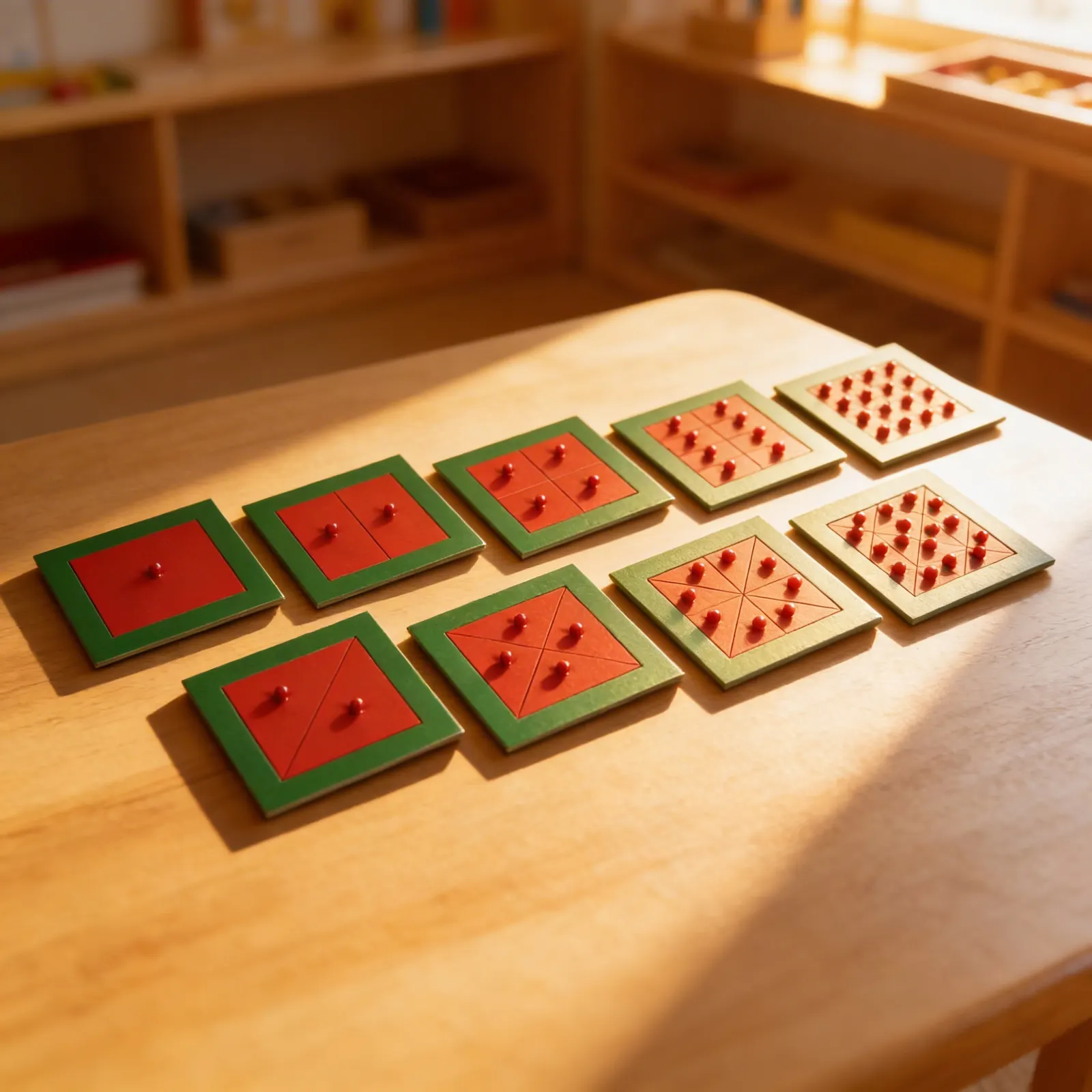
Nine metal frames with their bottoms, one set of insets divided into squares and rectangles and one set divided into triangles. The work is equivalence: a child lays the triangular pieces into the square frame, finds they fill it exactly, and has proved by hand that two shapes with different outlines can hold the same area. Identical, similar and equivalent stop being vocabulary and become three things the child has done. The set also serves the linear geometry work with the small metal insets. Painted metal, for ages 6 to 12.
Mathematical Understanding
Develops concrete understanding of fractions, equivalence, and geometric relationships through visual and tactile exploration.
Abstract Thinking
Bridges concrete manipulation to abstract mathematical concepts as children discover how shapes can be divided and recombined.
Problem-Solving Skills
Encourages logical thinking as children explore different ways to create equivalent shapes and understand part-whole relationships.
Fine Motor Precision
The small knobs require careful finger control, refining pincer grip while engaging with mathematical concepts.
How to present it
Place the nine metal plates on a work mat in order of complexity. Ensure adequate space for arranging removed pieces. Have tracing paper and colored pencils available.
- 1Begin with the simplest plate showing basic divisions. Demonstrate using the lifting knob to remove one section
- 2Remove all pieces from one plate, mixing them on the mat. Invite the child to reconstruct the original shape
- 3Compare pieces from different plates to discover equivalent areas
- 4Trace around the frame and removed pieces to create geometric designs
3 tips for parents
- When your child discusses their work, focus on the relationships they discovered rather than fraction names
- Provide opportunities at home to explore parts and wholes through cooking or building activities
- Support their investigations by asking 'What did you notice?' rather than teaching fraction concepts directly

If you are not sure it suits your child, we answer in person.
Norbert Kovalčín, founder of Faborino · write to him
There is no review here yet. We will ask you for one after you buy. Write the first review
What's in the Box
- Metal frames with bottoms: 9 green metal frames with bottoms
- Insets: squares and rectangles: 1 set of insets divided into squares and rectangles
- Insets: triangles: 1 set of insets divided into triangles
Size and material
| Packaging | 15 × 15 × 14 cm |
| Construction | Metal frames |
| Finish | Painted surface with green borders and red centers |
| Recommended Age | 6-12 years |
Care
Wipe with damp cloth, dry immediately
Frequently Asked Questions
What mathematical concepts do the Metal Squares teach?
The Metal Squares teach fractions, equivalence, geometric relationships, area concepts, and proportional reasoning. Children explore how shapes can be divided into equal parts, compare different fraction representations, and discover relationships between geometric forms through hands-on manipulation.
How do the nine plates progress in complexity?
The plates progress from simple whole shapes to increasingly complex subdivisions, including halves, thirds, quarters, and intricate triangular divisions. This progression allows children to build understanding gradually, moving from basic fraction concepts to more advanced geometric relationships and equivalencies.
What are the lifting knobs for?
The small lifting knobs on each metal piece allow children to easily remove and manipulate individual sections. This feature enables hands-on exploration of how shapes fit together, supports fraction work by allowing pieces to be rearranged, and helps develop fine motor control.
How does this material connect to other Montessori mathematics work?
The Metal Squares build upon earlier sensorial work with geometric shapes and prepare children for advanced fraction work, algebra, and geometry. They complement the fraction circles, constructive triangles, and other materials that explore mathematical relationships through concrete manipulation.
What skills do children develop using the Metal Squares?
Children develop spatial reasoning, mathematical thinking, problem-solving abilities, and abstract conceptualization. They gain concrete understanding of fractions, practice comparing equivalencies, explore geometric principles, and build foundations for later work in algebra and advanced mathematics.
Product safety
Manufacturer: Nienhuis Montessori, Anders Celsiusstraat 15, 7442 PB Nijverdal, Netherlands
Metal Squares