
Metal Volume Containers
The first photos are the maker's own. The other shots are illustrative.
Inv. no. NIE-012800
- Maker
- Nienhuis Montessori, since 1929
- Approval
- AMI
- Primary Material
- Painted metal
- Finish
- Smooth painted surface
- EAN
- 8719924006969
Final price incl. VAT. Free delivery.
Advice, warranty and returns are handled by us.
Why it costs €239.90
Behind the price of the original are things you can check yourself.
AMI approval
The material is approved by the Association Montessori Internationale (AMI). Nienhuis has made Montessori materials since 1929.
A verifiable original
The EAN 8719924006969 is on the box. It is the maker's number, not ours.
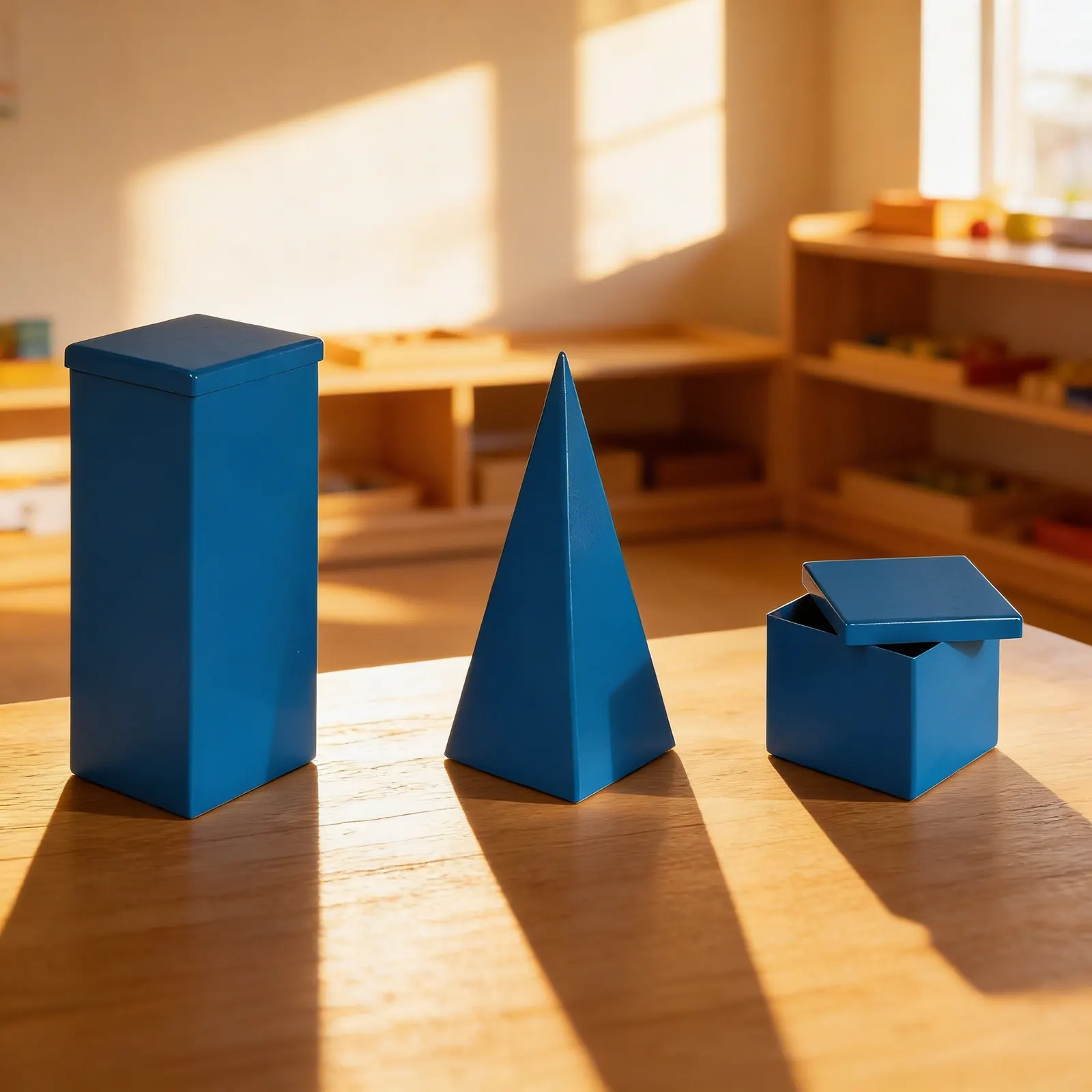
Metal Volume Containers in a child's hands
For hands-on mathematics, these accurately dimensioned metal volume containers introduce children to three-dimensional geometry through direct experience. Each container features a removable lid, allowing students to investigate volume relationships by filling, comparing, and measuring different geometric solids. The durable metal construction ensures years of classroom use while providing clear visual and tactile feedback for understanding spatial concepts.
Geometric Understanding
Children develop spatial reasoning by exploring three-dimensional shapes and their properties through direct manipulation.
Volume and Capacity Concepts
Hands-on filling activities build concrete understanding of volume relationships between different geometric solids.
Mathematical Reasoning
Comparing and measuring activities develop logical thinking and prepare for advanced geometric concepts.
Scientific Investigation
Encourages systematic exploration through measuring, comparing, and recording volume relationships.
How to present it
Arrange containers on a tray with measuring tools (graduated cylinder, ruler, rice/water for filling). Place formula cards nearby but face-down initially.
- 1Invite child to explore containers by removing lids and examining interior space
- 2Fill one container with rice or water, then pour contents into another to compare volumes
- 3Measure dimensions of each container and record findings
- 4Calculate volume using discovered measurements, then verify by filling
- 5Create volume equivalency chains showing which containers hold the same amount
3 tips for parents
- Practice volume concepts during cooking by comparing different shaped containers that hold the same amount
- Visit architecture sites or museums to identify geometric forms in buildings
- Create a 'volume investigation kit' with household containers for continued exploration

If you are not sure it suits your child, we answer in person.
Norbert Kovalčín, founder of Faborino · write to him
There is no review here yet. We will ask you for one after you buy. Write the first review
What's in the Box
- Rectangular Prism Container: with removable lid
- Triangular Prism Container: with removable lid
- Cube Container: with removable lid
Size and material
| Packaging | 19 × 12 × 24 cm |
| Primary Material | Painted metal |
| Finish | Smooth painted surface |
| Recommended Age | 6-12 years |
Care
Wipe with damp cloth, dry thoroughly to prevent rust
Frequently Asked Questions
What geometric shapes are included in the Metal Volume Containers set?
The set typically includes fundamental 3D shapes such as cubes, rectangular prisms, cylinders, cones, pyramids, and spheres. Each container has precise measurements and removable lids for hands-on exploration of volume relationships.
How do children use these containers for learning volume concepts?
Students fill the containers with materials like sand, water, or rice to compare volumes between different shapes. They can discover that shapes with the same base and height have related volumes, and explore concepts like displacement and capacity through practical experimentation.
What is the recommended age range and why?
These containers are designed for ages 6-12, aligning with when children develop spatial reasoning and can understand abstract mathematical concepts. The materials support progression from concrete manipulation to abstract understanding of volume formulas.
What makes the metal construction beneficial for classroom use?
The durable metal construction ensures longevity in classroom environments, provides precise edges for accurate measurements, and offers satisfying sensory feedback. The material is rust-resistant, easy to clean, and maintains its shape integrity over years of use.
How do these materials support Montessori mathematical principles?
These containers embody Montessori's concrete-to-abstract approach, allowing children to physically manipulate and compare volumes before introducing formulas. They support self-directed discovery, provide control of error through visual comparison, and integrate with other Montessori geometry materials.
Product safety
Manufacturer: Nienhuis Montessori, Anders Celsiusstraat 15, 7442 PB Nijverdal, Netherlands
Metal Volume Containers