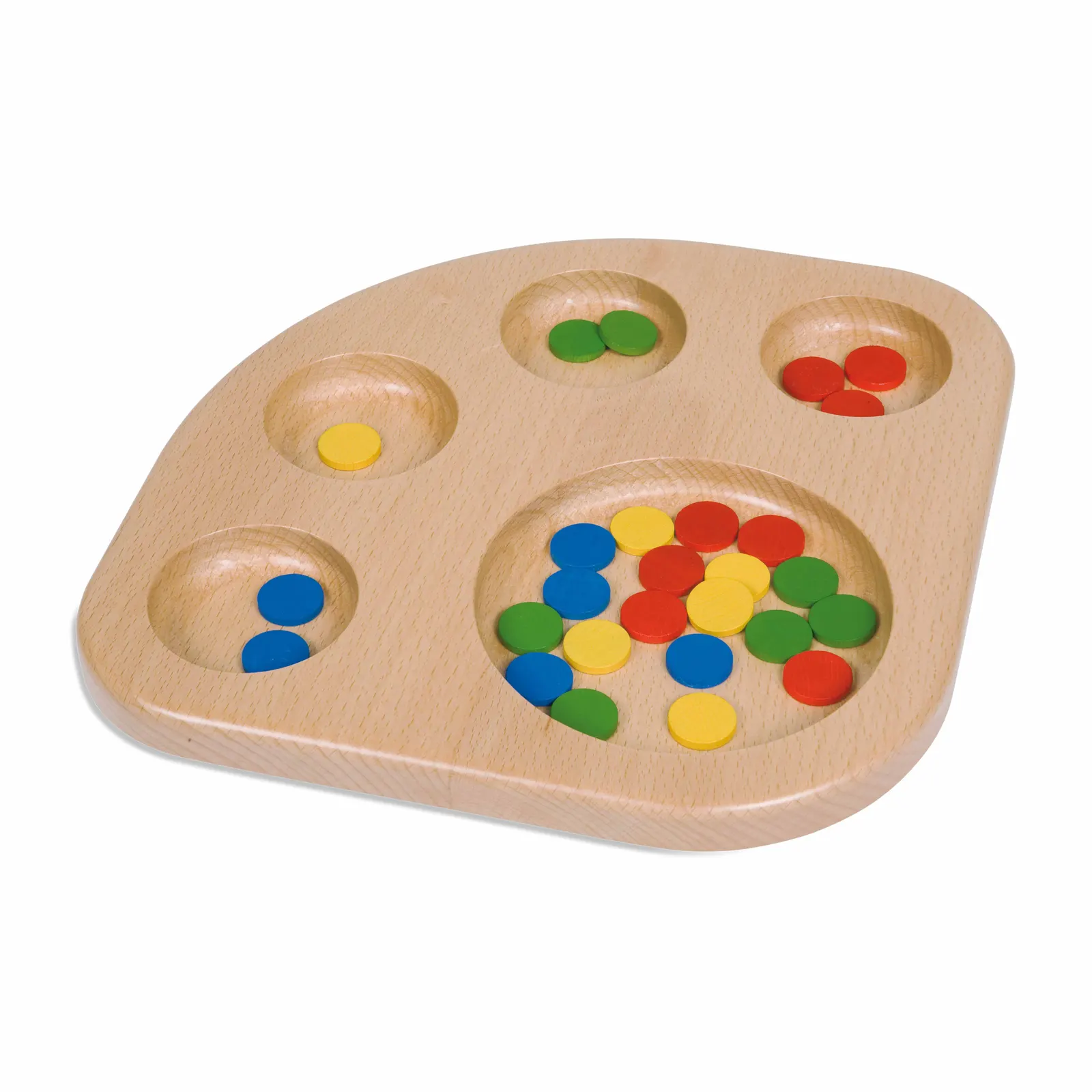
The Sorting Tray in natural and painted wood gives a child a defined surface for gathering and grouping small objects found around the room, from pebbles to buttons to seed pods. Moving each piece into its section by hand sharpens fine motor control and pincer grip, while sorting by colour, shape or kind builds the visual discrimination behind early classification. The tray does not include objects, so it is filled fresh from the environment each time. Painted and natural wood sections keep the groupings easy to read, suited to children from 0 to 3.
“The hands are the instruments of man's intelligence.”
This Sorting Tray embodies several fundamental principles of Maria Montessori's educational philosophy, most notably the concept of auto-education and the prepared environment designed to meet sensitive periods. The material perfectly exemplifies Montessori's understanding that children possess an internal drive for order and classification, particularly intense between 18 months and 3 years. The built-in control of error allows children to correct their own mistakes without adult intervention, supporting Montessori's belief that children are naturally capable of self-directed learning when provided with appropriately designed materials. The isolation of difficulty principle is evident in the material's singular focus on size discrimination and sorting, without additional complexities that might confuse the developing mind.
The graduated sizing unconsciously prepares the child's mathematical mind, demonstrating Montessori's insight that abstract concepts must first be experienced concretely through the senses. The material's presentation on a tray reflects Montessori's emphasis on order and beauty in the environment, while its individual nature supports the development of independence and concentration, core goals of Montessori education. This work directly serves the sensitive period for order, which Montessori observed as crucial for healthy psychological development and later learning success.


Heritage
Since 1929

Brands used by
schools worldwide

European brands

AMI
Endorsed

Everything you need to know about this material.
Contact Our ExpertsThe Sorting Tray is most beneficial between 18 months and 3 years, during the sensitive period for order. However, readiness varies by child. Look for signs such as interest in putting objects in containers, ability to focus on an activity for 5-10 minutes, and spontaneous sorting behaviors during play. Some children show readiness as early as 15 months, while others aren't interested until closer to 2 years.
This is completely normal exploratory behavior that serves important developmental purposes. Allow this exploration for several sessions, your child is learning about the properties of the materials through their senses. Most children naturally transition to purposeful sorting after satisfying their need to explore. If the behavior persists beyond 2-3 weeks, temporarily store the material and reintroduce it later when your child may be more developmentally ready.
Resist the urge to intervene immediately. The material is designed with a control of error, discs won't sit flush in incorrect wells, providing natural feedback. This self-correction opportunity builds independence, problem-solving skills, and confidence. Only assist if your child specifically asks for help or shows significant frustration after multiple attempts.
There's no set timeline, follow your child's interest and mastery level. Some children engage with this material for weeks or months, which is beneficial for developing concentration and perfecting skills. Consider introducing extensions or related materials when your child consistently completes the work independently and seeks additional challenges. The goal is mastery and satisfaction, not speed of progression.
While the material works best in an organized, prepared environment, it can certainly be used in a regular home setting. The key principles are: consistent placement on a low shelf, a designated workspace free from distractions, and presenting the material with care and purpose rather than as a casual toy. The child's respect for and engagement with the material often depends more on how it's presented than on the specific environment.
Brief initial engagement is normal, especially for younger children. Avoid forcing continued interaction, as this can create negative associations. Instead, ensure the material remains accessible and occasionally model its use during your own 'work' time. Many children return to materials multiple times before showing sustained interest. If disinterest persists, the child may not be developmentally ready, and reintroduction in a few weeks often yields better results.
Trusted across Europe
Premium educational materials, trusted by Montessori educators and families across Europe.

Faborino quality
Montessori-aligned