
Multiples Of Numbers Tables
The first photo is the maker's own. The other shots are illustrative.
Inv. no. NIE-560200
- Maker
- Nienhuis Montessori, since 1929
- Approval
- AMI
- Base Material
- Heavy-duty paper
- Surface
- Laminated finish
- EAN
- 8719924029869
Final price incl. VAT. Delivery €5.90, €120.10 to go for free delivery.
Advice, warranty and returns are handled by us.
Why it costs €28.90
Behind the price of the original are things you can check yourself.
AMI approval
The material is approved by the Association Montessori Internationale (AMI). Nienhuis has made Montessori materials since 1929.
A verifiable original
The EAN 8719924029869 is on the box. It is the maker's number, not ours.
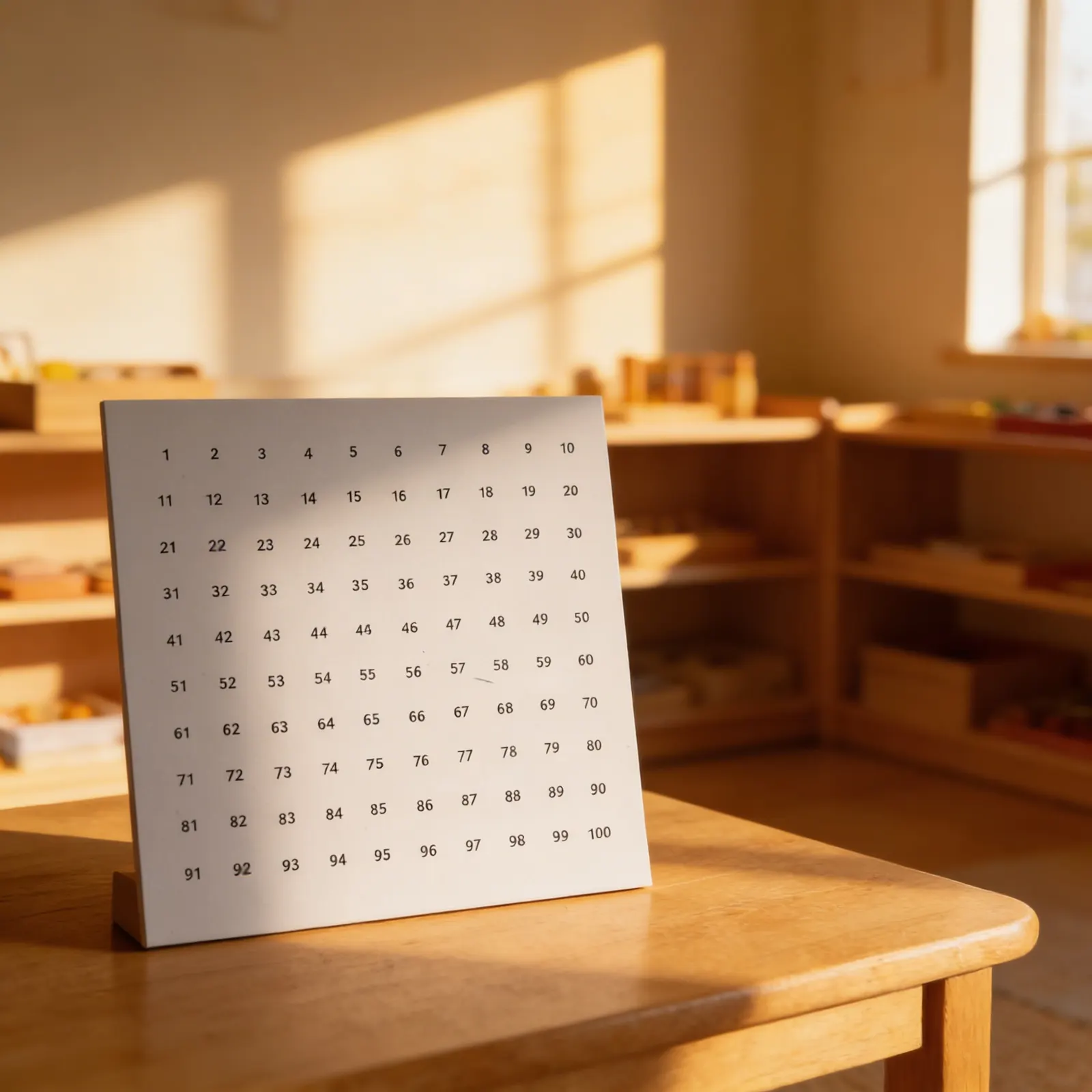
Multiples Of Numbers Tables in a child's hands
Two pads of seventy five sheets for recording the multiples of numbers. Where the earlier multiples pads split the work by range, this one is a single format used across the whole investigation, which is what a child needs once they stop being told which numbers to examine and start choosing. Having plenty of the same sheet is how a long piece of research stays one piece of research rather than five loose attempts. Paper with laminate, for ages 6 to 12.
Mathematical Pattern Recognition
Children identify skip counting sequences and multiplication patterns by highlighting multiples across the grid.
Visual Memory Development
The organized grid layout strengthens visual-spatial skills and number sequence memorization.
Abstract Thinking
Supports transition from concrete materials to abstract number relationships and mental mathematics.
Independent Discovery
Enables self-directed exploration of prime numbers, factors, and mathematical relationships.
How to present it
Place the Multiples of Numbers Tables on a work mat at eye level. Provide dry-erase markers in different colors, a small eraser, and a notebook for recording discoveries.
- 1Invite the child to choose a number between 2-10 and circle it on the chart
- 2Ask them to skip count by their chosen number, marking each multiple with the same color
- 3Once complete, invite observation of the pattern created - vertical, diagonal, or scattered
- 4Choose a second number and repeat with a different color, noting where patterns overlap
- 5Record discoveries in the notebook, drawing the patterns observed
3 tips for parents
- Practice skip counting during everyday activities like climbing stairs or setting the table
- Point out number patterns in calendars, clocks, or measuring tools at home
- Celebrate pattern discoveries rather than focusing on memorizing multiplication facts

If you are not sure it suits your child, we answer in person.
Norbert Kovalčín, founder of Faborino · write to him
There is no review here yet. We will ask you for one after you buy. Write the first review
What's in the Box
- Multiples Table Chart: Laminated 30×30cm grid
Size and material
| Packaging | 14 × 14 × 2 cm |
| Base Material | Heavy-duty paper |
| Surface | Laminated finish |
| Recommended Age | 6-12 years |
Care
Wipe with damp cloth, dry immediately
Frequently Asked Questions
What age range is this Multiples of Numbers Table designed for?
This material is designed for children ages 6-12, typically spanning lower and upper elementary in Montessori environments. It supports the progression from concrete multiplication work to abstract number theory concepts.
How does this table support Montessori mathematics learning?
The table serves as a control chart for multiplication work, helps children discover skip counting patterns, identify prime and composite numbers, and visualize mathematical relationships. It complements work with bead chains, multiplication boards, and other Montessori math materials.
What are the dimensions and materials of this table?
This is a laminated 10x10 grid displaying numbers 1-100. The lamination ensures durability for daily classroom use and allows children to mark patterns with dry-erase markers for hands-on exploration.
What specific mathematical concepts can children explore with this table?
Children can identify multiples of any number, discover prime numbers, explore factors, recognize square numbers, study divisibility rules, and observe number patterns. It's particularly useful for skip counting exercises and understanding multiplication relationships.
How does this differ from a standard hundred board?
While a hundred board is typically used for number recognition and sequencing, this Multiples Table is specifically designed for multiplication work and pattern identification. Its format and presentation are optimized for exploring mathematical relationships and serving as a reference during multiplication activities.
Product safety
Manufacturer: Nienhuis Montessori, Anders Celsiusstraat 15, 7442 PB Nijverdal, Netherlands
Multiples Of Numbers Tables