
Musical Instruments Matching Cards
The first photo is the maker's own. The other shots are illustrative.
Inv. no. NIE-EC0720B
- Maker
- Nienhuis Montessori, since 1929
- Material
- Durable plastic
- Finish
- Pre-cut with rounded corners
- EAN
- 8719924043292
Final price incl. VAT. Delivery €5.90, €95.10 to go for free delivery.
Advice, warranty and returns are handled by us.
Musical Instruments Matching Cards in a child's hands
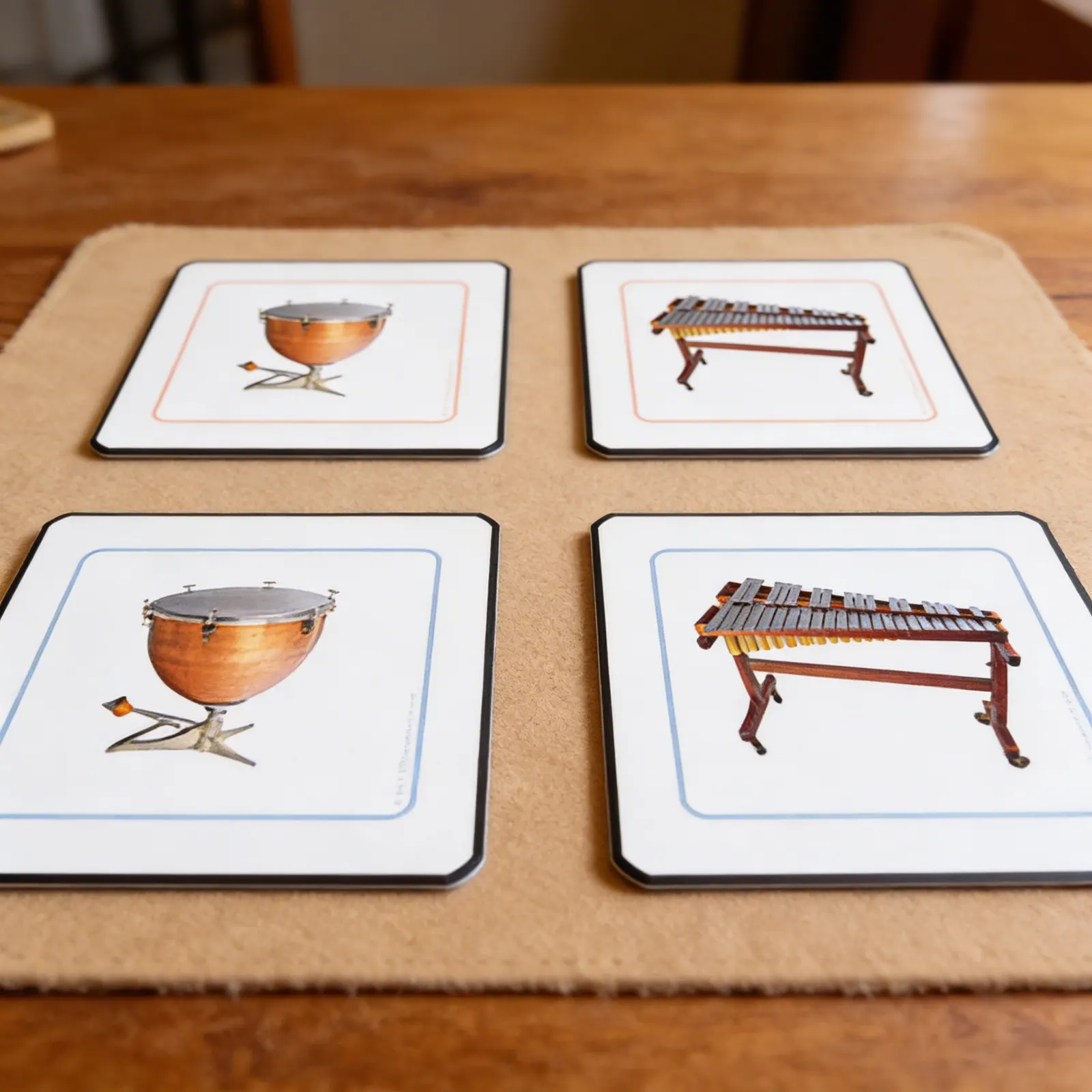
Designed for ages 3-6, this Musical Instruments Matching Cards set brings children face-to-face with different orchestral instruments through photographic images with color-coded borders. The pink and blue bordered cards feature clear photographs of timpani and xylophone, supporting the Montessori approach to musical education through visual discrimination and matching activities. A good match for developing auditory awareness and classification skills in the primary classroom.
Visual Discrimination
Children develop observation skills by matching identical instrument images and recognizing color-coded borders.
Music Appreciation
Introduces orchestral instruments visually, preparing children for future musical experiences and sound recognition.
Classification Skills
Supports the development of categorization abilities through sorting by instrument type and border color.
Vocabulary Development
Expands musical vocabulary with proper instrument names and descriptions through three-period lessons.
How to present it
Place one set of cards face-up in a grid pattern on a work mat. Keep the matching set in a neat stack face-down.
- 1Select one card from the face-down stack and examine the instrument photograph carefully
- 2Scan the face-up cards to find the matching instrument image
- 3Place the selected card below its match to create pairs
- 4Continue until all instruments are matched in pairs
3 tips for parents
- Visit music stores or concerts to see real versions of the pictured instruments
- Create homemade instrument books using magazine cutouts to extend the matching concept
- Play 'I Spy' games using instrument characteristics shown in the photographs

If you are not sure it suits your child, we answer in person.
Norbert Kovalčín, founder of Faborino · write to him
There is no review here yet. We will ask you for one after you buy. Write the first review
What's in the Box
- Pink-bordered cards: 2 matching instrument photos
- Blue-bordered cards: 2 matching instrument photos
Size and material
| Packaging | 15 × 15 × 2 cm |
| Material | Durable plastic |
| Finish | Pre-cut with rounded corners |
| Recommended Age | 3-6 years |
Care
Wipe with slightly damp cloth, dry immediately
Frequently Asked Questions
What instruments are included in this Musical Instruments Matching Cards set?
This set features photographic images of various orchestral instruments including timpani and xylophone. Each instrument is presented with clear, high-quality photographs on cards with color-coded borders (pink and blue) to aid in classification and matching activities.
How do these matching cards support Montessori musical education?
These cards align with Montessori principles by providing concrete visual representations of instruments before abstract musical concepts. Children develop visual discrimination skills through matching activities, learn to classify instruments by type, and build vocabulary while preparing for future music appreciation and theory work.
What specific skills do children develop using these musical instrument cards?
Children develop visual discrimination, classification abilities, vocabulary expansion, auditory awareness (by connecting visual images to sounds), fine motor skills through card handling, concentration, and memory. The cards also introduce cultural awareness through exposure to orchestral instruments.
What activities can be done with these musical instrument matching cards?
Activities include traditional matching exercises, sorting by color-coded borders, three-period lessons for vocabulary, creating instrument families, memory games, discussing instrument sounds and roles, and pairing with actual instrument sounds through recordings or live demonstrations.
Are these cards suitable for children who haven't had music lessons?
Yes, these cards are specifically designed as an introduction to musical instruments for young children ages 3-6, requiring no prior musical knowledge. They serve as a foundation for musical awareness and can inspire interest in music before formal lessons begin.
Product safety
Manufacturer: Nienhuis Montessori, Anders Celsiusstraat 15, 7442 PB Nijverdal, Netherlands
Musical Instruments Matching Cards