
Mystery Bags: Geometric Shapes Tactile Recognition Activity
Made by Nienhuis Montessori · shipped by Heutink International (Netherlands) About the maker
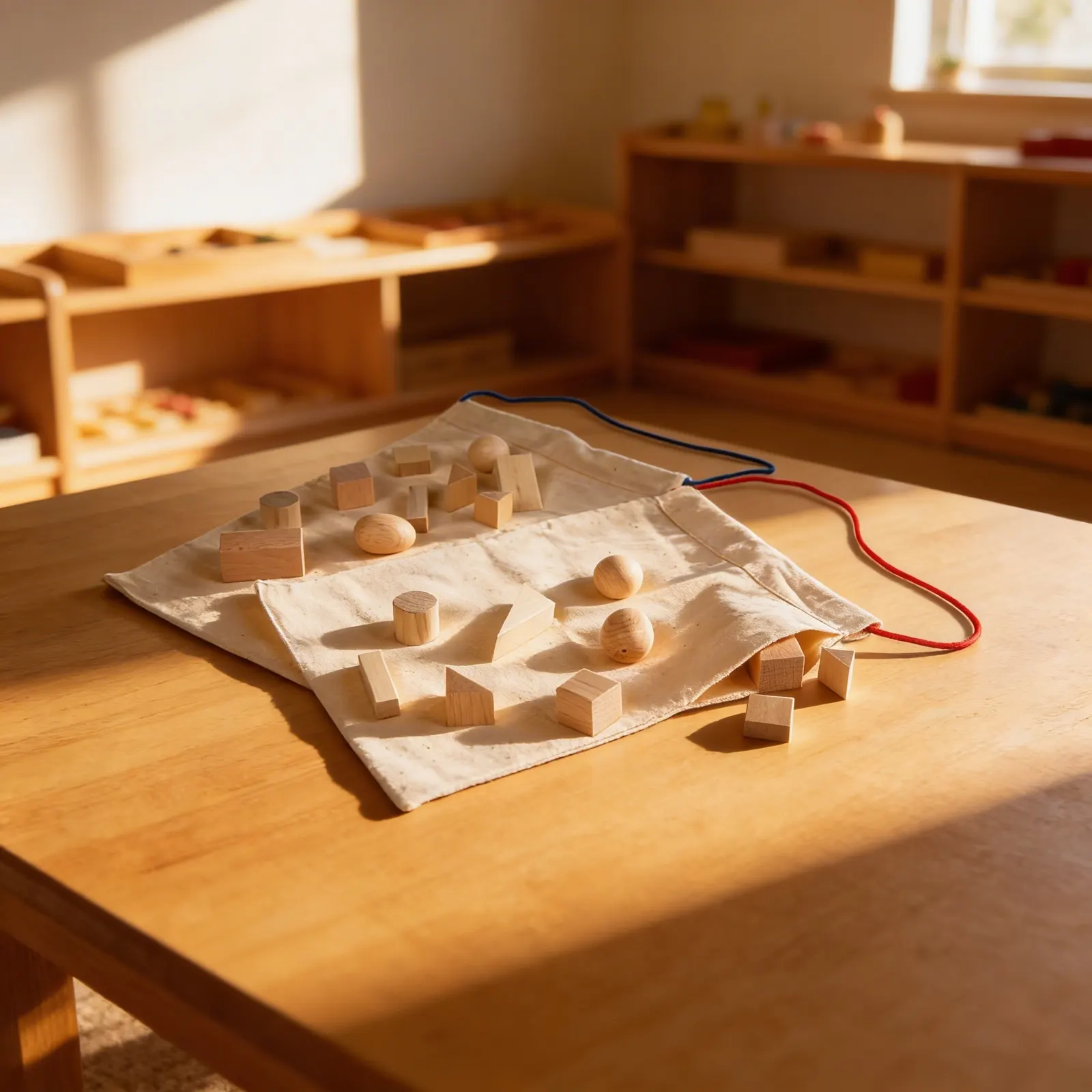
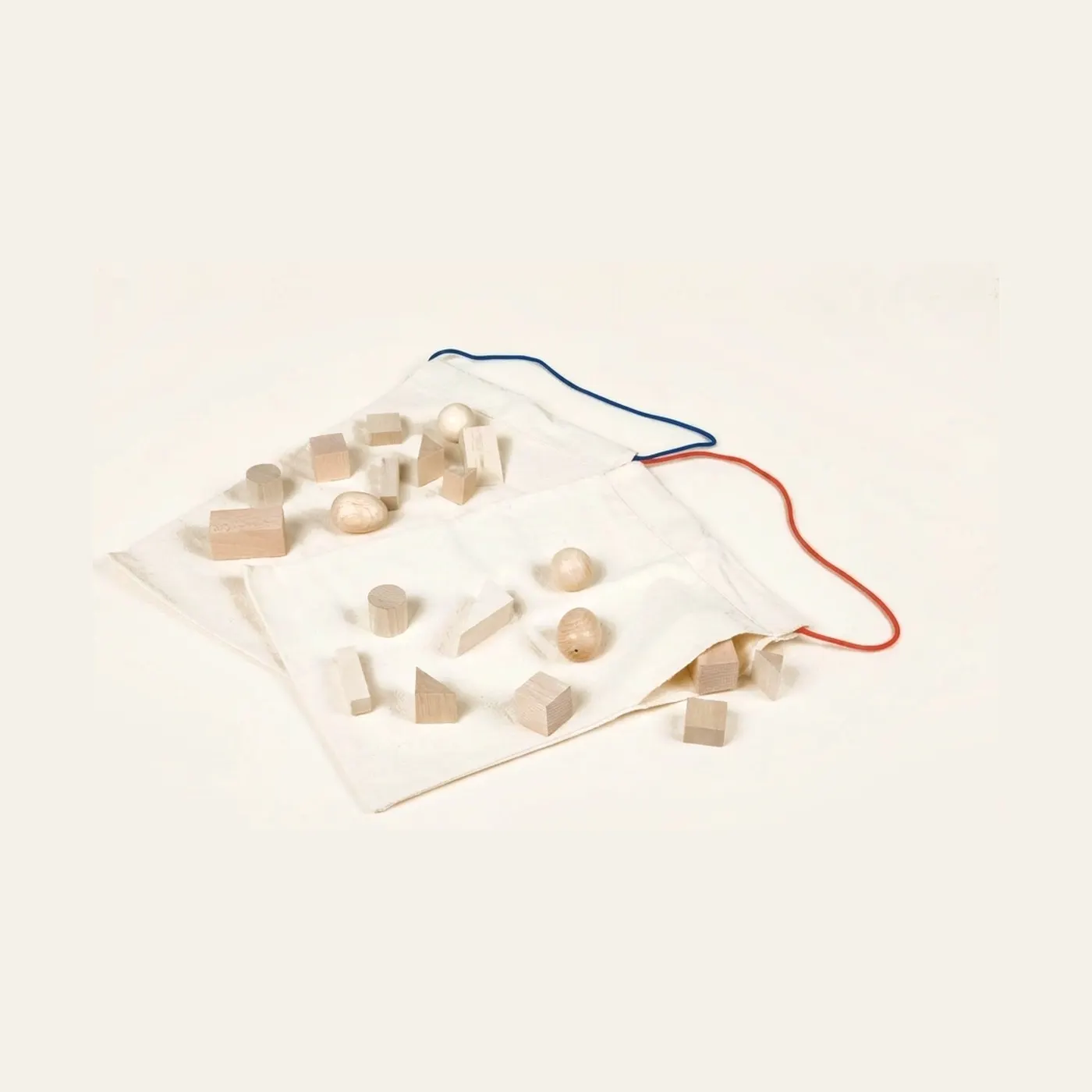
Two cloth bags, each holding the same set of small geometric solids, for matching by touch. Two bags is what separates this from the familiar objects version: a child is not naming what they hold, they are finding its twin in the other bag, so the judgement is made entirely between two hands with no word required. That makes it usable long before the vocabulary for a rectangular prism exists. Wood with fabric cord, for ages 3 to 6.
“The hands are the instruments of man's intelligence.”
This material embodies Montessori's principle of isolating difficulty by combining stereognostic development with geometric shape recognition.
- Refinement of stereognostic sense through tactile discrimination of geometric forms
- Development of fine motor control and pincer grip through cord manipulation
- Preparation for mathematical mind through concrete geometric shape recognition
- Enhancement of concentration through focused tactile exploration
Read More
Through the fabric cord pathway system, children engage their tactile-muscular memory while their visual sense is naturally subdued, allowing for true stereognostic exploration. The material respects the child's need for repetition and self-correction, as the raised pathways provide immediate feedback. This aligns with Montessori's understanding that the hand is the instrument of the mind - by tracing pathways and encountering geometric solids through touch, children build neural pathways that connect concrete sensorial experiences with abstract geometric concepts. The material serves as a bridge between the early sensorial work with geometric solids and later mathematical understanding.
How to present it
Follow the Montessori method of presentation for optimal child development.
Place the board on a table mat. Ensure all geometric solids are positioned correctly on their pathways. Have the child wash hands to enhance tactile sensitivity.
- 1
Invite the child to explore one pathway with eyes open first, slowly guiding the cord along the raised path
Model slow, deliberate movements to encourage mindful exploration - 2
When encountering a geometric solid, pause and explore it thoroughly with fingertips
Use the three-period lesson to introduce shape names: 'This is a sphere' - 3
Encourage the child to close eyes and repeat the pathway, focusing on the tactile experience
Sit beside, not across from the child, to maintain the same perspective - 4
After exploring all pathways, invite the child to match the felt shapes with corresponding geometric solids cabinet pieces
This creates a connection between different sensorial materials
Every Child Is a Little Creator

Heritage
Since 1929

In classrooms
Around the world

European brands
Nienhuis, GAM, Educo

AMI approved
To the association standard
Mystery Bags: Geometric Shapes Tactile Recognition Activity
