
Name CardsSecond Set Of Botany Cards
The first photo is the maker's own. The other shots are illustrative.
Inv. no. NIE-0196A1
- Maker
- Nienhuis Montessori, since 1929
- Approval
- AMI
- Card Material
- Heavy paper stock
- Finish
- Laminated for durability
- EAN
- 8719924010423
Final price incl. VAT. Delivery €5.90, €118.10 to go for free delivery.
Advice, warranty and returns are handled by us.
Why it costs €30.90
Behind the price of the original are things you can check yourself.
AMI approval
The material is approved by the Association Montessori Internationale (AMI). Nienhuis has made Montessori materials since 1929.
A verifiable original
The EAN 8719924010423 is on the box. It is the maker's number, not ours.
Name Cards in a child's hands
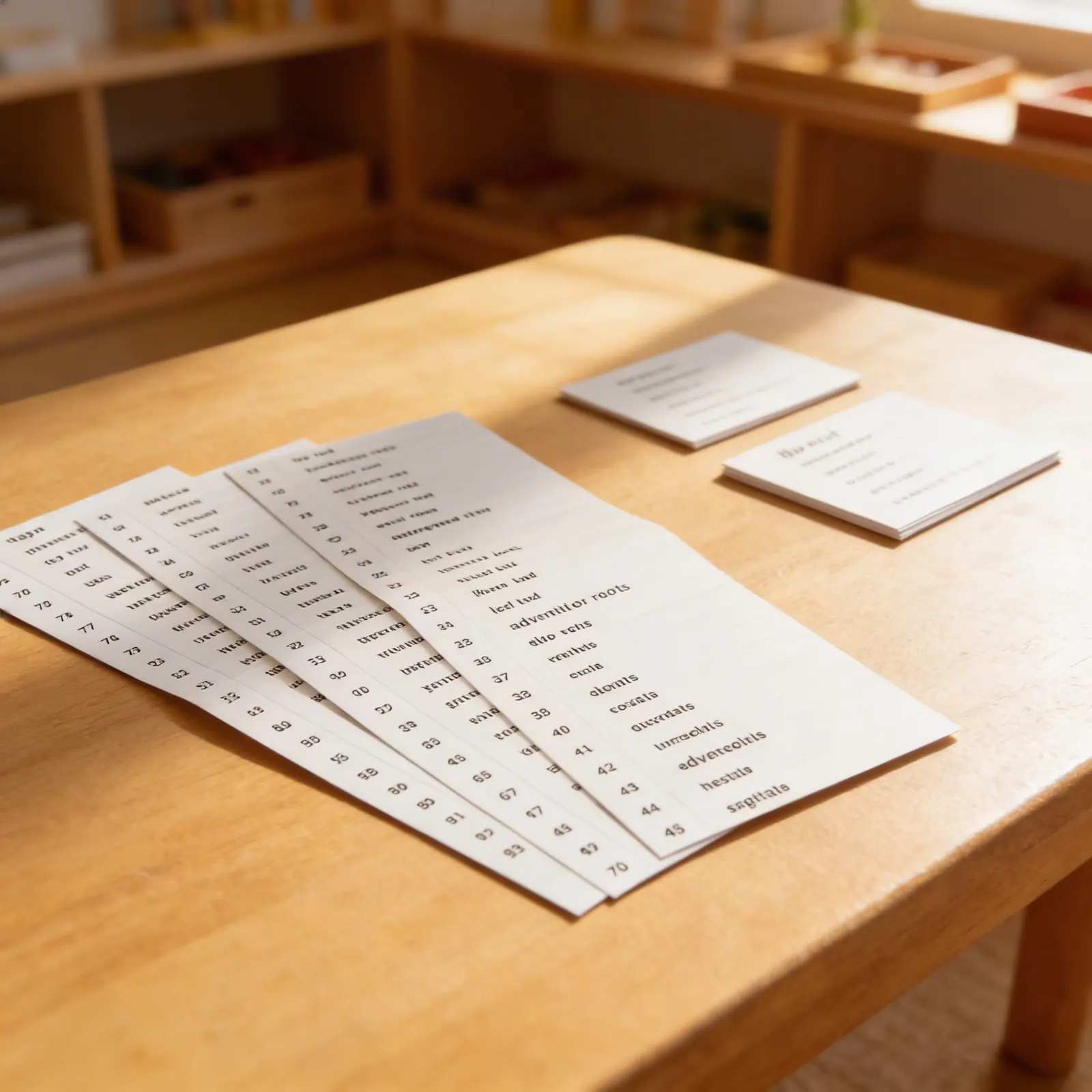
Two sets of plastic labels with the nomenclature of classification for the second set of botany cards. The second set moves from the parts of a plant to how plants are grouped, and grouping is where the words get long and the child stops being able to guess. Two identical sets is what makes the work self checking: one is laid out, the other stays as the answer, and nobody has to be asked. Cards sold separately. Plastic, for ages 3 to 12.
Scientific Vocabulary
Introduces precise botanical terminology, building the foundation for scientific classification and communication.
Reading Development
Reinforces reading skills through repeated exposure to specialized vocabulary in context.
Systematic Thinking
Numbered grid format promotes organized learning and helps children understand relationships between botanical concepts.
Independence
Self-correcting nature of nomenclature work allows children to verify their understanding autonomously.
How to present it
Arrange the botany cards in sequence on a mat, ensuring the numbered grid is visible. Have a plant specimen or botanical puzzle available for concrete reference.
- 1Introduce 3-4 new botanical terms from the cards using three-period lesson
- 2Invite the child to match nomenclature cards with corresponding plant parts
- 3Practice reading the botanical terms independently using the numbered sequence
- 4Create botanical definitions by combining multiple nomenclature cards
3 tips for parents
- Point out botanical features during outdoor time using vocabulary from the cards
- Create a nature journal together, labeling plant parts with learned terminology
- Visit botanical gardens to see diverse examples of the plant characteristics studied

If you are not sure it suits your child, we answer in person.
Norbert Kovalčín, founder of Faborino · write to him
There is no review here yet. We will ask you for one after you buy. Write the first review
What's in the Box
- Nomenclature Cards: Approx. 3 cards with botanical terms
- Grid Format: Multiple terms per card with numbering
Size and material
| Packaging | 33 × 12 × 1 cm |
| Card Material | Heavy paper stock |
| Finish | Laminated for durability |
| Recommended Age | 6-12 years |
Care
Wipe with slightly damp cloth; dry immediately
Frequently Asked Questions
What botanical concepts does the Second Set of Botany Cards cover?
This set presents specialized botanical vocabulary building upon basic plant knowledge, introducing more advanced nomenclature and classification terms. The cards expand children's understanding beyond simple plant parts to include specific botanical terminology used in scientific classification.
How do these cards differ from the first set of botany cards?
While the first set introduces basic plant parts and structures, this second set advances to specialized botanical vocabulary and classification concepts. It's designed for children who have mastered fundamental plant terminology and are ready for more complex botanical nomenclature.
What is the recommended sequence for using these cards with other botany materials?
Begin with the First Set of Botany Cards for basic plant parts, then progress to this Second Set for advanced vocabulary. These cards work well alongside botany puzzles, plant specimens, and classification activities to create a comprehensive botanical study program.
How are the cards organized for independent learning?
The cards feature a systematic grid format with numbered entries and clear typography, allowing children to work independently. This organization supports self-directed learning and enables children to progress through botanical concepts at their own pace.
What makes these cards suitable for ages 3-6 despite the advanced vocabulary?
The laminated cards use clear, simple typography and organized presentation that makes complex terms accessible to young learners. The systematic approach allows children to absorb specialized vocabulary naturally through repeated exposure and classification activities.
Product safety
Manufacturer: Nienhuis Montessori, Anders Celsiusstraat 15, 7442 PB Nijverdal, Netherlands
Name Cards