
Name CardsThird Set Of Botany Cards
The first photo is the maker's own. The other shots are illustrative.
Inv. no. NIE-0197A1
- Maker
- Nienhuis Montessori, since 1929
- Approval
- AMI
- Card Material
- Premium cardstock
- Finish
- Matte coating
- EAN
- 8719924010478
Final price incl. VAT. Delivery €5.90, €110.10 to go for free delivery.
Advice, warranty and returns are handled by us.
Why it costs €38.90
Behind the price of the original are things you can check yourself.
AMI approval
The material is approved by the Association Montessori Internationale (AMI). Nienhuis has made Montessori materials since 1929.
A verifiable original
The EAN 8719924010478 is on the box. It is the maker's number, not ours.
Name Cards in a child's hands
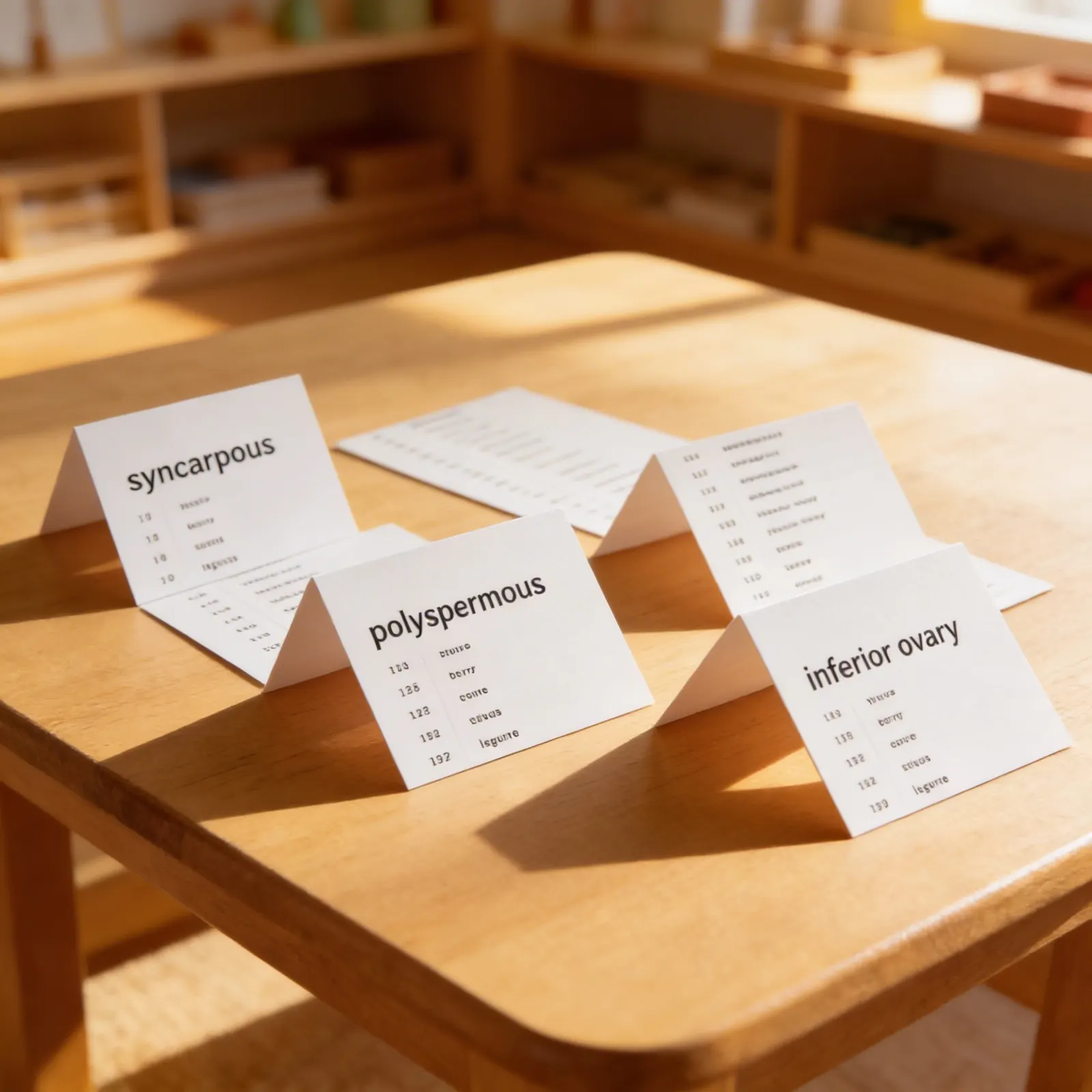
Two sets of plastic labels carrying the nomenclature of classification for the third set of botany cards. Two sets is what makes them usable alone: one stays with the cards as the control, the other is what the child places, and the check happens without asking. Classification names are long, Latin and unguessable, so a label a child can compare letter by letter is the only workable form. Cards sold separately. Plastic, for ages 3 to 12.
Scientific Classification
Develops understanding of botanical taxonomy and plant categorization through systematic study of fruit types and plant structures.
Vocabulary Enrichment
Introduces specialized scientific terminology, expanding language skills with precise botanical vocabulary.
Visual Discrimination
Enhances observation skills through detailed examination of plant characteristics and structural differences.
Sequential Learning
Numbered progression supports organized, methodical approach to complex botanical concepts.
How to present it
Arrange a small selection of 6-8 cards from the set on a mat, choosing related concepts (e.g., all fruit types or all leaf structures). Have the picture cards, label cards, and control cards organized separately.
- 1Begin with three-period lesson for new terminology, showing picture card while naming the botanical structure
- 2Invite child to match picture cards with corresponding label cards
- 3Progress to matching exercises with larger groups of cards as vocabulary expands
- 4Encourage child to create their own botanical classifications using the cards
3 tips for parents
- Look for examples of botanical structures from the cards during nature walks or grocery shopping
- Support vocabulary development by using precise botanical terms in everyday conversation
- Create a home collection of botanical specimens that correspond to studied card concepts

If you are not sure it suits your child, we answer in person.
Norbert Kovalčín, founder of Faborino · write to him
There is no review here yet. We will ask you for one after you buy. Write the first review
What's in the Box
- Botanical Nomenclature Cards: 99 cards numbered 95-193
- Topic Categories: Fruit types, plant structures, botanical terms
Size and material
| Packaging | 33 × 12 × 1 cm |
| Card Material | Premium cardstock |
| Finish | Matte coating |
| Recommended Age | 6-12 years |
Care
Wipe with dry cloth; avoid moisture
Frequently Asked Questions
What specific botanical concepts are covered in this Third Set of Botany Cards?
This advanced set covers fruit types (simple, aggregate, multiple), complex plant structures, botanical terminology, and classification systems. The cards numbered 95-193 build upon the foundation established in the first two sets, introducing more sophisticated botanical concepts appropriate for children who have mastered basic plant parts.
How do these cards differ from the First and Second Sets of Botany Cards?
While the First Set introduces basic plant parts and the Second Set covers plant families and life cycles, this Third Set focuses on advanced classification and terminology. It includes more complex botanical concepts like fruit morphology, specialized plant structures, and scientific nomenclature that prepare children for elementary-level botany studies.
What is the recommended sequence for using these cards with young children?
Begin with three-part card matching activities, then progress to nomenclature lessons where children learn specific terminology. Follow with classification exercises sorting different fruit types or plant structures. The numbered sequence (95-193) provides a suggested progression, but adapt based on individual child interest and readiness.
How many cards are included and what is their format?
This comprehensive set includes approximately 98 cards (numbered 95-193), featuring beautifully illustrated three-part cards with control cards, picture cards, and labels. Each concept includes detailed botanical illustrations with accurate scientific representation suitable for young learners while maintaining Montessori aesthetic principles.
Can these cards be used effectively in a home environment?
Yes, these cards work excellently in home settings. Create a dedicated botany shelf, combine with real specimens when possible, and follow the child's interest. Parents can support learning by exploring botanical concepts in nature, visiting botanical gardens, and connecting card lessons to everyday experiences with fruits and plants.
Product safety
Manufacturer: Nienhuis Montessori, Anders Celsiusstraat 15, 7442 PB Nijverdal, Netherlands
Name Cards