
North AmericaWaterways (50)
The first photo is the maker's own. The other shots are illustrative.
Inv. no. NIE-552700
- Maker
- Nienhuis Montessori, since 1929
- Approval
- AMI
- Primary Material
- Paper/cardstock
- Print Type
- Full color geographical print
- EAN
- 8719924029258
Final price incl. VAT. Delivery €5.90, €125.10 to go for free delivery.
Advice, warranty and returns are handled by us.
Why it costs €23.90
Behind the price of the original are things you can check yourself.
AMI approval
The material is approved by the Association Montessori Internationale (AMI). Nienhuis has made Montessori materials since 1929.
A verifiable original
The EAN 8719924029258 is on the box. It is the maker's number, not ours.
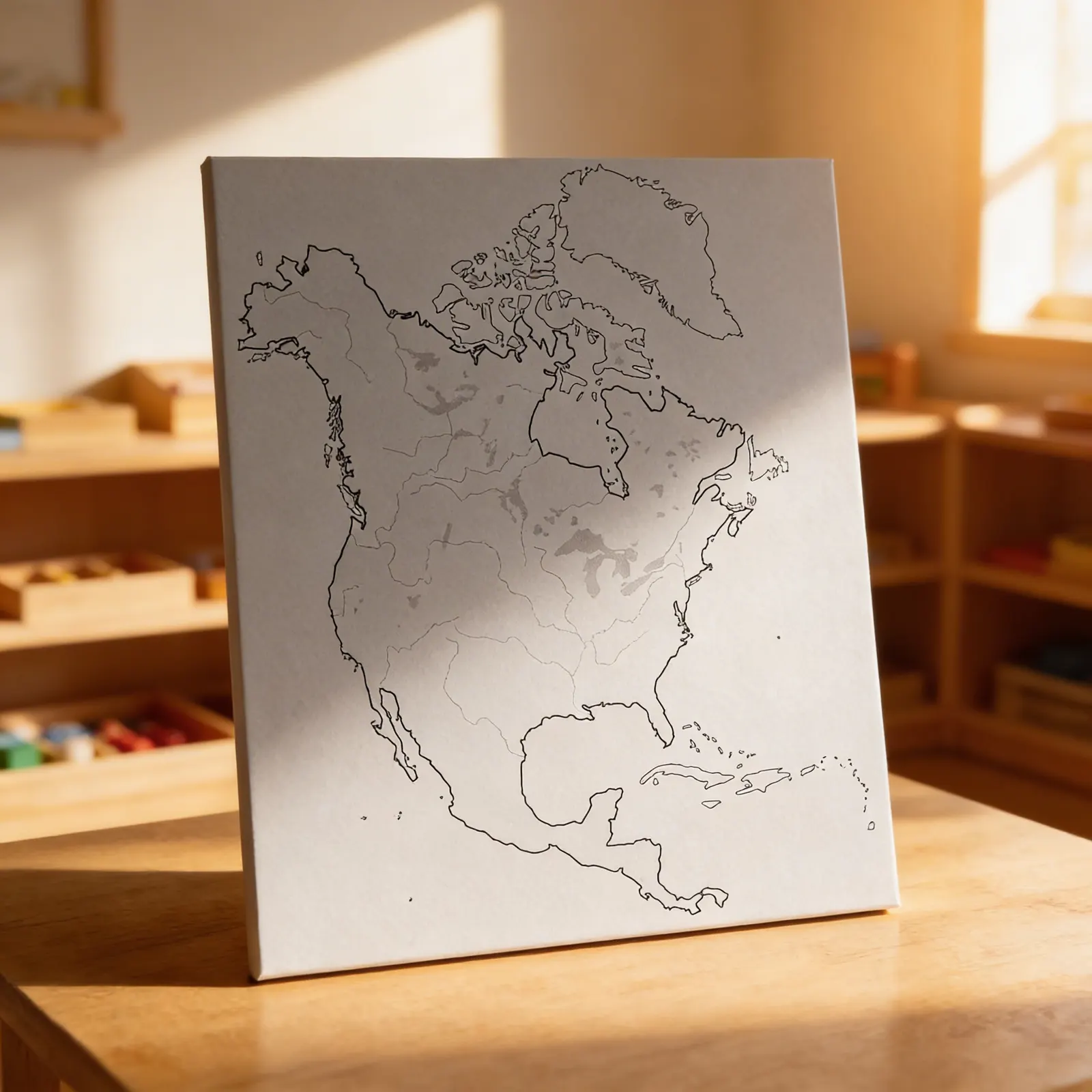
North America in a child's hands
Fifty waterways maps of North America, marked with the rivers and the lakes. The Great Lakes are the reason this sheet is worth having: five bodies of fresh water large enough to have their own weather, sitting on a border, draining through one river to the sea. A child who traces that once has a picture of a watershed, which is a hard idea to give any other way. Paper and cardstock, for ages 3 to 12.
Geographic Understanding
Builds spatial awareness of North American water systems and their relationship to political boundaries and human settlement.
Environmental Connections
Helps children understand how rivers, lakes, and oceans connect different regions and influence climate and ecology.
Visual Discrimination
Develops ability to trace water pathways and distinguish between different types of water bodies and land features.
Cultural Geography
Introduces concepts of how waterways influence trade, transportation, and the development of cities and civilizations.
How to present it
Place the waterways map on a table at child height. Have a blue pencil and tracing paper available. Ensure good lighting to see water system details clearly.
- 1Invite the child to explore the map, starting at the Arctic Ocean and moving fingers along the coastline
- 2Choose one major river system like the Mississippi and trace its entire path from source to mouth
- 3Compare river lengths by tracing different waterways with your finger
- 4Identify all five Great Lakes, noting how they connect to each other and to the ocean
- 5Find your local waterway on the map and trace where its water eventually flows
3 tips for parents
- During bath time, create 'rivers' with water flow to reinforce how waterways connect and flow downward
- When crossing bridges or seeing bodies of water, reference the map: 'This creek flows into the river we saw on your map'
- Support geographical vocabulary by using proper names for local waterways rather than just 'the river' or 'the lake'

If you are not sure it suits your child, we answer in person.
Norbert Kovalčín, founder of Faborino · write to him
There is no review here yet. We will ask you for one after you buy. Write the first review
What's in the Box
- Waterways Map: 50×70cm North American geography map
- Geographic Features: Approx. 50 waterways and regions marked
Size and material
| Packaging | 44 × 28 × 1 cm |
| Primary Material | Paper/cardstock |
| Print Type | Full color geographical print |
| Recommended Age | 3-6 years |
Care
| Cleaning | Wipe gently with dry cloth |
| Storage | Store flat or rolled in dry location |
Frequently Asked Questions
What waterways are included on this North American map?
The map features major river systems including the Mississippi, Missouri, Colorado, and St. Lawrence rivers, the Great Lakes system, Arctic waterways, coastal boundaries along the Atlantic, Pacific, and Gulf of Mexico, plus significant lakes and water networks throughout Canada, the United States, and Mexico.
How can 3-6 year olds use this detailed waterways map?
Young children can trace rivers with their fingers, identify and name major water bodies, match water feature cards to locations, color different waterways, and explore how rivers flow from mountains to oceans. The visual presentation helps them understand water's role in geography through hands-on exploration.
What learning concepts does this waterways map support?
This map develops understanding of water cycles, directional concepts (rivers flow downhill), geographical vocabulary (river, lake, ocean, gulf), spatial relationships between water and land, how water shapes landscapes, and the importance of waterways for transportation and settlement patterns.
What materials or activities complement this waterways map?
Enhance learning with water cycle experiments, blue ribbons or yarn to trace river paths, water feature nomenclature cards, photos of famous waterways, simple boats for discussing water transportation, and books about rivers and lakes. Consider pairing with landform materials for complete geographical understanding.
How does this map present complex geography for young learners?
The map uses clear, simplified lines to show water systems while maintaining geographical accuracy. Major waterways are prominently featured with age-appropriate detail levels. The visual design emphasizes the interconnected nature of water systems without overwhelming young children with excessive detail.
Product safety
Manufacturer: Nienhuis Montessori, Anders Celsiusstraat 15, 7442 PB Nijverdal, Netherlands
North America