
Number Rods Activity Set
The first photo is the maker's own. The other shots are illustrative.
Inv. no. NIE-062801
- Maker
- Nienhuis Montessori, since 1929
- Approval
- AMI
- Primary Material
- Solid wood with finish
- Activity Cards
- Laminated cardstock
- EAN
- 8719924013783
Final price incl. VAT. Delivery €5.90, €78.10 to go for free delivery.
Advice, warranty and returns are handled by us.
Why it costs €70.90
Behind the price of the original are things you can check yourself.
AMI approval
The material is approved by the Association Montessori Internationale (AMI). Nienhuis has made Montessori materials since 1929.
A verifiable original
The EAN 8719924013783 is on the box. It is the maker's number, not ours.
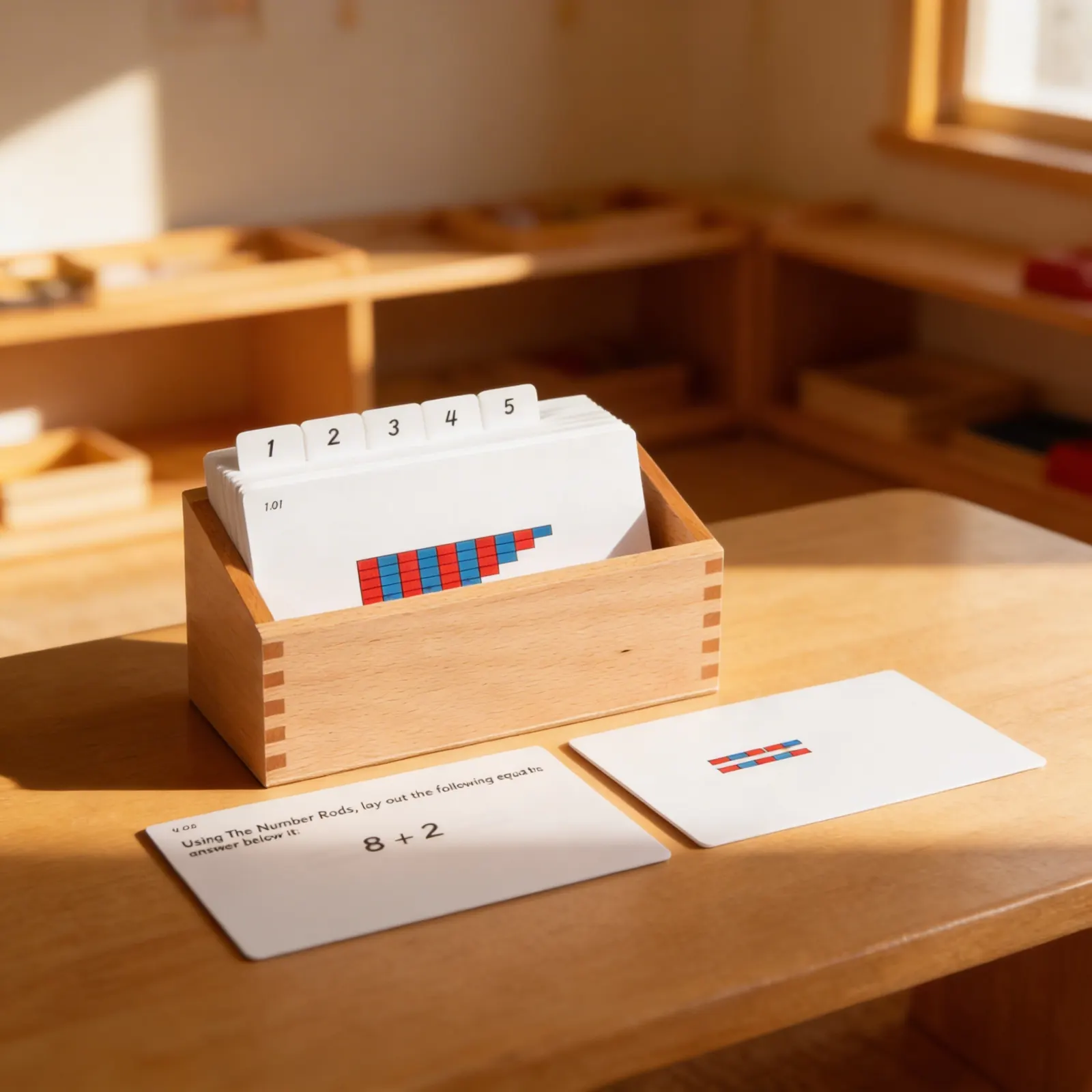
Number Rods Activity Set in a child's hands
Exercise cards with divider tabs in a wooden box, extending the number rods. The rods are usually the first mathematics a child ever meets, at three, and they are also one of the few materials still useful at six, because length carries quantity in a way counters never will. These cards are what bridges that gap: without them the rods get exhausted in a term, with them they keep producing work for three years. Number rods sold separately. Wood and cardstock, for ages 3 to 6.
Number Concept Formation
Visual and tactile representation of quantities 1-5 helps children internalize number values and relationships through concrete manipulation.
Mathematical Reasoning
Equation cards bridge concrete rod work to abstract mathematical thinking, supporting the natural progression of mathematical understanding.
Fine Motor Precision
Handling and arranging the rods develops hand control and coordination while reinforcing mathematical concepts through movement.
How to present it
Arrange the wooden rods horizontally on a mat from shortest to longest. Place equation cards in a basket nearby. Ensure adequate floor space for rod arrangements and combinations.
- 1Introduce the shortest rod as 'one' by holding it and counting its single segment. Place it at the top left of the mat
- 2Present each successive rod, counting segments aloud while running your finger along each division. Arrange in stair formation
- 3Demonstrate combining two shorter rods to equal a longer one (e.g., 2-rod plus 3-rod equals 5-rod)
- 4Introduce equation cards by matching them to corresponding rod combinations
- 5Invite the child to create their own rod combinations and find matching equation cards
3 tips for parents
- Practice counting objects around the home to reinforce one-to-one correspondence learned with rods
- Create simple addition stories using toys or snacks that mirror rod combination work
- Avoid rushing to written equations, physical manipulation with rods builds crucial number sense

If you are not sure it suits your child, we answer in person.
Norbert Kovalčín, founder of Faborino · write to him
There is no review here yet. We will ask you for one after you buy. Write the first review
What's in the Box
- Number Rods: 5 segmented rods (1-5 units)
- Equation Cards: Addition problems matching rod combinations
- Wooden Storage Box: With corner joints
Size and material
| Packaging | 20 × 14 × 10 cm |
| Primary Material | Solid wood with finish |
| Activity Cards | Laminated cardstock |
| Recommended Age | 3-6 years |
Care
Wipe with slightly damp cloth, dry immediately
Frequently Asked Questions
What mathematical concepts do the Number Rods teach?
The Number Rods help children understand quantity, number sequence, counting, length comparison, and basic addition. They provide a concrete representation of numbers 1-10, allowing children to physically see and feel the difference between quantities while developing number sense through hands-on manipulation.
How do the equation cards work with the wooden rods?
The equation cards correspond to the segmented rods, showing mathematical relationships visually. Children match the rods to equations, creating a multi-sensory learning experience. For example, they can combine a 2-segment rod with a 3-segment rod to demonstrate that 2+3=5, making abstract concepts concrete.
What skills will my child develop using this material?
Children develop counting skills, one-to-one correspondence, number recognition, understanding of quantity relationships, visual discrimination, fine motor control, and foundational addition concepts. The material also enhances concentration, order, and prepares children for more advanced mathematical work.
How do I present the Number Rods to my child?
Start by introducing rods 1-3, having your child carry and arrange them from shortest to longest. Count the segments together, emphasizing the quantity each represents. Gradually add more rods, introduce comparison language, and eventually present the equation cards when the child shows readiness for addition concepts.
What makes these Number Rods different from regular counting blocks?
Unlike separate counting blocks, these rods are continuous units with clear segments, showing quantities as unified wholes. This design helps children understand that 'five' is one quantity, not just five separate items. The precise increments and color coding support visual discrimination and mathematical relationships essential to Montessori methodology.
Product safety
Manufacturer: Nienhuis Montessori, Anders Celsiusstraat 15, 7442 PB Nijverdal, Netherlands
Number Rods Activity Set