
Number TilesCounting Practice
The first photo is the maker's own. The other shots are illustrative.
Inv. no. NIE-0138B0
- Maker
- Nienhuis Montessori, since 1929
- Approval
- AMI
- Tray
- Solid wood construction
- Tiles
- Durable painted wood
- EAN
- 8719924007355
Final price incl. VAT. Delivery €5.90, €77.10 to go for free delivery.
Advice, warranty and returns are handled by us.
Why it costs €71.90
Behind the price of the original are things you can check yourself.
AMI approval
The material is approved by the Association Montessori Internationale (AMI). Nienhuis has made Montessori materials since 1929.
A verifiable original
The EAN 8719924007355 is on the box. It is the maker's number, not ours.
Number Tiles in a child's hands
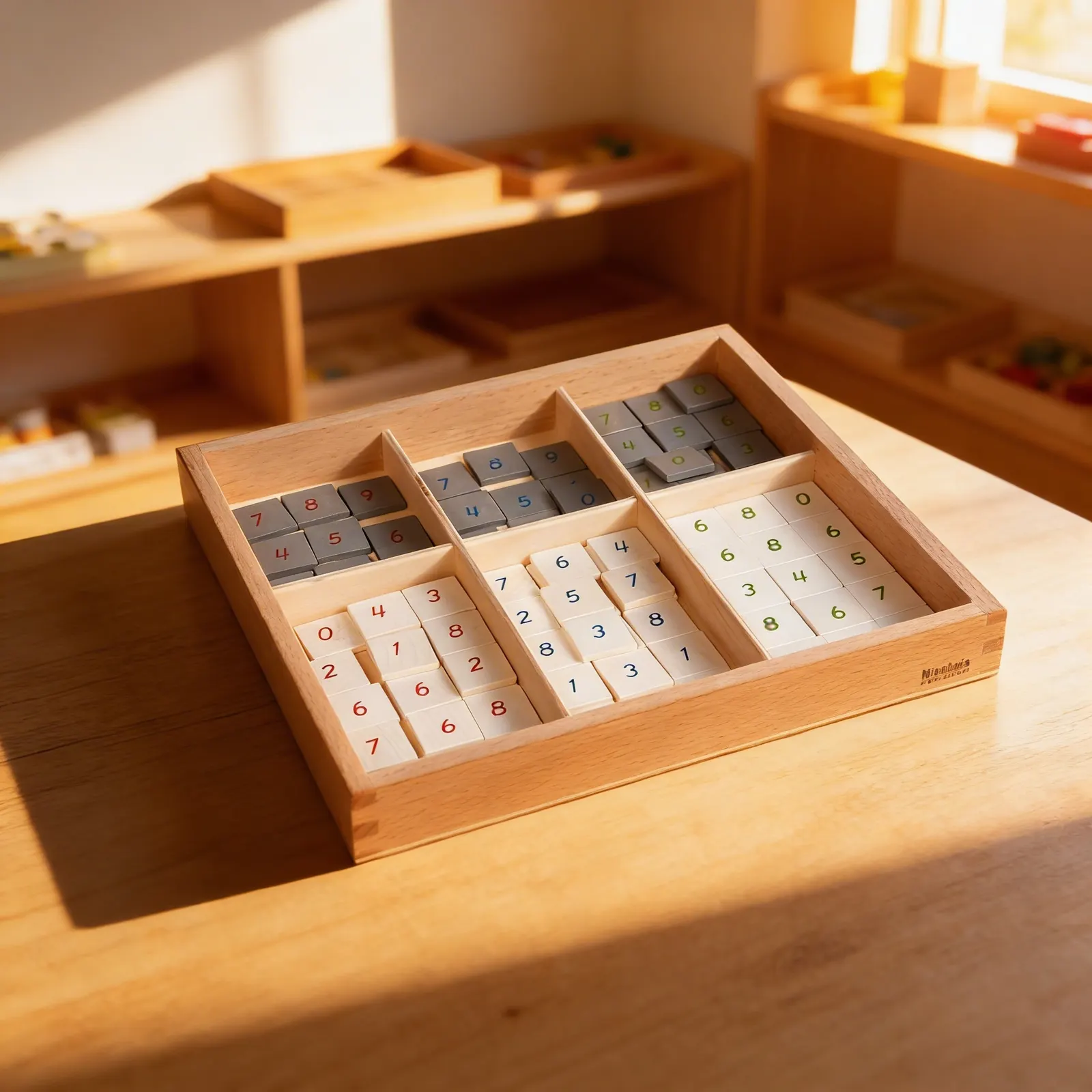
A set of colour-coded number tiles, designed for use with the Checker Board (the multiplication material), the Decimal Checker Board and the Flat Bead Frame, which is used for operations with the decimal hierarchies. The tiles are an accessory: the boards and the frame are separate products and are not part of this set. Intended for children aged 6 to 12 who work with larger numbers on these materials. Packaging 24 × 23 × 5 cm, weight 0.78 kg.
Number Recognition
Color-coded tiles help children associate numerals with quantity while developing visual discrimination skills through repeated handling and sorting activities.
Mathematical Order
The compartmentalized design naturally guides children to understand number sequence and develop systematic thinking through organized placement of tiles.
Fine Motor Precision
Manipulating individual tiles refines pincer grasp and hand-eye coordination essential for later writing activities.
Pattern & Sequence Work
Multiple tiles of each number enable children to create patterns, explore skip counting, and build foundation for multiplication concepts.
How to present it
Place the wooden sorting tray on a work mat. Ensure each compartment contains its complete set of color-coded tiles (0-9). Position the tray so the child can easily access all compartments.
- 1Invite the child to remove all tiles from one compartment, mixing them on the mat
- 2Ask the child to arrange the tiles in order from 0-9, left to right
- 3Once ordered, have the child return each tile to its compartment while naming the numeral
- 4Introduce a second color set and create number pairs (two 3s, two 7s)
- 5Progress to creating multi-digit numbers using tiles from different compartments
3 tips for parents
- Practice number recognition during daily activities - point out numerals on clocks, calendars, and signs
- Create simple number sequences at home using household items like blocks or buttons
- Avoid rushing to larger numbers - mastery of 0-9 forms the foundation for all future math work

If you are not sure it suits your child, we answer in person.
Norbert Kovalčín, founder of Faborino · write to him
There is no review here yet. We will ask you for one after you buy. Write the first review
What's in the Box
- Colour-coded number tiles: for use with the Checker Board, Decimal Checker Board and Flat Bead Frame, sold separately
Size and material
| Packaging | 24 × 23 × 5 cm |
| Tray | Solid wood construction |
| Tiles | Durable painted wood |
| Recommended Age | 6-12 years |
Care
| Cleaning | Wipe with slightly damp cloth, dry immediately |
| Storage | Keep in dry environment, tiles stored in designated compartments |
Frequently Asked Questions
What activities can children do with the Number Tiles?
Children can practice number recognition, create number sequences, match quantities to numerals, build multi-digit numbers, and explore skip counting patterns. The tiles support activities like ordering numbers 0-9, creating number lines, and pairing with counters for quantity association.
How many tiles of each number are included in the set?
The set includes multiple tiles of each number from 0-9, organized in nine separate compartments within the wooden sorting tray. Each number has its own color coding, allowing for various mathematical activities and ensuring enough tiles for creating multi-digit numbers.
What makes these tiles suitable for ages 3-6?
The tiles feature large, clear numerals that are easy for small hands to manipulate. The color-coding helps with visual discrimination, while the wooden tray promotes organization skills. The material progresses from simple number recognition for 3-year-olds to more complex sequencing and place value work for 6-year-olds.
How does the wooden sorting tray support learning?
The nine-compartment tray teaches organization and classification skills while keeping materials accessible. Children learn to sort by number, maintain order in their work environment, and develop independence in material care. The structured storage reinforces number sequence and supports the Montessori principle of external order promoting internal order.
Can these tiles be combined with other Montessori math materials?
Yes, the Number Tiles complement many Montessori materials including the Number Rods, Spindle Boxes, Cards and Counters, and Golden Bead materials. They can be used to label quantities, create number cards for matching activities, and support the transition from concrete to abstract number concepts.
Product safety
Manufacturer: Nienhuis Montessori, Anders Celsiusstraat 15, 7442 PB Nijverdal, Netherlands
Number Tiles