
Numerals And SignsInternational Version
The first photo is the maker's own. The other shots are illustrative.
Inv. no. NIE-002720
- Maker
- Nienhuis Montessori, since 1929
- Approval
- AMI
- Tray
- Natural wood with dividers
- Numerals & Signs
- Durable plastic
- EAN
- 8719924001506
Final price incl. VAT. Free delivery.
Advice, warranty and returns are handled by us.
Why it costs €186.90
Behind the price of the original are things you can check yourself.
AMI approval
The material is approved by the Association Montessori Internationale (AMI). Nienhuis has made Montessori materials since 1929.
A verifiable original
The EAN 8719924001506 is on the box. It is the maker's number, not ours.
Numerals And Signs in a child's hands
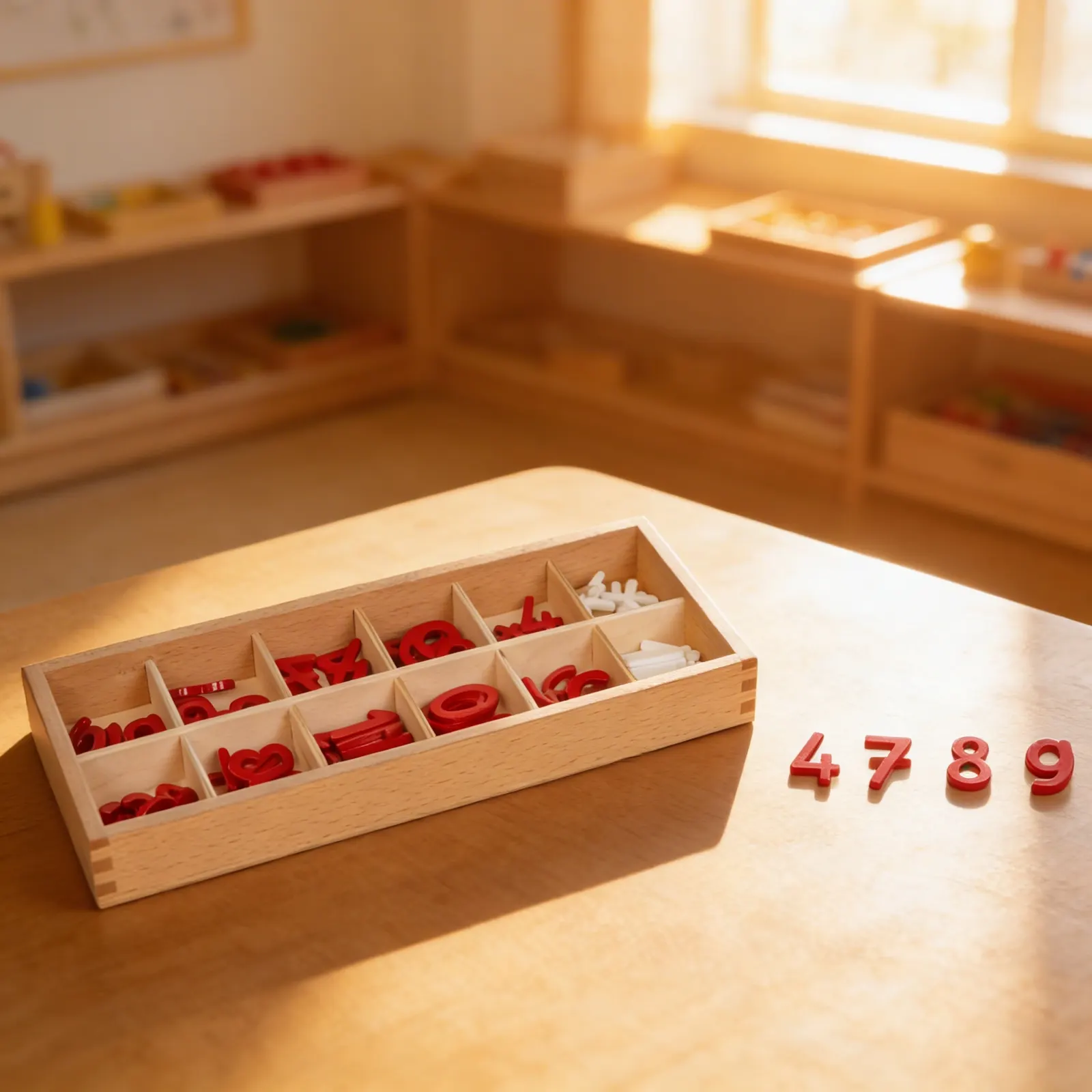
A wooden box holding six full sets of cut-out numerals together with the plus and minus signs, which is what makes written addition and subtraction possible before a child can write. Six sets is the working number: an equation needs its two terms, its result and the digits repeated within them, and running out of sevens halfway through is exactly the interruption that ends a piece of work. The child composes the equation, solves it with material, then composes the answer. Wood with plastic, for ages 3 to 6.
Mathematical Foundation
Concrete manipulation of numerals and symbols builds understanding of abstract mathematical concepts through sensorial experience.
Symbol Recognition
Repeated handling of numerals and operation signs develops visual discrimination and mathematical literacy.
Order and Sequence
The compartmentalized design reinforces numerical order and supports the child's natural sense of organization.
Problem-Solving Skills
Combining numerals with operation signs enables hands-on exploration of mathematical relationships and equation building.
How to present it
Place the wooden tray on a mat at the child's work area. Ensure all numerals and signs are properly sorted in their compartments. Have paper available for recording equations if desired.
- 1Invite the child to explore the tray, removing one numeral at a time and naming it
- 2Demonstrate placing numerals in sequence from 0-9 on the mat
- 3Introduce operation signs one at a time, naming each symbol
- 4Build simple equations using numerals and one operation sign
- 5Encourage the child to create their own number combinations and equations
3 tips for parents
- Notice numbers in daily life and connect them to the symbols your child is learning
- Avoid drilling or testing, let your child show you what they've discovered
- Support mathematical language by describing operations you see them creating

If you are not sure it suits your child, we answer in person.
Norbert Kovalčín, founder of Faborino · write to him
There is no review here yet. We will ask you for one after you buy. Write the first review
What's in the Box
- Wooden compartment tray: 10 sections for organized storage
- Red plastic numerals: 0-9 in Montessori red
- White operation signs: Basic mathematical symbols
Size and material
| Packaging | 30 × 13 × 5 cm |
| Tray | Natural wood with dividers |
| Numerals & Signs | Durable plastic |
| Recommended Age | 3-6 years |
Care
Wipe tray with damp cloth; clean plastic pieces with mild soap and water
Frequently Asked Questions
What materials are included in the Numerals and Signs International Version?
This set includes red and white plastic numerals (0-9) with multiple quantities of each number, plus mathematical operation signs (+, -, ×, ÷, =) all stored in a wooden compartmentalized tray. The International Version uses universally recognized mathematical symbols suitable for worldwide use.
How does this material support early mathematical development?
Children physically manipulate the numerals to build numbers, create equations, and explore mathematical relationships concretely. This hands-on approach helps develop number sense, understanding of place value, and familiarity with mathematical symbols before moving to abstract written work.
What is the difference between this and other Montessori number materials?
Unlike the golden beads or number rods that represent quantities visually, these numerals focus on symbol recognition and mathematical notation. They complement other Montessori math materials by bridging the gap between concrete quantity work and abstract mathematical writing.
What activities can children do with these numerals and signs?
Children can practice number formation, create multi-digit numbers to understand place value, set up and solve simple equations, match numerals to quantities from other materials, and explore mathematical patterns. The material supports work from simple number recognition to complex operations.
Why are the numerals in red and white plastic?
The color coding follows Montessori principles where different colors represent different place values or mathematical concepts. The durable plastic construction allows for frequent handling by young children, while the smooth surface makes the numerals easy to manipulate and arrange on work mats.
Product safety
Manufacturer: Nienhuis Montessori, Anders Celsiusstraat 15, 7442 PB Nijverdal, Netherlands
Numerals And Signs