
Numerals And SignsUS Version
The first photo is the maker's own. The other shots are illustrative.
Inv. no. NIE-0027A3
- Maker
- Nienhuis Montessori, since 1929
- Approval
- AMI
- Tray
- Natural wood with dividers
- Numerals & Signs
- Durable red plastic
- EAN
- 8719924001520
Final price incl. VAT. Free delivery.
Advice, warranty and returns are handled by us.
Why it costs €186.90
Behind the price of the original are things you can check yourself.
AMI approval
The material is approved by the Association Montessori Internationale (AMI). Nienhuis has made Montessori materials since 1929.
A verifiable original
The EAN 8719924001520 is on the box. It is the maker's number, not ours.
Numerals And Signs in a child's hands
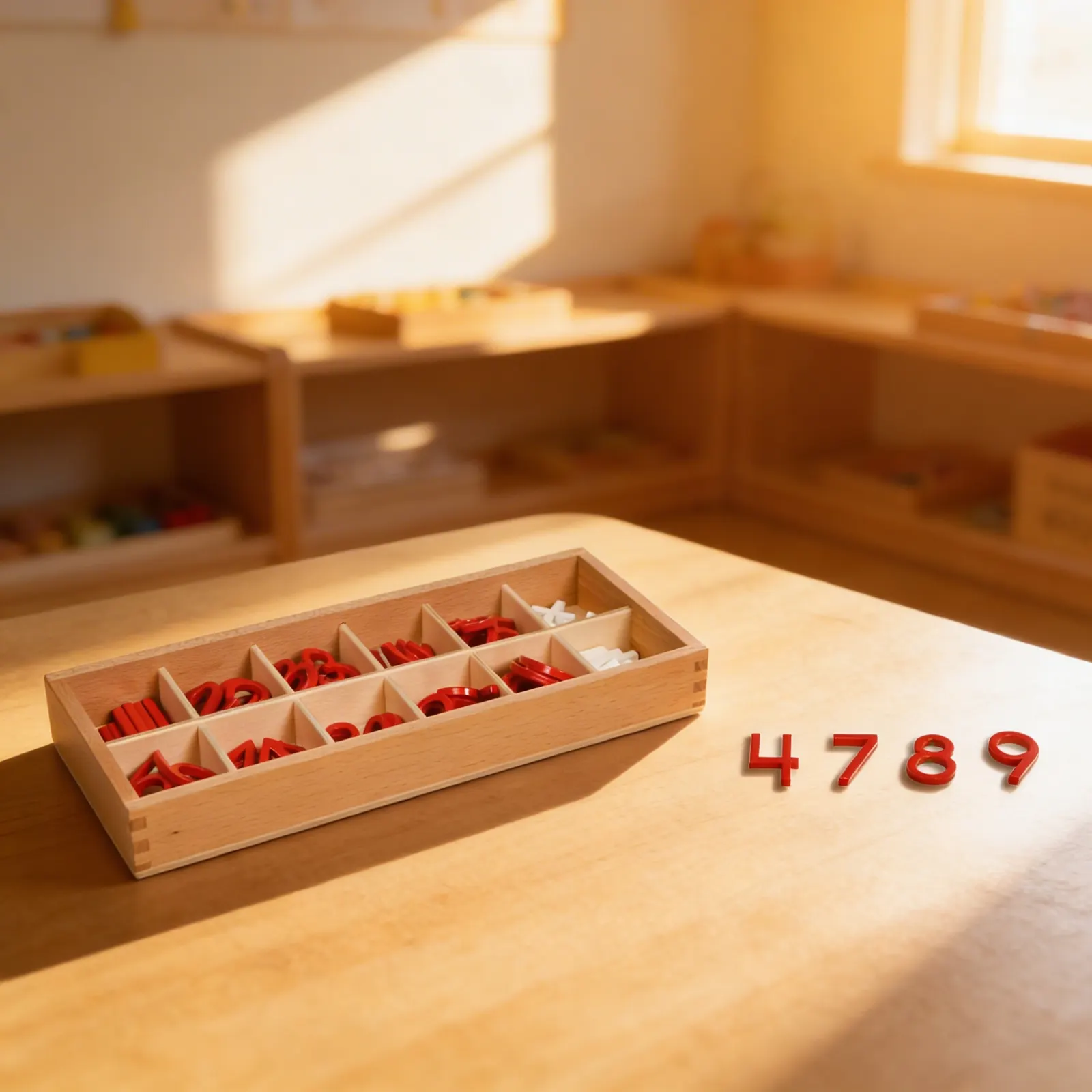
A rich educational resource, this Numerals and Signs material provides hands-on practice with mathematical symbols essential for early arithmetic work. The wooden compartmented tray organizes red plastic numerals (0-9) and operation signs, and children can then build equations and explore number relationships. Designed specifically for the US market, this material supports the transition from concrete mathematical concepts to abstract symbol recognition.
Symbol Recognition
Children develop familiarity with numerals and mathematical signs through repeated handling and sorting.
Mathematical Foundation
Prepares for arithmetic operations by providing concrete symbols that can be manipulated to form equations.
Order and Classification
The compartmented design reinforces concepts of order, sequence, and categorization essential for mathematical thinking.
Fine Motor Refinement
Precise placement of symbols in compartments enhances pincer grip and hand-eye coordination.
How to present it
Place the wooden tray on a work mat. Ensure all red plastic numerals 0-9 are in their compartments, along with operation signs. Have golden bead material nearby for initial presentations.
- 1Invite the child to bring quantity cards and match them with the plastic numerals, starting with single digits
- 2Show how to build two-digit numbers by placing numerals side by side, reading left to right
- 3Introduce the plus sign by combining two small quantities with beads, then representing with numerals
- 4Demonstrate the equals sign as 'the same as' by showing equivalent bead quantities
- 5Build simple addition equations like 2 + 3 = 5, verifying with golden beads
3 tips for parents
- Practice reading house numbers, prices, and dates using similar numeral formation at home
- Create simple addition stories using toys or snacks, writing equations together
- Notice when your child spontaneously uses mathematical language like 'plus,' 'equals,' or 'makes'

If you are not sure it suits your child, we answer in person.
Norbert Kovalčín, founder of Faborino · write to him
There is no review here yet. We will ask you for one after you buy. Write the first review
What's in the Box
- Wooden compartmented tray: 10 sections with dividers
- Red plastic numerals: Multiple sets of 0-9
- Mathematical signs: Operation symbols for equations
Size and material
| Packaging | 30 × 15 × 7 cm |
| Tray | Natural wood with dividers |
| Numerals & Signs | Durable red plastic |
| Recommended Age | 3-6 years |
Care
Wipe wooden tray with damp cloth; wash plastic pieces with mild soap and water
Frequently Asked Questions
What mathematical symbols are included in this US version set?
The set includes red plastic numerals 0-9 and essential operation signs (addition, subtraction, multiplication, division, and equals). All pieces are organized in a wooden compartmented tray for easy access and storage.
How does this material differ from other numeral sets?
This US version features durable red plastic numerals and signs specifically sized for young hands, stored in a quality wooden tray with individual compartments. The material is designed to complement other Montessori math materials while supporting the transition from concrete to abstract mathematical concepts.
What activities can children do with the Numerals and Signs material?
Children can build simple equations, practice number recognition, create addition and subtraction problems, explore mathematical relationships, and work alongside concrete materials like golden beads or number rods to connect quantities with symbols.
At what point should this material be introduced in the Montessori curriculum?
This material is typically introduced after children have worked extensively with concrete mathematical materials and can recognize quantities. It serves as a bridge between manipulating physical objects and working with abstract mathematical symbols, usually around ages 4-5.
How does this material support mathematical development?
The material helps children recognize and form numerals correctly, understand mathematical symbols and their meanings, build equations independently, and develop abstract thinking skills by connecting concrete quantities to symbolic representation.
Product safety
Manufacturer: Nienhuis Montessori, Anders Celsiusstraat 15, 7442 PB Nijverdal, Netherlands
Numerals And Signs