
O-Rings For ChainsCopper (10)
The first photo is the maker's own. The other shots are illustrative.
Inv. no. NIE-00860048
- Maker
- Nienhuis Montessori, since 1929
- Approval
- AMI
- Primary Material
- Copper-colored metal
- Construction
- Split-ring design
- EAN
- 8719924004804
Final price incl. VAT. Delivery €5.90, €139.00 to go for free delivery.
Advice, warranty and returns are handled by us.
Why it costs €10.00
Behind the price of the original are things you can check yourself.
AMI approval
The material is approved by the Association Montessori Internationale (AMI). Nienhuis has made Montessori materials since 1929.
A verifiable original
The EAN 8719924004804 is on the box. It is the maker's number, not ours.
O-Rings For Chains in a child's hands
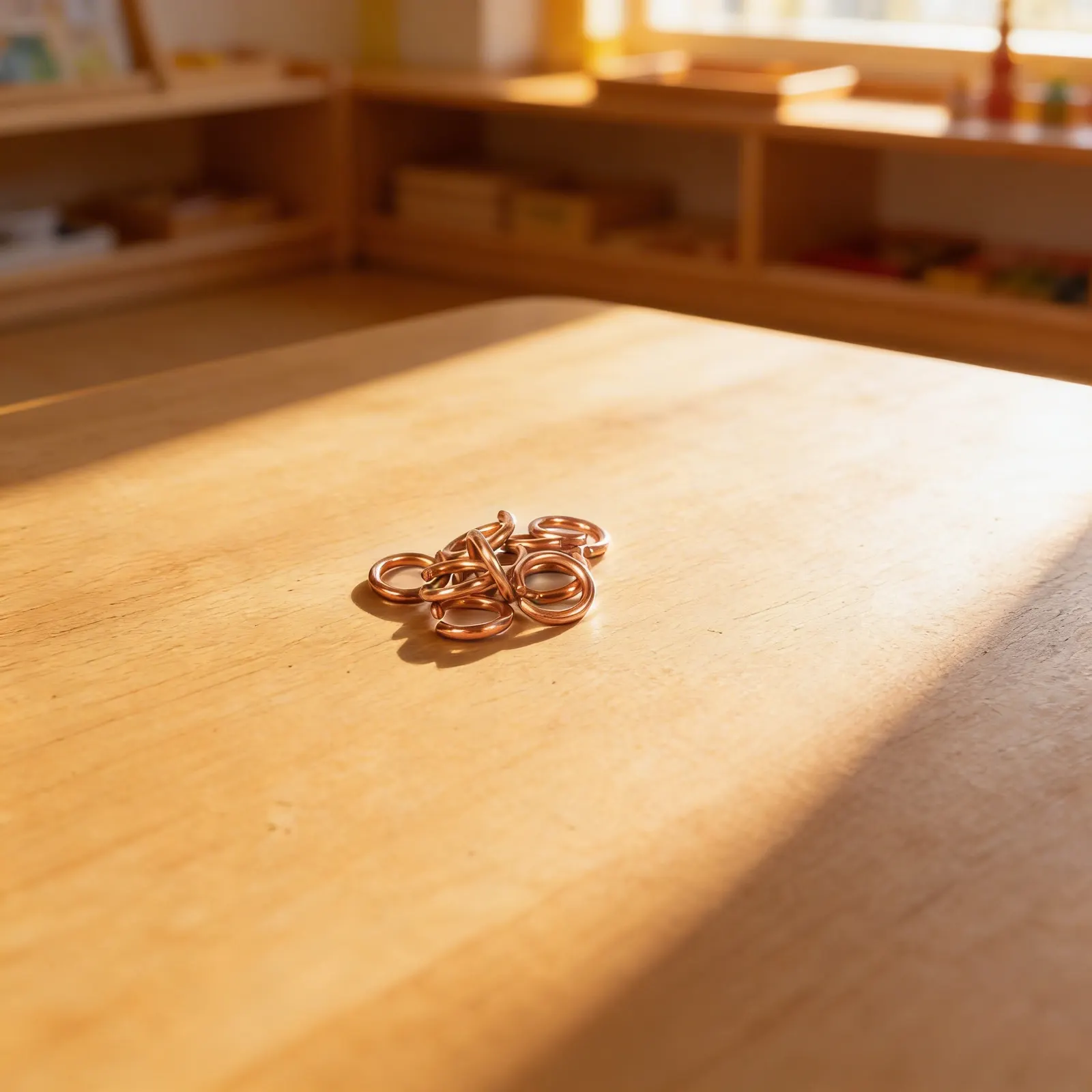
Ten copper O-rings for the bead chains, sold as a pack. Copper is the point rather than a detail: the chains are strung on wire of the same colour, so a copper ring disappears into the chain while a steel one announces itself at the end of every hundred. Rings are small, they are handled every time a chain is hung or taken down, and they leave with the vacuum cleaner. The bead chains, the hanging hooks and the cabinet are separate items.
Fine Motor Control
Opening and closing split rings strengthens pincer grip and develops the precise hand movements needed for writing.
Mathematical Connections
Physically linking bead chains helps children understand numerical relationships and skip-counting patterns through hands-on manipulation.
Practical Life Skills
Working with connectors develops concentration, coordination, and problem-solving abilities essential for daily tasks.
Sequential Thinking
Organizing and connecting chains in order reinforces logical thinking and mathematical sequence understanding.
How to present it
Place O-rings in a small bowl on the math shelf near the bead chains. Ensure rings are fully closed and free from sharp edges.
- 1Demonstrate holding the O-ring between thumb and forefinger, locating the split opening
- 2Model gently twisting the ring open just enough to slide onto the bead wire
- 3Connect two bead segments by threading both wires through the same O-ring
- 4Practice opening and closing rings repeatedly before attempting chain work
3 tips for parents
- Practice with key rings at home to build similar finger strength and coordination
- Notice how your child problem-solves when a ring won't open easily
- Celebrate the persistence required to connect long chains, this builds mathematical stamina

If you are not sure it suits your child, we answer in person.
Norbert Kovalčín, founder of Faborino · write to him
There is no review here yet. We will ask you for one after you buy. Write the first review
What's in the Box
- Copper O-Rings: 10 split-ring connectors
Size and material
| Packaging | 13 × 9 × 1 cm |
| Primary Material | Copper-colored metal |
| Construction | Split-ring design |
| Recommended Age | 3-6 years |
Care
Wipe with dry cloth; avoid moisture to prevent tarnishing
Frequently Asked Questions
What size chains are these copper O-rings compatible with?
These O-rings are designed to work with standard Montessori bead chains, typically accommodating chain wire diameters between 1-2mm. They're suitable for connecting golden bead chains, colored bead chains, and skip-counting chain materials commonly used in Montessori mathematics.
How do children use these O-rings with chain materials?
Children use these O-rings to join bead chain segments together, creating longer chains for skip-counting exercises or connecting chains to form squares and cubes. The split-ring design allows children to open the ring slightly, slip it through chain ends, and create secure connections independently.
Are these O-rings safe for young children to handle?
Yes, these copper O-rings are appropriately sized for children ages 3-6, with smooth edges and no sharp points. However, as with all small materials, adult supervision is recommended. The copper material is non-toxic and the rings are large enough to manipulate safely while small enough to develop pincer grip.
Why are copper O-rings preferred over other materials?
Copper O-rings offer several advantages: they're durable and won't rust, they have a pleasant weight that provides sensory feedback, they're easy to see against colorful beads, and the material is soft enough to open slightly without requiring excessive force from small hands.
How many chain connections can be made with 10 O-rings?
With 10 O-rings, children can make up to 10 connections between chain segments. This allows for creating one very long chain, multiple medium chains, or connecting chains into geometric shapes. Extra rings also serve as replacements if any are misplaced during activities.
Product safety
Manufacturer: Nienhuis Montessori, Anders Celsiusstraat 15, 7442 PB Nijverdal, Netherlands
O-Rings For Chains