
Yellow CubeLarge Geometric Solid (27cm)
The first photo is the maker's own. The other shots are illustrative.
Inv. no. NIE-012902
- Maker
- Nienhuis Montessori, since 1929
- Approval
- AMI
- Product size
- 27 × 27 × 27 cm
- Primary Material
- Approx. solid wood
- Finish
- Approx. yellow paint or lacquer
- EAN
- 8719924007010
Final price incl. VAT. Free delivery.
Advice, warranty and returns are handled by us.
Why it costs €258.90
Behind the price of the original are things you can check yourself.
AMI approval
The material is approved by the Association Montessori Internationale (AMI). Nienhuis has made Montessori materials since 1929.
A verifiable original
The EAN 8719924007010 is on the box. It is the maker's number, not ours.
Yellow Cube in a child's hands
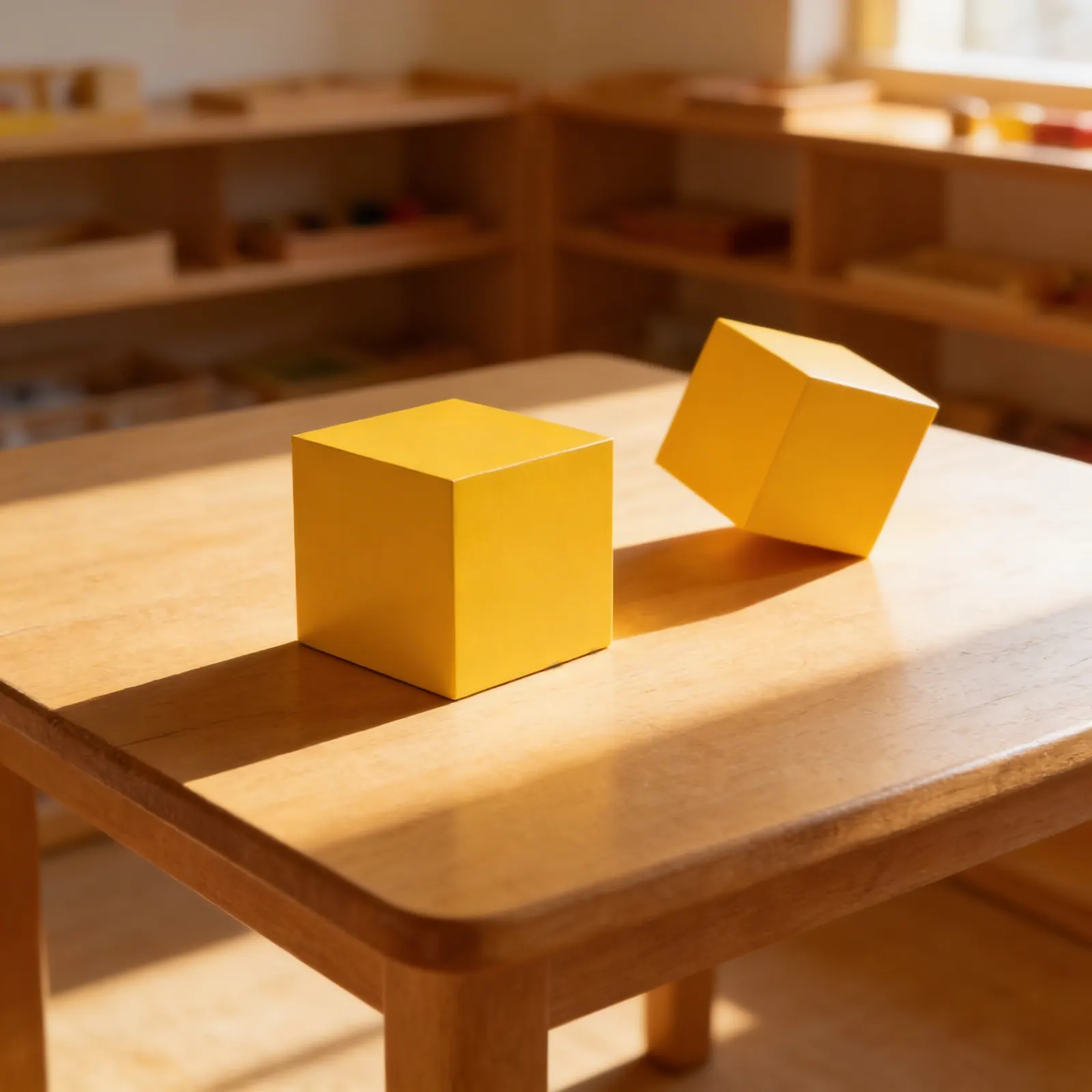
A yellow cube of 27 cm on each edge, large enough that a child has to use both arms and a considered grip to move it. Scale is the lesson here: a cube this size makes volume something the whole body registers, and set beside the smaller solids it turns the jump between sizes into a physical fact rather than a number. It also serves as a fixed point in the room, a shape children return to and compare other things against. Wood, 27 x 27 x 27 cm, for ages 6 to 12.
Spatial Intelligence
Develops understanding of three-dimensional space, volume, and geometric relationships through hands-on exploration.
Mathematical Preparation
Provides concrete experience with cubing, volume calculations, and advanced geometric concepts.
Sensorial Refinement
Engages visual, tactile, and baric senses through color recognition, surface exploration, and weight perception.
Abstract Thinking
Bridges concrete manipulation to abstract mathematical concepts through physical representation of geometric principles.
How to present it
Place the Yellow Cube on a large work mat in an open area. Ensure adequate space for movement around the cube. Have a smaller tray nearby with paper and pencil for recording observations.
- 1Invite the child to carry the cube with both hands, feeling its weight and dimensions
- 2Explore each face of the cube, counting edges and vertices
- 3Measure one edge using a ruler or meter stick, discovering the 27cm length
- 4Calculate the area of one face (27 × 27 = 729 square cm)
- 5Explore the concept of volume by discussing 27 × 27 × 27
3 tips for parents
- Support your child's spatial reasoning at home by identifying cubic objects and estimating their dimensions relative to the Yellow Cube
- Encourage mathematical thinking by asking questions about how many smaller cubes might fit inside
- Connect the cube work to real-world applications like packaging, architecture, and storage solutions

If you are not sure it suits your child, we answer in person.
Norbert Kovalčín, founder of Faborino · write to him
There is no review here yet. We will ask you for one after you buy. Write the first review
What's in the Box
- Yellow Cube: 27 × 27 × 27 cm geometric solid
Size and material
| Product size | 27 × 27 × 27 cm |
| Packaging | 31 × 30 × 30 cm |
| Primary Material | Approx. solid wood |
| Finish | Approx. yellow paint or lacquer |
| Recommended Age | 6-12 years |
Care
Wipe with slightly damp cloth, dry immediately
Frequently Asked Questions
What is the purpose of the large yellow cube in Montessori education?
The 27cm yellow cube helps children aged 6-12 understand three-dimensional space, volume, and geometric relationships. It serves as a concrete manipulative for exploring advanced mathematical concepts including cubic measurements, spatial reasoning, and the relationship between linear, square, and cubic dimensions.
How does this differ from the smaller cubes in Montessori materials?
This substantial 27cm cube is specifically designed for upper elementary students (6-12 years) and represents a more advanced geometric solid. Its larger size allows for deeper exploration of volume concepts and serves as a reference point for understanding cubic measurements, unlike smaller cubes used for basic counting or early sensorial work.
What activities can children do with this yellow cube?
Children can explore volume calculations, compare it with other geometric solids, use it for understanding cubic roots, create architectural designs, study the relationship between edge length and volume, and use it as a concrete reference for abstract mathematical concepts like x³ or calculating cubic meters.
Why is the cube specifically yellow and 27cm in size?
The yellow color follows Montessori's systematic color-coding for geometric solids, making it visually distinct and memorable. The 27cm dimension is pedagogically significant as 27 is 3³, allowing children to physically experience how three units cubed equals 27 cubic units, bridging concrete and abstract mathematical understanding.
Is this cube hollow or solid, and how durable is it?
This educational cube is typically made of solid, high-quality wood or dense material to provide appropriate weight and durability for classroom use. The solid construction gives children a true sensorial experience of mass and volume while ensuring the material withstands years of handling by multiple students.
Product safety
Manufacturer: Nienhuis Montessori, Anders Celsiusstraat 15, 7442 PB Nijverdal, Netherlands
Yellow Cube