
Opposites Matching Cards
The first photo is the maker's own. The other shots are illustrative.
Inv. no. NIE-EC0607
- Maker
- Nienhuis Montessori, since 1929
- Material
- Durable plastic
- Finish
- Pre-cut with rounded corners
- EAN
- 8719924043094
Final price incl. VAT. Delivery €5.90, €117.10 to go for free delivery.
Advice, warranty and returns are handled by us.
Opposites Matching Cards in a child's hands
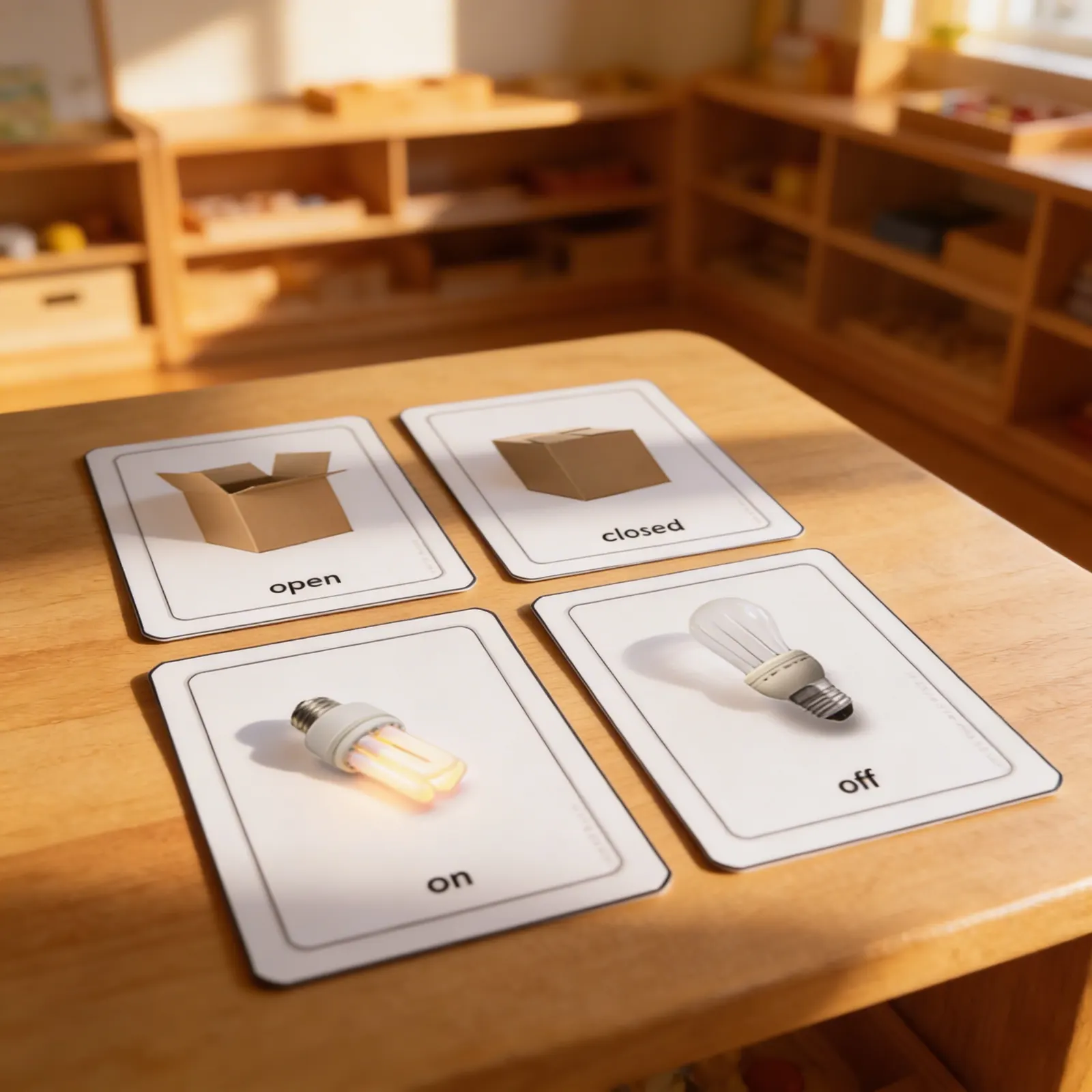
Opposites matching cards, pairs of real photographs that argue with each other: full and empty, open and shut, over and under. Opposites are how a young child gets a grip on adjectives, because a word like heavy means nothing until something light is put beside it, and a photograph pair does that in one move. The cards are the language work that looks like a game. Durable plastic with rounded corners. In English.
Language Development
Expands vocabulary and strengthens understanding of opposing concepts through visual-linguistic connections.
Critical Thinking
Encourages comparative analysis and logical reasoning as children identify relationships between opposites.
Visual Discrimination
Photorealistic images help children observe details and distinguish between contrasting attributes.
Conceptual Understanding
Builds foundational knowledge of abstract concepts through concrete visual representations.
How to present it
Arrange 6-8 pairs of opposite cards face up on a mat. Start with concrete, easily observable opposites like big/small or full/empty.
- 1Invite the child to examine one card closely, naming the concept shown
- 2Ask the child to find the card showing the opposite concept
- 3Place matched pairs together in a column
- 4Continue until all pairs are matched
- 5Review matches together, discussing each opposite relationship
3 tips for parents
- Point out opposites during daily routines: hot breakfast/cold milk, dirty hands/clean hands
- Play 'opposite games' during car rides or waiting times using objects you see
- Read books featuring opposite concepts and discuss the illustrations together

If you are not sure it suits your child, we answer in person.
Norbert Kovalčín, founder of Faborino · write to him
There is no review here yet. We will ask you for one after you buy. Write the first review
What's in the Box
- Opposites Cards: Approx. 4 pairs showing contrasting concepts
Size and material
| Packaging | 15 × 15 × 1 cm |
| Material | Durable plastic |
| Finish | Pre-cut with rounded corners |
| Recommended Age | 3-6 years |
Care
Wipe with damp cloth, air dry completely
Frequently Asked Questions
What age group are these Opposites Matching Cards designed for?
These cards are specifically designed for children ages 3-6 years old, aligning with the Montessori sensitive period for language development and classification skills during the preschool and early elementary years.
How many pairs of opposites are included in this set?
While the exact number isn't specified, typical Montessori opposites matching sets include 12-20 pairs of contrasting concepts, providing comprehensive coverage of common opposite relationships children encounter in daily life.
What makes these cards safe for young children to handle?
The cards feature sturdy cardstock construction with rounded corners to prevent paper cuts and ensure safe handling. The durable material also withstands frequent use by small hands during independent learning activities.
How do photorealistic images benefit learning compared to illustrations?
Photorealistic images help children make direct connections to real-world objects and situations, supporting concrete learning before abstract thinking. This authentic visual representation aids in transferring learned concepts to everyday experiences.
What specific skills do children develop using these matching cards?
Children develop critical thinking, visual discrimination, vocabulary expansion, logical reasoning, and classification skills. The activity also enhances concentration, promotes independent learning, and builds foundational literacy through text label recognition.
Product safety
Manufacturer: Nienhuis Montessori, Anders Celsiusstraat 15, 7442 PB Nijverdal, Netherlands
Opposites Matching Cards