Partes De La Tortuga (Spanish Edition)
The first photo is the maker's own. The other shots are illustrative.
Inv. no. NIE-ECSP0460
- Maker
- Nienhuis Montessori, since 1929
- Card Material
- Laminated cardstock
- Finish
- Protective laminate coating
- EAN
- 8719924043551
Final price incl. VAT.
This material is no longer made
The manufacturer has withdrawn it, so we cannot order it in. The page stays here because the material itself is still worth knowing about.
Available instead
Parts Of A Turtle (Reptile)
Would you buy it if we could source it or make it ourselves? Enough people saying yes is what makes the attempt worth it.
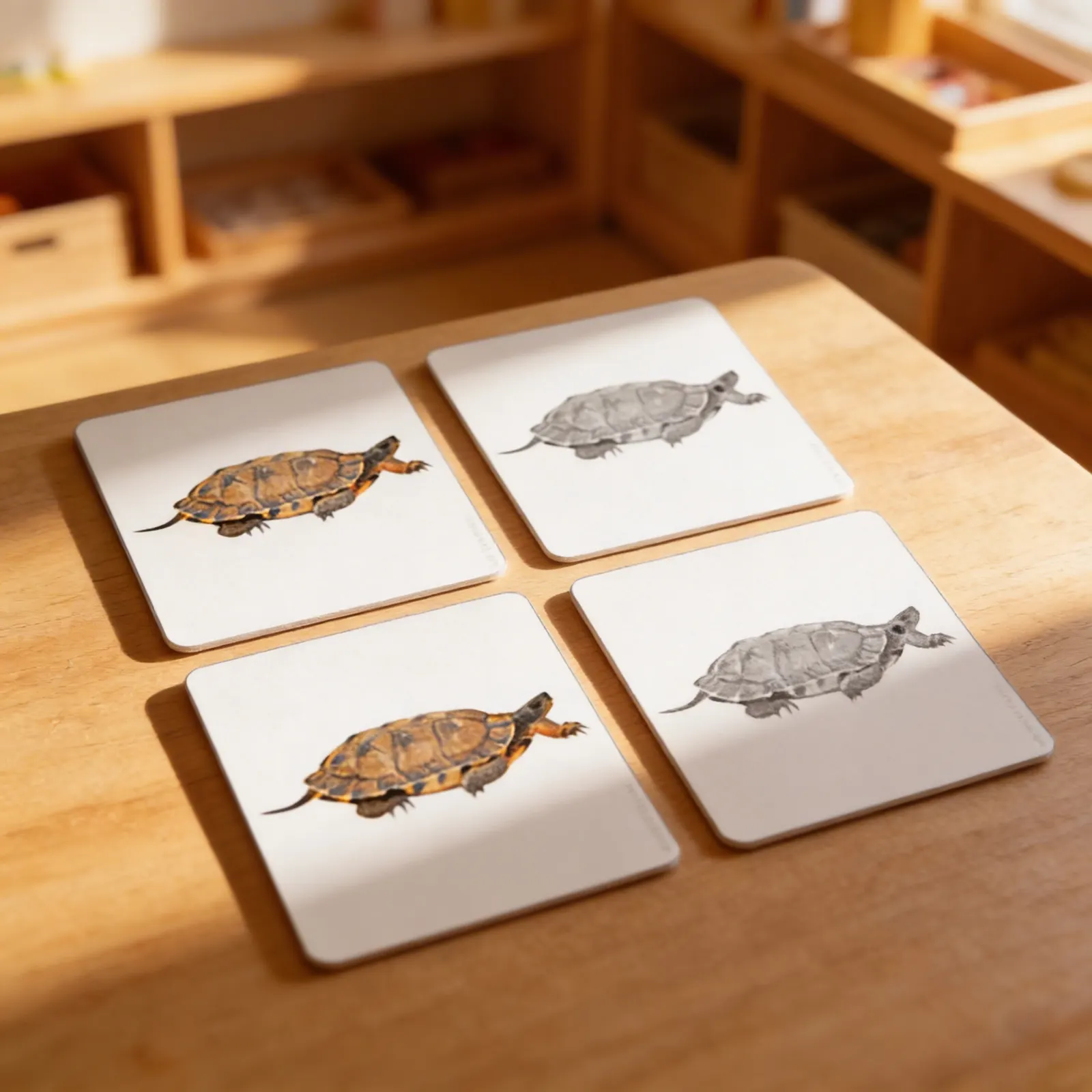
Partes De La Tortuga (Spanish Edition) in a child's hands
Partes De La Tortuga, the parts of a turtle in Spanish. It is the reptile set, and the reptile chosen is the one whose most famous part hides all the others: the shell is named, and then so is everything the shell covers. Working in Spanish adds the layer this material is bought for, a second set of words for parts a child can already point at. The cards are in Spanish. Photograph, control chart and labels.
Language Development
Builds Spanish vocabulary and reading skills through matching activities and visual association with anatomical terms.
Visual Discrimination
Develops ability to match identical images and recognize subtle differences between colored and grayscale versions.
Scientific Knowledge
Introduces zoological concepts and turtle anatomy, fostering early interest in natural sciences.
Fine Motor Control
Handling and arranging cards refines pincer grip and hand-eye coordination essential for writing preparation.
How to present it
Lay out control cards with colored turtle illustrations on a mat. Place grayscale cards in a basket to the left and Spanish labels in another basket to the right.
- 1Introduce 3-4 control cards, naming each turtle part in Spanish clearly
- 2Match grayscale cards to colored controls one at a time
- 3Read Spanish labels aloud before placing below corresponding pictures
- 4Remove control cards and work with grayscale and labels only
3 tips for parents
- Visit aquariums or pet stores to observe real turtles and practice Spanish vocabulary
- Create simple Spanish labels for household items to reinforce language learning
- Read Spanish picture books about animals to support vocabulary development

If you are not sure it suits your child, we answer in person.
Norbert Kovalčín, founder of Faborino · write to him
There is no review here yet. We will ask you for one after you buy. Write the first review
What's in the Box
- Control Cards: Approx. 6 colored turtle anatomy illustrations with labels
- Matching Cards: Approx. 6 grayscale illustrations without labels
- Label Cards: Approx. 6 separate Spanish vocabulary labels
Size and material
| Packaging | 15 × 15 × 1 cm |
| Card Material | Laminated cardstock |
| Finish | Protective laminate coating |
| Recommended Age | 3-6 years |
Care
Wipe with slightly damp cloth, dry immediately
Frequently Asked Questions
What parts of the turtle are included in these nomenclature cards?
The cards typically include essential turtle anatomy parts such as caparazón (shell), cabeza (head), patas (legs), cola (tail), plastrón (plastron), and other key anatomical features. Each part is clearly illustrated and labeled in Spanish to help children learn both zoological vocabulary and anatomy.
How do three-part cards work for language learning?
Three-part cards consist of a colored control card showing the complete turtle with labels, matching grayscale pictures without labels, and separate Spanish vocabulary cards. Children match the pictures to the labels, promoting independent learning, visual discrimination, and Spanish language acquisition through hands-on manipulation.
Can non-Spanish speaking parents use these cards effectively?
Yes! The visual nature of the cards makes them accessible to all. Parents can learn alongside their children using the control cards as reference. The clear illustrations help convey meaning even without prior Spanish knowledge, making it an excellent family learning tool.
What Montessori skills do these cards develop?
These cards develop multiple skills including visual discrimination, vocabulary building, reading readiness, classification abilities, and fine motor control. They also support the Montessori principle of learning through concrete materials before moving to abstract concepts, while introducing scientific vocabulary in Spanish.
How can I extend learning with these turtle anatomy cards?
Extensions include creating turtle art projects, researching different turtle species, visiting aquariums or nature centers, comparing turtle anatomy to other reptiles, and incorporating the cards into Spanish language lessons. Children can also create their own drawings and labels to reinforce learning.
Product safety
Manufacturer: Nienhuis Montessori, Anders Celsiusstraat 15, 7442 PB Nijverdal, Netherlands
Partes De La Tortuga (Spanish Edition)