Parts of the CrustaceanZoology Cards (Spanish Edition)
The first photo is the maker's own. The other shots are illustrative.
Inv. no. NIE-ECSP0454
- Maker
- Nienhuis Montessori, since 1929
- Card Material
- Cardstock with laminate coating
- Finish
- Glossy protective lamination
- EAN
- 8719924043490
Final price incl. VAT.
This material is no longer made
The manufacturer has withdrawn it, so we cannot order it in. The page stays here because the material itself is still worth knowing about.
Would you buy it if we could source it or make it ourselves? Enough people saying yes is what makes the attempt worth it.
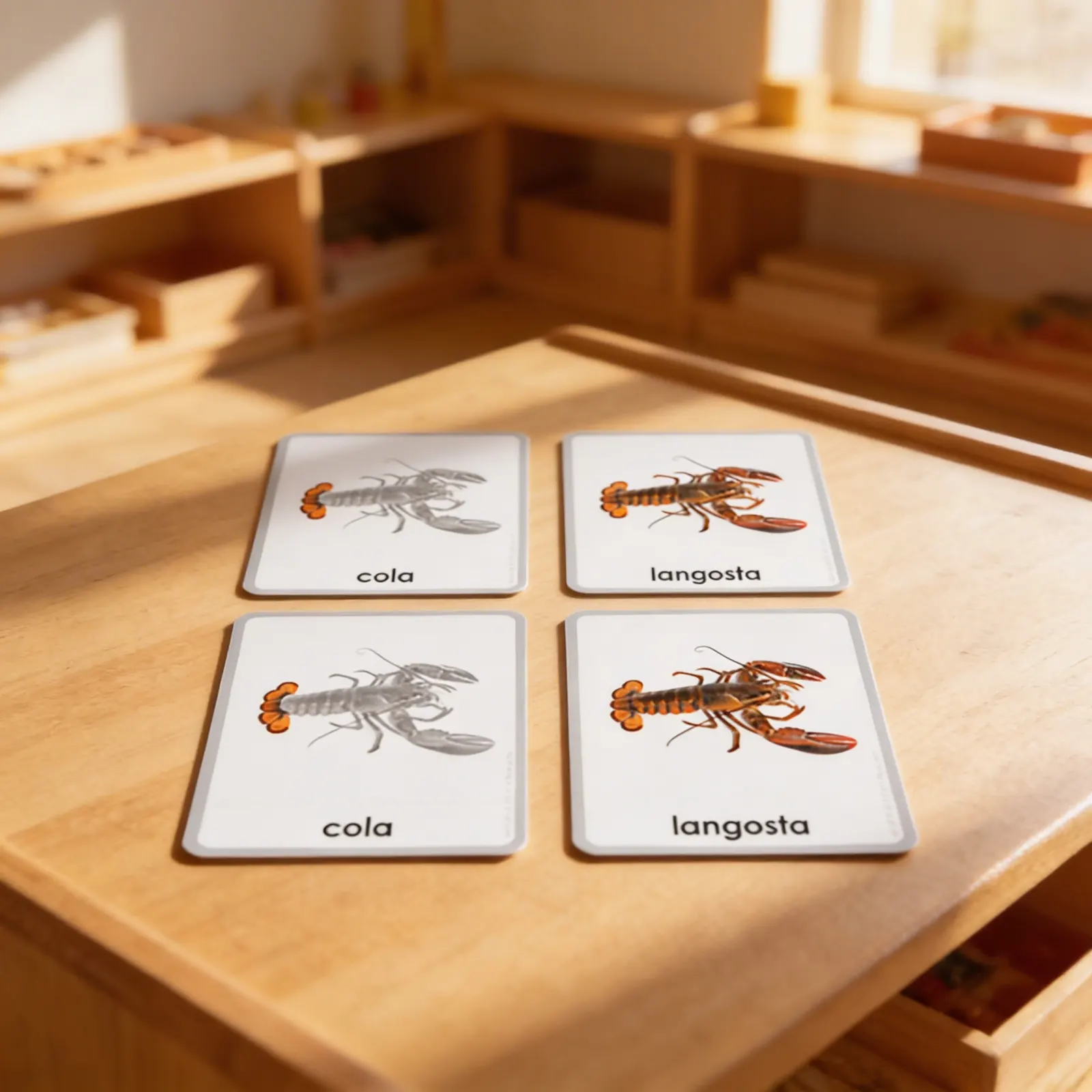
Parts of the Crustacean in a child's hands
Partes Del Crustáceo, the parts of a crustacean in Spanish. Crustaceans are the group children meet on a plate before they meet in a classification, and this set puts the two together: the shell, the claws and the segments named properly, so a crab stops being seafood and becomes an arthropod with a body plan. The cards are in Spanish. Photograph, control chart and labels. Card stock, full colour.
Scientific Classification
Introduces zoological concepts and anatomical vocabulary through concrete visual materials.
Language Development
Builds Spanish vocabulary while reinforcing the connection between spoken and written language.
Visual Discrimination
Color-coded highlighting helps children identify and differentiate anatomical features.
Concentration Skills
Matching and labeling activities develop focus and attention to detail.
How to present it
Place the control cards (picture with label) in a column on the left side of the work mat. Stack the picture cards and label cards separately to the right.
- 1Introduce 3-4 control cards, naming each lobster part in Spanish while pointing to the color-coded area
- 2Match picture cards to their corresponding control cards by observing the highlighted body parts
- 3Read label cards aloud and place them below their matching pictures
- 4Remove control cards and work with pictures and labels independently
3 tips for parents
- Visit seafood markets or aquariums to observe live crustaceans and practice vocabulary
- Create simple Spanish labels for crustacean parts in picture books at home
- Support Spanish pronunciation by learning the terms together

If you are not sure it suits your child, we answer in person.
Norbert Kovalčín, founder of Faborino · write to him
There is no review here yet. We will ask you for one after you buy. Write the first review
What's in the Box
- Control Cards: Approx. 6 cards with labeled anatomy
- Picture Cards: Matching unlabeled illustrations
- Label Cards: Separate Spanish vocabulary labels
Size and material
| Packaging | 15 × 15 × 1 cm |
| Card Material | Cardstock with laminate coating |
| Finish | Glossy protective lamination |
| Recommended Age | 3-6 years |
Care
Wipe with damp cloth, dry immediately
Frequently Asked Questions
What body parts are included in these crustacean nomenclature cards?
The cards feature essential crustacean anatomy including cefalotórax (cephalothorax), abdomen, antenas (antennae), tenazas (claws), patas (legs), telson, and ojos (eyes). Each part is color-coded on the lobster illustration for easy identification and matching.
How do three-part nomenclature cards work in Montessori education?
Three-part cards consist of a control card (picture with label), a picture card (unlabeled), and a label card. Children match the unlabeled picture to its corresponding label, then use the control card for self-correction. This promotes independent learning and vocabulary development.
Are these cards suitable for children who don't speak Spanish at home?
Yes, these cards are excellent for introducing Spanish vocabulary to all children. The visual nature of the material, combined with the three-part card format, supports language learning through picture-word association, making them ideal for bilingual education or Spanish language introduction.
What is the quality and durability of these nomenclature cards?
The cards are printed on high-quality cardstock and laminated for durability, making them suitable for repeated classroom use. The lamination protects against spills and allows for easy cleaning, ensuring the materials maintain their appearance through years of handling by young children.
How can I extend learning activities with these crustacean cards?
Extensions include creating definition booklets, labeling a real lobster shell or model, comparing crustacean anatomy to other arthropods, sorting activities with other animal cards, and incorporating the vocabulary into Spanish conversation practice or nature journaling activities.
Product safety
Manufacturer: Nienhuis Montessori, Anders Celsiusstraat 15, 7442 PB Nijverdal, Netherlands
Parts of the Crustacean