
Parts Of A Butterfly (Insects)
The first photo is the maker's own. The other shots are illustrative.
Inv. no. NIE-EC0451
- Maker
- Nienhuis Montessori, since 1929
- Card Material
- Durable plastic
- Finish
- Pre-cut with rounded corners
- EAN
- 8719924042738
Final price incl. VAT. Delivery €5.90, €122.10 to go for free delivery.
Advice, warranty and returns are handled by us.
Parts Of A Butterfly (Insects) in a child's hands
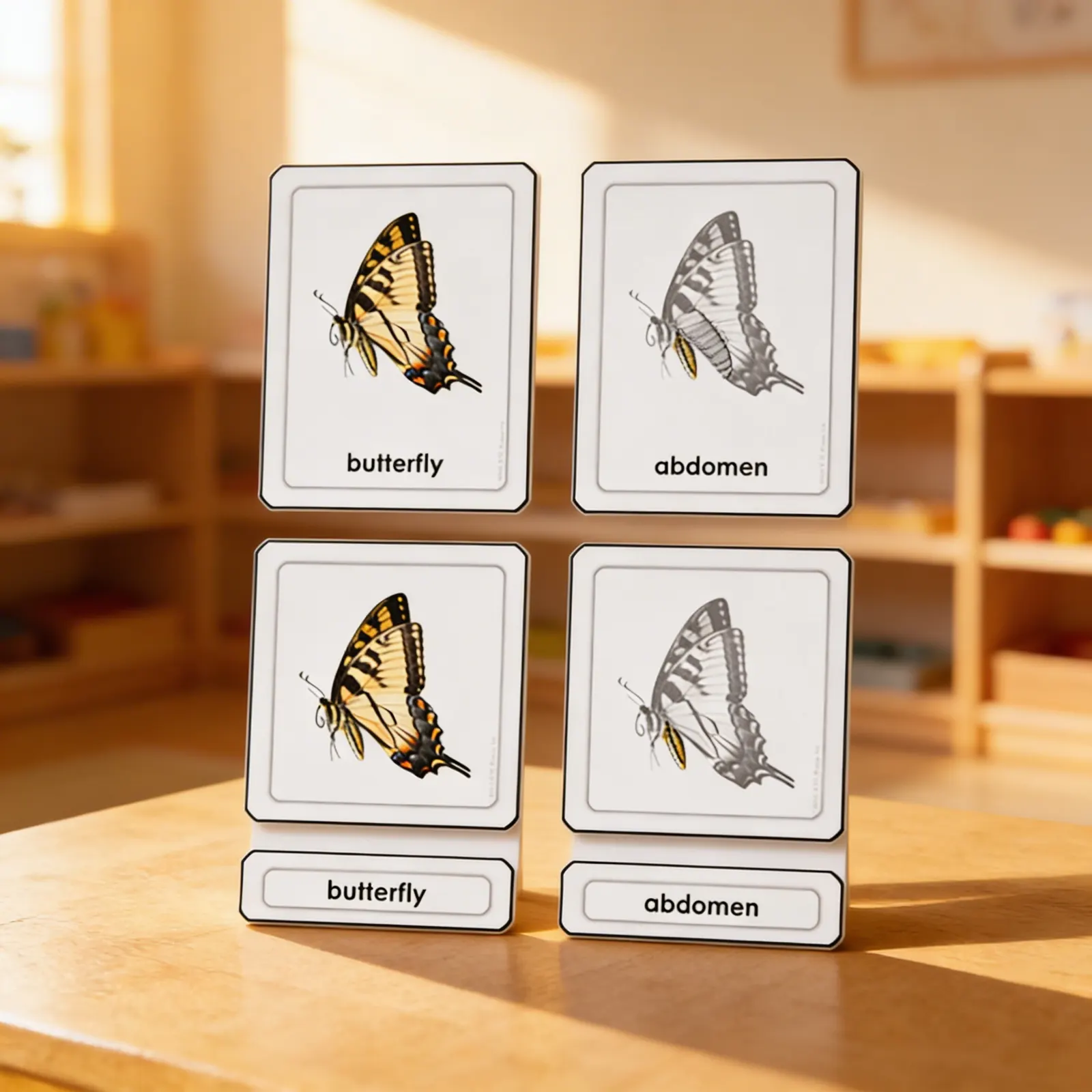
Parts of a butterfly, the insect card set, with the head, thorax and abdomen named along with the rest. Those three words are what makes an insect an insect, and a butterfly is the best animal to meet them on because the three parts are visible without a lens. A child who has named them here can then check a beetle and a bee and find the same three. Real photograph, control chart and labels. Durable plastic. In English.
Scientific Vocabulary
Children learn precise anatomical terminology for butterfly parts, building their scientific language foundation.
Visual Discrimination
Matching activities refine the ability to identify and distinguish specific anatomical features.
Reading Preparation
Label matching supports early reading skills and word-picture association.
Natural Science Interest
Colour photographs foster appreciation for insect biology and natural world exploration.
How to present it
Place the picture cards in a column on the left side of the work mat. Stack the label cards face up in a small basket. Keep control cards separate for self-correction.
- 1Examine one picture card closely, noting the highlighted butterfly part
- 2Select a label card and read it aloud (or have child attempt reading)
- 3Place the label below its matching picture card
- 4Continue matching all labels to pictures
- 5Use control cards to verify correct matches
3 tips for parents
- Visit gardens or butterfly exhibits to observe real butterflies and identify the parts learned with the cards
- Create a simple butterfly book together using photographs and labeling the anatomical features
- When reading butterfly stories, pause to identify body parts in the illustrations

If you are not sure it suits your child, we answer in person.
Norbert Kovalčín, founder of Faborino · write to him
There is no review here yet. We will ask you for one after you buy. Write the first review
What's in the Box
- Control Cards: Cards with images and labels
- Picture Cards: Matching cards without labels
- Label Cards: Separate labels for matching activities
Size and material
| Packaging | 15 × 15 × 1 cm |
| Card Material | Durable plastic |
| Finish | Pre-cut with rounded corners |
| Recommended Age | 3-6 years |
Care
Wipe with damp cloth, dry immediately
Frequently Asked Questions
What butterfly parts are included in these Montessori cards?
The cards name the head, thorax and abdomen, the three parts that make an insect an insect, along with the other parts of the butterfly. Each part is shown in colour photography.
How do three-part classification cards work for teaching butterfly anatomy?
Three-part cards consist of a control card (picture with label), a picture card (image only), and a label card (text only). Children match the picture cards to labels while using the control card for self-correction, promoting independent learning and vocabulary development.
Are these butterfly anatomy cards suitable for preschoolers who can't read yet?
Yes, these cards are perfect for pre-readers aged 3-6. Non-readers can match pictures visually and learn vocabulary through oral lessons, while emerging readers can begin associating words with images, supporting both language and science learning simultaneously.
What material are these Montessori butterfly cards made from?
The cards are made of durable plastic, pre-cut with rounded corners, so nothing needs laminating and they stand up to frequent use in the classroom or at home.
How can I extend learning beyond just matching the butterfly parts cards?
You can enhance learning by observing real butterflies outdoors, creating butterfly art projects, reading butterfly books, discussing metamorphosis, comparing butterfly parts to other insects, or using magnifying glasses to examine preserved specimens or detailed photographs.
Product safety
Manufacturer: Nienhuis Montessori, Anders Celsiusstraat 15, 7442 PB Nijverdal, Netherlands
Parts Of A Butterfly (Insects)