
Parts Of A Fish (Osteichthyes)
The first photo is the maker's own. The other shots are illustrative.
Inv. no. NIE-EC0459
- Maker
- Nienhuis Montessori, since 1929
- Product size
- 9.5 × 12.7 cm
- Material
- Durable plastic
- Finish
- Pre-cut with rounded corners
- EAN
- 8719924042806
Final price incl. VAT. Delivery €5.90, €122.10 to go for free delivery.
Advice, warranty and returns are handled by us.
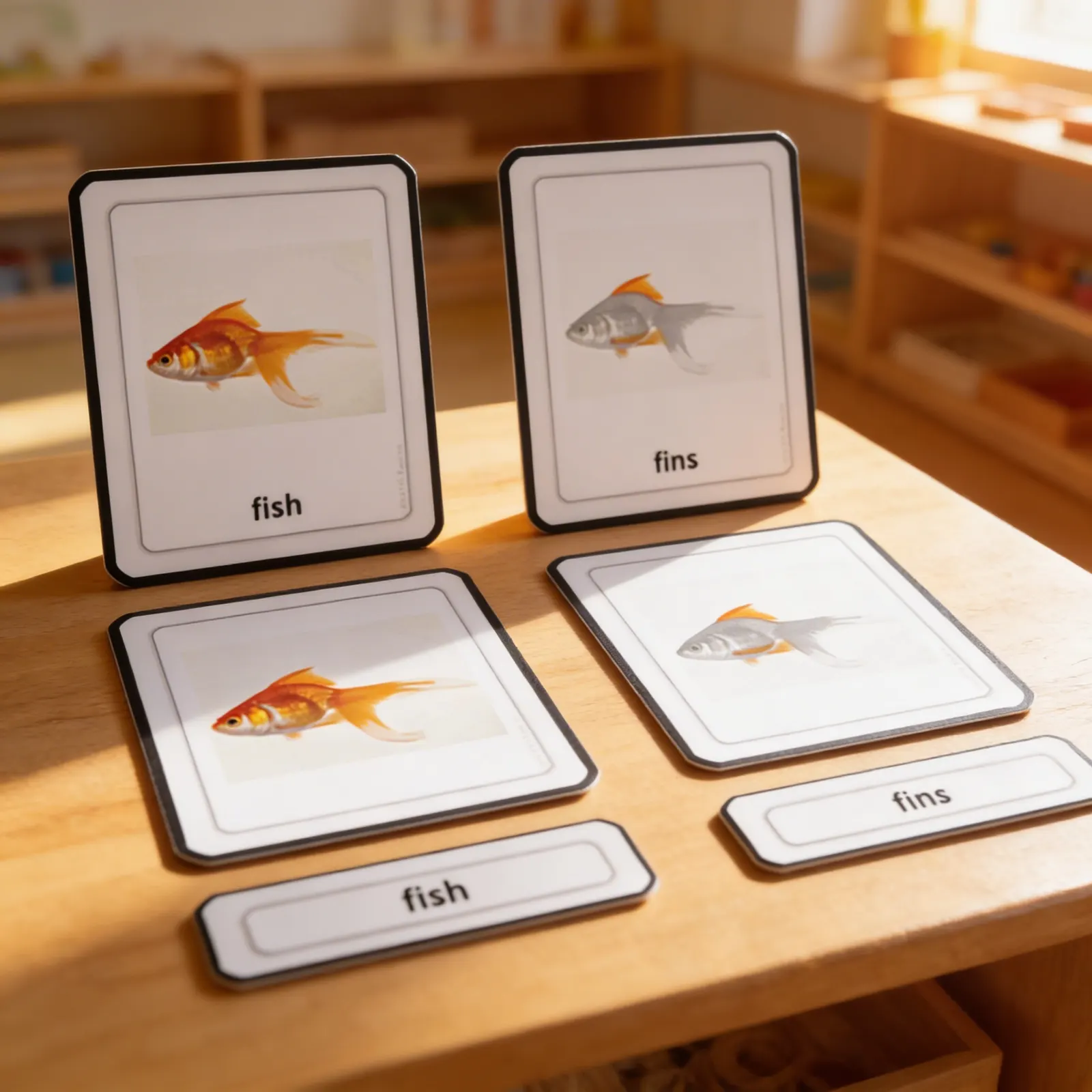
Parts Of A Fish (Osteichthyes) in a child's hands
Professionally designed nomenclature cards introducing fish anatomy through the Montessori three-part card method. This essential zoology material features clear photographic images of a bony fish (Osteichthyes) with labeled anatomical parts, supporting scientific vocabulary development and classification skills. The durable plastic cards enable children to match pictures with corresponding labels, building precise language and understanding of vertebrate anatomy.
Scientific Vocabulary
Introduces precise anatomical terms through visual matching and reading activities.
Classification Skills
Develops understanding of vertebrate characteristics and biological categorization.
Visual Discrimination
Enhances ability to identify and match specific anatomical features.
Reading Preparation
Connects visual recognition with written labels, supporting early literacy development.
How to present it
Place the control cards (image with label) in a column on the left side of the work mat. Stack the picture cards and label cards separately in baskets to the right.
- 1Invite the child to match each picture card to its corresponding control card
- 2Once pictures are matched, introduce the label cards one at a time
- 3Demonstrate placing labels below their matching pictures
- 4Remove control cards and invite the child to work with pictures and labels only
3 tips for parents
- Visit aquariums or pet stores to observe real fish, using the vocabulary learned from the cards
- Point out fish anatomy when preparing fish for meals, connecting learning to daily life
- Create simple fish drawings together, labeling parts using the nomenclature learned

If you are not sure it suits your child, we answer in person.
Norbert Kovalčín, founder of Faborino · write to him
There is no review here yet. We will ask you for one after you buy. Write the first review
What's in the Box
- Control Cards: Complete fish images with labels
- Picture Cards: Matching images without labels
- Label Cards: Separate nomenclature labels
- Total Cards: Approx. 18 pieces (6 sets)
Size and material
| Product size | 9.5 × 12.7 cm |
| Packaging | 15 × 15 × 1 cm |
| Material | Durable plastic |
| Finish | Pre-cut with rounded corners |
| Recommended Age | 3-6 years |
Care
Wipe with damp cloth, dry immediately
Frequently Asked Questions
What anatomical parts of the fish are included in these cards?
The cards typically include essential external features such as fins (dorsal, pectoral, pelvic, anal, caudal), scales, gills/gill cover, eyes, mouth, and lateral line. Each part is clearly photographed and labeled to help children identify and learn the scientific names of fish anatomy.
How do three-part cards work in the Montessori method?
Three-part cards consist of a control card (picture with label), a picture card (image only), and a label card (text only). Children first learn vocabulary using the control card, then practice matching the separate pictures and labels independently, promoting self-correction and reinforcing learning through repetition.
Are these cards suitable for children who cannot read yet?
Yes, these cards are designed for pre-readers and early readers. Non-reading children can work with the picture cards to identify parts visually, while teachers or parents introduce vocabulary orally. As reading skills develop, children can independently match labels to pictures.
What type of fish is featured in these nomenclature cards?
The cards feature a bony fish (Osteichthyes), which represents the most common type of fish children encounter. The clear photographic images show a typical bony fish with easily identifiable external features, making it ideal for introducing basic fish anatomy.
How durable are the laminated cards for classroom use?
The cards are professionally laminated for durability, making them water-resistant and suitable for repeated handling by young children. The lamination protects against spills, fingerprints, and general wear, ensuring the cards maintain their quality through years of classroom or home use.
Product safety
Manufacturer: Nienhuis Montessori, Anders Celsiusstraat 15, 7442 PB Nijverdal, Netherlands
Parts Of A Fish (Osteichthyes)