
Parts Of A Flower
The first photo is the maker's own. The other shots are illustrative.
Inv. no. NIE-EC0463
- Maker
- Nienhuis Montessori, since 1929
- Product size
- 9.5 × 12.7 cm
- Material
- Durable plastic
- Finish
- Pre-cut with rounded corners
- EAN
- 8719924042844
Final price incl. VAT. Delivery €5.90, €122.10 to go for free delivery.
Advice, warranty and returns are handled by us.
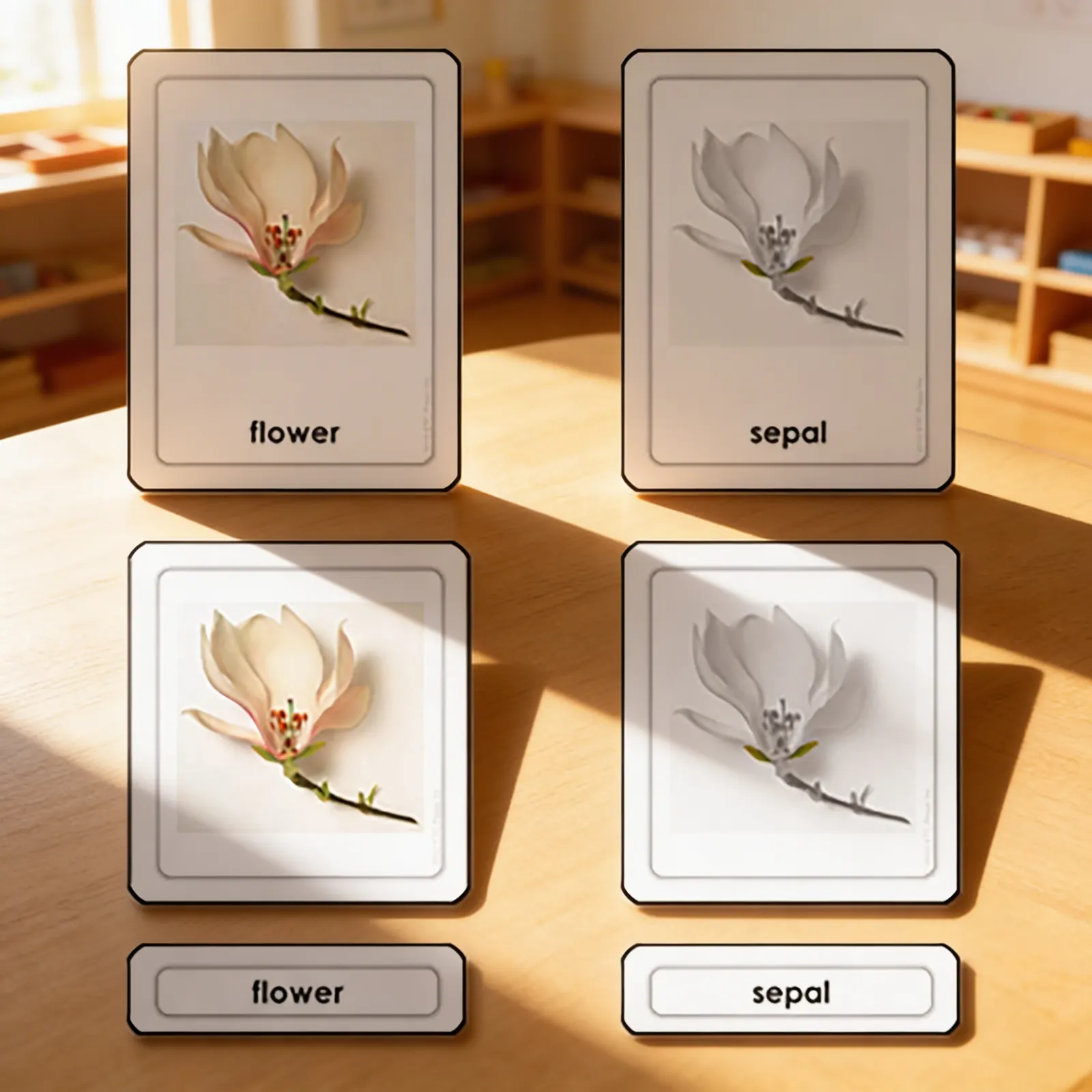
Parts Of A Flower in a child's hands
Parts of a flower, the botany card set that names what a flower is actually for. Petals are the part a child notices and the part that matters least: the work of a flower happens in the stamen and the pistil, and a set that names them turns a decoration into a mechanism. Best used with a real flower taken apart beside it. Real photograph, control chart and labels. Durable plastic with rounded corners. In English.
Scientific Vocabulary
Builds precise botanical terminology through visual association and repetition.
Visual Discrimination
Develops ability to identify and distinguish different plant structures.
Classification Skills
Introduces systematic thinking through matching and categorizing flower parts.
Reading Preparation
Connects visual representations with written labels, supporting early literacy.
How to present it
Place the complete flower diagram card on the left side of the work mat. Arrange the individual part cards in a column to the right. Keep label cards in a separate container.
- 1Examine the complete magnolia diagram together, pointing to each part as you name it slowly
- 2Select one part card (e.g., petals) and place it below the complete diagram
- 3Find the corresponding label card and place it beneath the part illustration
- 4Continue matching all parts and labels, creating organized columns
- 5Once comfortable, introduce the control card showing all parts labeled for independent checking
3 tips for parents
- Visit gardens or flower shops to identify flower parts in real specimens using the vocabulary from class
- Press flowers at home and label the parts to create your own botanical collection
- When reading books featuring flowers, pause to identify and name the parts shown in illustrations

If you are not sure it suits your child, we answer in person.
Norbert Kovalčín, founder of Faborino · write to him
There is no review here yet. We will ask you for one after you buy. Write the first review
What's in the Box
- Picture Cards: Approx. 3 illustrated flower part cards
- Label Cards: Approx. 3 matching nomenclature labels
- Control Card: Complete labeled diagram (if included)
Size and material
| Product size | 9.5 × 12.7 cm |
| Packaging | 15 × 15 × 1 cm |
| Material | Durable plastic |
| Finish | Pre-cut with rounded corners |
| Recommended Age | 3-6 years |
Care
Wipe with damp cloth, dry immediately
Frequently Asked Questions
What flower parts are included in this card set?
The set includes cards for all major flower parts including petals, sepals, stamens, pistil, receptacle, and peduncle. Each part is clearly illustrated on the magnolia flower diagram with corresponding label cards for matching activities.
How do children use these flower anatomy cards?
Children first explore the control card showing the complete labeled flower, then match individual part cards to their corresponding labels. They can also use the cards for three-part matching activities and to label real flowers during nature studies.
Are the cards suitable for children who cannot read yet?
Yes, the cards feature clear botanical illustrations that allow non-readers to work with the material visually. Teachers can introduce vocabulary orally while children match pictures, gradually building recognition of the written labels as reading skills develop.
What makes these cards appropriate for ages 3-6?
The cards feature simple, clear illustrations with basic flower parts that young children can identify. The laminated material is durable for small hands, and the matching activity develops visual discrimination skills appropriate for this age group's developmental stage.
Can these cards be used with real flowers?
Absolutely! The cards work excellently alongside real flower specimens. Children can compare the illustrated magnolia parts to real flowers, helping them identify similar structures in different flower types and deepening their understanding of plant anatomy.
Product safety
Manufacturer: Nienhuis Montessori, Anders Celsiusstraat 15, 7442 PB Nijverdal, Netherlands
Parts Of A Flower