
Parts Of A Fruit
The first photo is the maker's own. The other shots are illustrative.
Inv. no. NIE-EC0466
- Maker
- Nienhuis Montessori, since 1929
- Product size
- 9.5 × 12.7 cm
- Material
- Durable plastic
- Finish
- Pre-cut with rounded corners
- EAN
- 8719924042851
Final price incl. VAT. Delivery €5.90, €122.10 to go for free delivery.
Advice, warranty and returns are handled by us.
Parts Of A Fruit in a child's hands
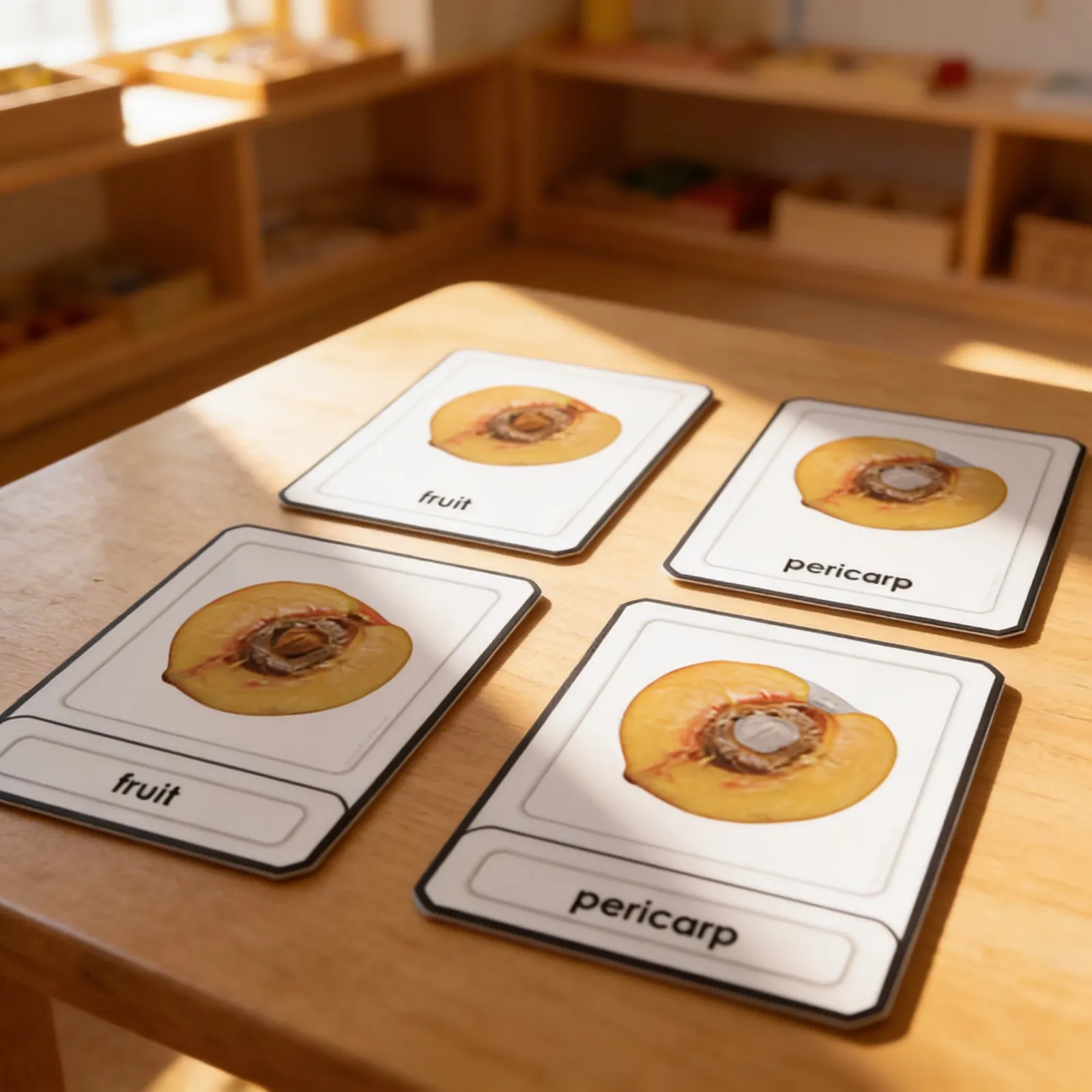
Connecting children to the living world, this Parts of a Fruit three-part card set puts children in direct contact with the scientific terminology and structure of stone fruits through beautifully illustrated cross-section images. The durable plastic cards present clear visuals of a peach or nectarine's anatomy, featuring labeled and unlabeled versions that support the Montessori approach to building vocabulary through concrete visual representation and self-directed matching activities.
Scientific Vocabulary
Introduces precise botanical terminology including 'pericarp' and fruit anatomy, building the foundation for later scientific study.
Visual Discrimination
Develops careful observation skills as children match images and labels, noticing subtle details in the fruit's structure.
Reading Preparation
Supports early literacy through meaningful word-object associations and left-to-right visual scanning patterns.
Classification Skills
Encourages understanding of parts-to-whole relationships essential for logical thinking and scientific classification.
How to present it
Place the control cards (labeled pictures) in a column on the left side of the work mat. Stack the picture cards and label cards in separate piles to the right.
- 1Examine each control card carefully, reading the labels aloud
- 2Match each unlabeled picture card to its corresponding control card
- 3Read each separate label card and place it below the matched pictures
- 4Use the control cards to check your work independently
3 tips for parents
- Visit farmers' markets to explore different stone fruits and compare their internal structures
- Create a fruit journal together, drawing and labeling parts after snack time
- Use proper terminology casually: 'The mesocarp of this peach is so juicy!'

If you are not sure it suits your child, we answer in person.
Norbert Kovalčín, founder of Faborino · write to him
There is no review here yet. We will ask you for one after you buy. Write the first review
What's in the Box
- Picture Cards: Unlabeled fruit cross-section images
- Label Cards: Separate nomenclature labels
- Control Cards: Complete labeled images for self-checking
Size and material
| Product size | 9.5 × 12.7 cm |
| Packaging | 15 × 15 × 0 cm |
| Material | Durable plastic |
| Finish | Pre-cut with rounded corners |
| Recommended Age | 3-6 years |
Care
Wipe with damp cloth and dry immediately
Frequently Asked Questions
What fruit parts are included in this three-part card set?
This set features detailed cross-section illustrations of stone fruits (peach or nectarine), showing parts including the skin, flesh, pit/stone, seed, and stem. Each part is clearly labeled in the control cards to help children learn proper botanical terminology.
How do three-part cards work in Montessori education?
Three-part cards consist of a picture card, a label card, and a control card (picture with label). Children match the separate pictures and labels, then check their work using the control card. This self-correcting format promotes independent learning and vocabulary development.
What age group is this material designed for?
These cards are designed for children ages 3-6 years, aligning with the Montessori primary classroom. The material introduces scientific vocabulary at a developmentally appropriate level when children are naturally interested in naming and categorizing their world.
Are the cards durable for classroom use?
Yes, the cards are laminated for durability, making them suitable for repeated handling by young children in both classroom and home settings. The lamination protects the beautiful illustrations and ensures long-lasting use.
How can I extend learning with these cards?
You can extend activities by having children match real fruit cross-sections to the cards, create their own fruit drawings, sort fruits by type, or explore other fruits' anatomy. The cards also support language development through vocabulary lessons and discussion.
Product safety
Manufacturer: Nienhuis Montessori, Anders Celsiusstraat 15, 7442 PB Nijverdal, Netherlands
Parts Of A Fruit