
Parts Of A Spider (Arachnid)
The first photo is the maker's own. The other shots are illustrative.
Inv. no. NIE-EC0452
- Maker
- Nienhuis Montessori, since 1929
- Material
- Durable plastic
- Finish
- Pre-cut with rounded corners
- EAN
- 8719924042745
Final price incl. VAT. Delivery €5.90, €122.10 to go for free delivery.
Advice, warranty and returns are handled by us.
Parts Of A Spider (Arachnid) in a child's hands
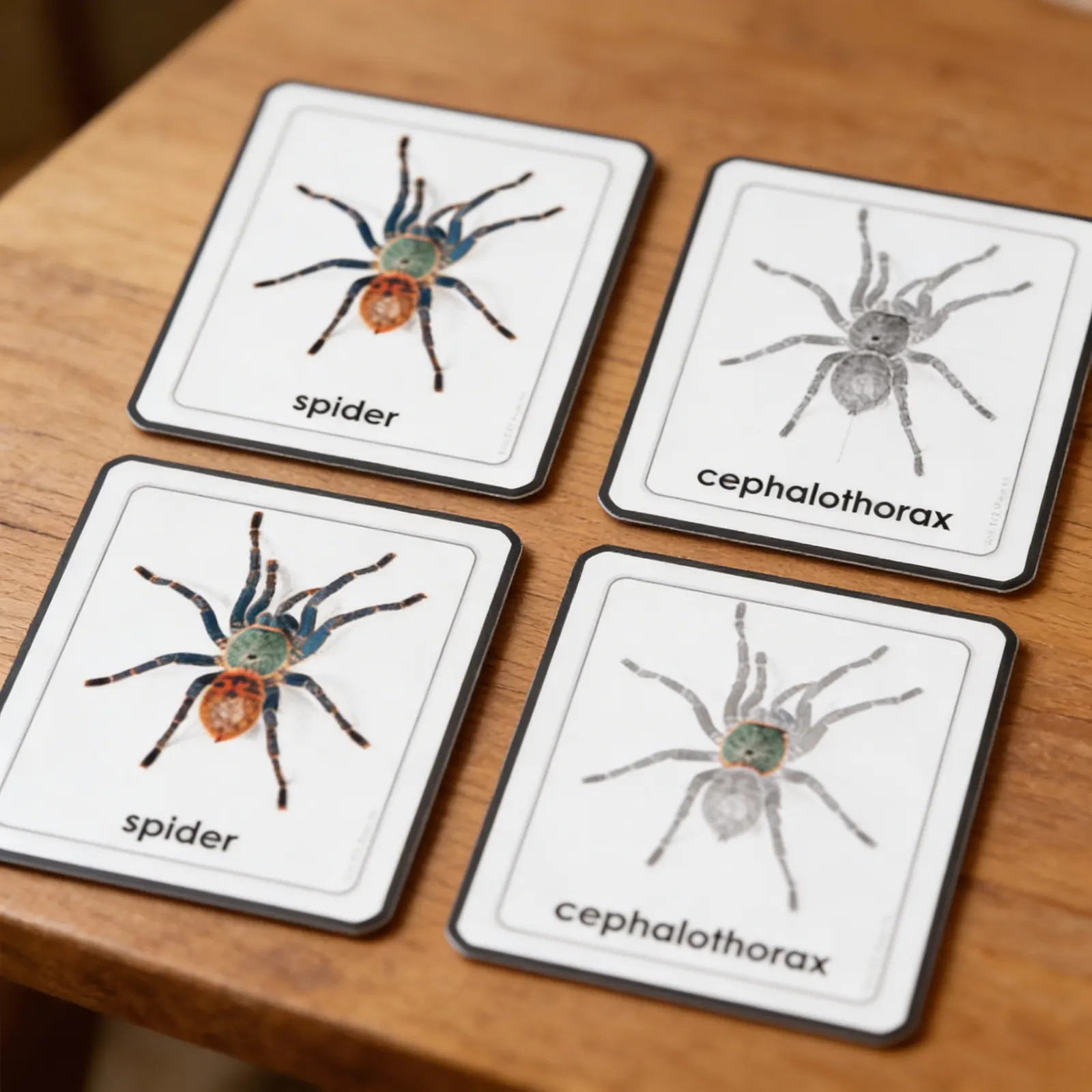
Parts of a spider, the arachnid card set. A spider is the animal children are told is an insect and is not, and this set is where the difference stops being a correction and becomes visible: two body parts instead of three, eight legs instead of six, no antennae and no wings. Laid beside the butterfly cards it makes the classification obvious. Real photograph, control chart and labels. Durable plastic. In English.
Scientific Vocabulary
Builds precise anatomical terminology through visual association and repetitive matching work.
Reading Preparation
Develops sight word recognition and connects written labels to visual representations.
Classification Skills
Enhances ability to identify and categorize parts of living creatures systematically.
Independent Learning
Control cards enable self-correction, fostering autonomy and confidence in knowledge acquisition.
How to present it
Place the colored picture cards in a column on the left side of the work mat. Stack the matching grayscale cards nearby. Keep labels in a separate container.
- 1Invite the child to match each colored spider part card with its grayscale counterpart, creating rows across the mat
- 2Once all pictures are matched, introduce one label at a time, reading it aloud before placing it below the corresponding pictures
- 3Remove all grayscale cards and labels, leaving only colored pictures. Invite the child to read and place labels independently
- 4For reading practice, use only labels and grayscale cards, matching text to pictures without color cues
3 tips for parents
- Look for spiders in your garden or home to observe the body parts learned with the cards
- Use correct terms like 'cephalothorax' instead of 'head' when discussing spiders together
- Visit a natural history museum to see preserved spider specimens and identify the parts

If you are not sure it suits your child, we answer in person.
Norbert Kovalčín, founder of Faborino · write to him
There is no review here yet. We will ask you for one after you buy. Write the first review
What's in the Box
- Picture Cards: Approx. 6 color-coded spider anatomy cards
- Label Cards: Matching text labels for each body part
- Control Cards: Complete picture-label combinations for self-checking
Size and material
| Packaging | 15 × 15 × 0 cm |
| Material | Durable plastic |
| Finish | Pre-cut with rounded corners |
| Recommended Age | 3-6 years |
Care
Wipe with damp cloth, dry immediately
Frequently Asked Questions
What spider body parts are included in this Montessori card set?
The set includes essential arachnid anatomy parts such as cephalothorax, abdomen, eight legs, spinnerets, chelicerae (fangs), pedipalps, and eyes. Each part is clearly illustrated with color-coded diagrams on durable cards suitable for repeated handling by young children.
How do children use these 3-part nomenclature cards?
Children match the picture cards with corresponding labels, use grayscale control cards for self-correction, and practice reading vocabulary. Activities progress from simple matching to reading labels independently, building both visual discrimination and early literacy skills.
Are these cards suitable for children afraid of spiders?
Yes, the educational illustrations present spiders in a scientific, non-threatening way that helps children understand arachnids objectively. Learning accurate information about spider anatomy often reduces fears by replacing misconceptions with factual knowledge.
What's the difference between picture cards and control cards?
Picture cards feature full-color illustrations with labels, while control cards show the same images in grayscale without text. Children use control cards to check their work independently after matching pictures with separate label cards, following the Montessori principle of self-correction.
Can these cards be used alongside real spider observations?
Absolutely! These cards complement nature study perfectly. Children can observe real spiders (safely) outdoors or in containers, then use the cards to identify and name the parts they've seen, reinforcing concrete learning with abstract representation.
Product safety
Manufacturer: Nienhuis Montessori, Anders Celsiusstraat 15, 7442 PB Nijverdal, Netherlands
Parts Of A Spider (Arachnid)