
Parts Of A Starfish (Echinoderms)
The first photo is the maker's own. The other shots are illustrative.
Inv. no. NIE-EC0455
- Maker
- Nienhuis Montessori, since 1929
- Product size
- 9.5 × 12.7 cm
- Material
- Durable plastic
- Finish
- Pre-cut with rounded corners
- EAN
- 8719924042769
Final price incl. VAT. Delivery €5.90, €122.10 to go for free delivery.
Advice, warranty and returns are handled by us.
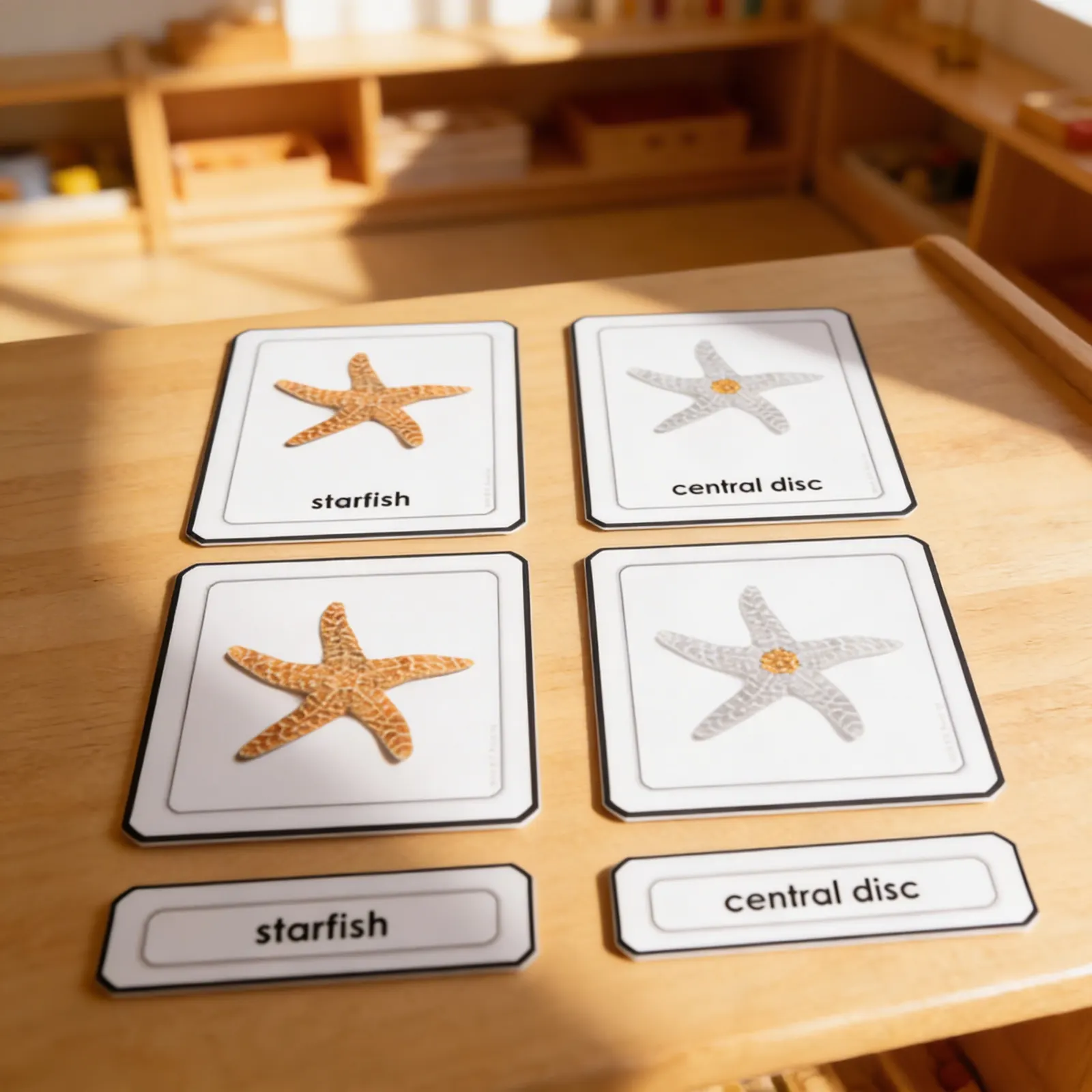
Parts Of A Starfish (Echinoderms) in a child's hands
Parts of a starfish, the echinoderm card set. A starfish has no head, no front and no left or right: it is built around a centre rather than along a line, and naming its parts is the first time a child meets an animal that does not follow the plan every other animal seems to. That is worth more than the vocabulary. Real photograph, control chart and labels. Durable plastic with rounded corners. In English.
Scientific Classification
Builds understanding of invertebrate anatomy and introduces systematic observation skills fundamental to biological sciences.
Visual Discrimination
Matching isolated parts to whole images develops keen observational abilities and attention to detail.
Vocabulary Enrichment
Introduces precise scientific terminology for echinoderm anatomy, expanding language skills in natural sciences.
Independent Learning
Self-correcting 3-part card format allows autonomous exploration and builds confidence in scientific study.
How to present it
Place the laminated cards on a mat or table. Separate into three groups: whole starfish pictures, isolated body part cards, and nomenclature labels. Start with just pictures for non-readers.
- 1Present the whole starfish card, examining its complete form and pointing out visible features
- 2Match each isolated body part card to its location on the whole starfish image
- 3Introduce nomenclature labels one at a time, reading each aloud before matching
- 4Create a complete set by arranging whole picture, part, and label in columns
- 5Mix all cards and invite independent matching without the control cards
3 tips for parents
- Visit aquarium touch tanks to observe real starfish movement and feeding behaviors
- Collect library books about echinoderms to reinforce the vocabulary learned with cards
- Practice naming starfish parts during beach visits or while examining shells and sea life

If you are not sure it suits your child, we answer in person.
Norbert Kovalčín, founder of Faborino · write to him
There is no review here yet. We will ask you for one after you buy. Write the first review
What's in the Box
- Whole starfish cards: Complete organism images
- Isolated part cards: Individual anatomical features
- Nomenclature labels: Scientific vocabulary cards
- Control cards: Approx. 6 matching sets total
Size and material
| Product size | 9.5 × 12.7 cm |
| Packaging | 15 × 15 × 0 cm |
| Material | Durable plastic |
| Finish | Pre-cut with rounded corners |
| Recommended Age | 3-6 years |
Care
Wipe with slightly damp cloth, dry immediately
Frequently Asked Questions
What specific starfish body parts are included in this 3-part card set?
The set includes cards for essential starfish anatomy including the central disk, arms (rays), tube feet, madreporite, eyespots, spines, and mouth. Each part is clearly illustrated and labeled to help children identify and learn the correct scientific terminology for echinoderm structures.
How do these cards support the Montessori approach to teaching zoology?
These cards follow the Montessori three-part card format, allowing children to work independently through matching exercises. They support concrete to abstract learning by first presenting the whole starfish, then isolating individual parts, and finally introducing nomenclature labels, building scientific vocabulary through hands-on manipulation.
Are the cards durable enough for classroom use by young children?
Yes, the cards are printed on high-quality cardstock and laminated for durability, making them resistant to spills, tears, and frequent handling by small hands. The lamination also allows for easy cleaning and ensures the materials will last through years of classroom or home use.
What age group benefits most from these starfish anatomy cards?
While designed for ages 3-6, these cards work best with children who have experience with simpler matching activities. Typically, 4-6 year olds gain the most benefit as they can engage with both the visual matching and vocabulary components, though younger children can start with simple picture matching.
How many cards are included and what are the dimensions?
The set includes 24 cards total: 8 complete starfish cards, 8 isolated body part cards, and 8 nomenclature labels. Each card measures approximately 3.5 x 3.5 inches, an ideal size for small hands to manipulate while providing clear, detailed illustrations of each anatomical feature.
Product safety
Manufacturer: Nienhuis Montessori, Anders Celsiusstraat 15, 7442 PB Nijverdal, Netherlands
Parts Of A Starfish (Echinoderms)