
Parts To A Whole
The first photo is the maker's own. The other shots are illustrative.
Inv. no. NIE-EC0648
- Maker
- Nienhuis Montessori, since 1929
- Material
- Durable plastic
- Finish
- Pre-cut with rounded corners
- EAN
- 8719924043223
Final price incl. VAT. Delivery €5.90, €109.10 to go for free delivery.
Advice, warranty and returns are handled by us.
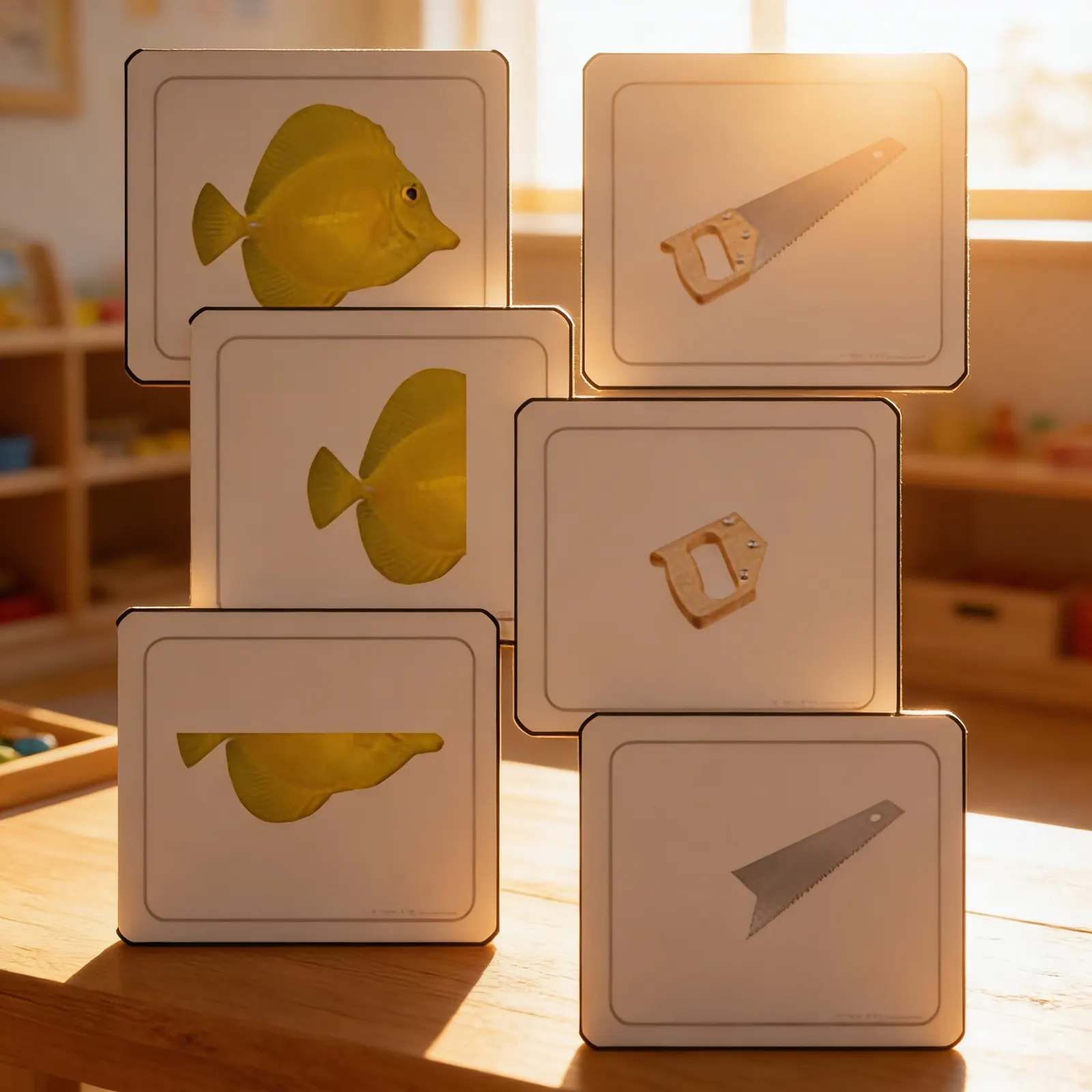
Parts To A Whole in a child's hands
Parts to a whole: a child sees part of an object and works out what the whole one is. It is a harder task than it looks, because recognising something from a fragment means holding a picture in mind and checking it against what is on the card, which is the work the visual part of the brain does constantly and rarely gets asked to do deliberately. Real photographs. Durable plastic with rounded corners. In English.
Visual Discrimination
Children refine their ability to observe details and recognize relationships between whole objects and their component parts.
Logical Thinking
Matching activities develop analytical skills as children identify which parts belong to each whole object.
Language Development
Introduces vocabulary for parts and wholes while encouraging descriptive language about object components.
Concentration
Self-correcting nature of the activity promotes focused attention and independent problem-solving skills.
How to present it
Place the Parts to a Whole cards on a mat or table. Separate the whole object cards from the component part cards. Begin with 3-4 sets for initial presentations.
- 1Lay out the whole object cards in a vertical column on the left
- 2Mix the component part cards and place them in a pile
- 3Select one part card and examine it carefully
- 4Match the part card to its corresponding whole object
- 5Continue until all parts are matched to their wholes
- 6Name each whole and its parts using specific vocabulary
3 tips for parents
- Point out part-whole relationships in daily life: 'The wheel is part of the bicycle'
- Let your child help with cooking to see ingredients as parts of a whole dish
- During cleanup time, discuss how toys have parts that fit together

If you are not sure it suits your child, we answer in person.
Norbert Kovalčín, founder of Faborino · write to him
There is no review here yet. We will ask you for one after you buy. Write the first review
What's in the Box
- Matching Cards: Approx. 6 cards showing whole objects and parts
Size and material
| Packaging | 29 × 23 × 1 cm |
| Material | Durable plastic |
| Finish | Pre-cut with rounded corners |
| Recommended Age | 3-6 years |
Care
Wipe with slightly damp cloth and dry immediately
Frequently Asked Questions
What age group is this material designed for?
The Parts to a Whole matching cards are designed for children ages 3-6 years old, aligning with the Montessori early childhood curriculum for developing visual discrimination and logical thinking skills.
How many card sets are included and what objects do they feature?
The set includes multiple laminated card pairs featuring clear photographs of familiar items such as fish, tools, and everyday objects. Each set shows a complete object and its corresponding parts for matching activities.
How do children use these cards in a Montessori environment?
Children match cards showing whole objects with cards displaying their component parts. This self-correcting activity helps develop analytical thinking, visual perception, and understanding of part-whole relationships through independent exploration.
What skills does this material help develop?
This material develops visual discrimination, logical thinking, analytical skills, vocabulary expansion, concentration, and understanding of how parts combine to form wholes. It also enhances fine motor skills through card handling and sorting.
Are the cards durable for classroom use?
Yes, the cards are laminated for durability, making them suitable for repeated handling in classroom environments. The lamination protects the clear photographs from wear and allows for easy cleaning between uses.
Product safety
Manufacturer: Nienhuis Montessori, Anders Celsiusstraat 15, 7442 PB Nijverdal, Netherlands
Parts To A Whole