
Parts of the TreeBotany Cards (Spanish Edition)
The first photo is the maker's own. The other shots are illustrative.
Inv. no. NIE-ECSP0462
- Maker
- Nienhuis Montessori, since 1929
- Card Material
- Heavy cardstock
- Finish
- Laminated protective coating
- EAN
- 8719924043575
Final price incl. VAT.
This material is no longer made
The manufacturer has withdrawn it, so we cannot order it in. The page stays here because the material itself is still worth knowing about.
Available instead
Parts Of A Tree
Would you buy it if we could source it or make it ourselves? Enough people saying yes is what makes the attempt worth it.
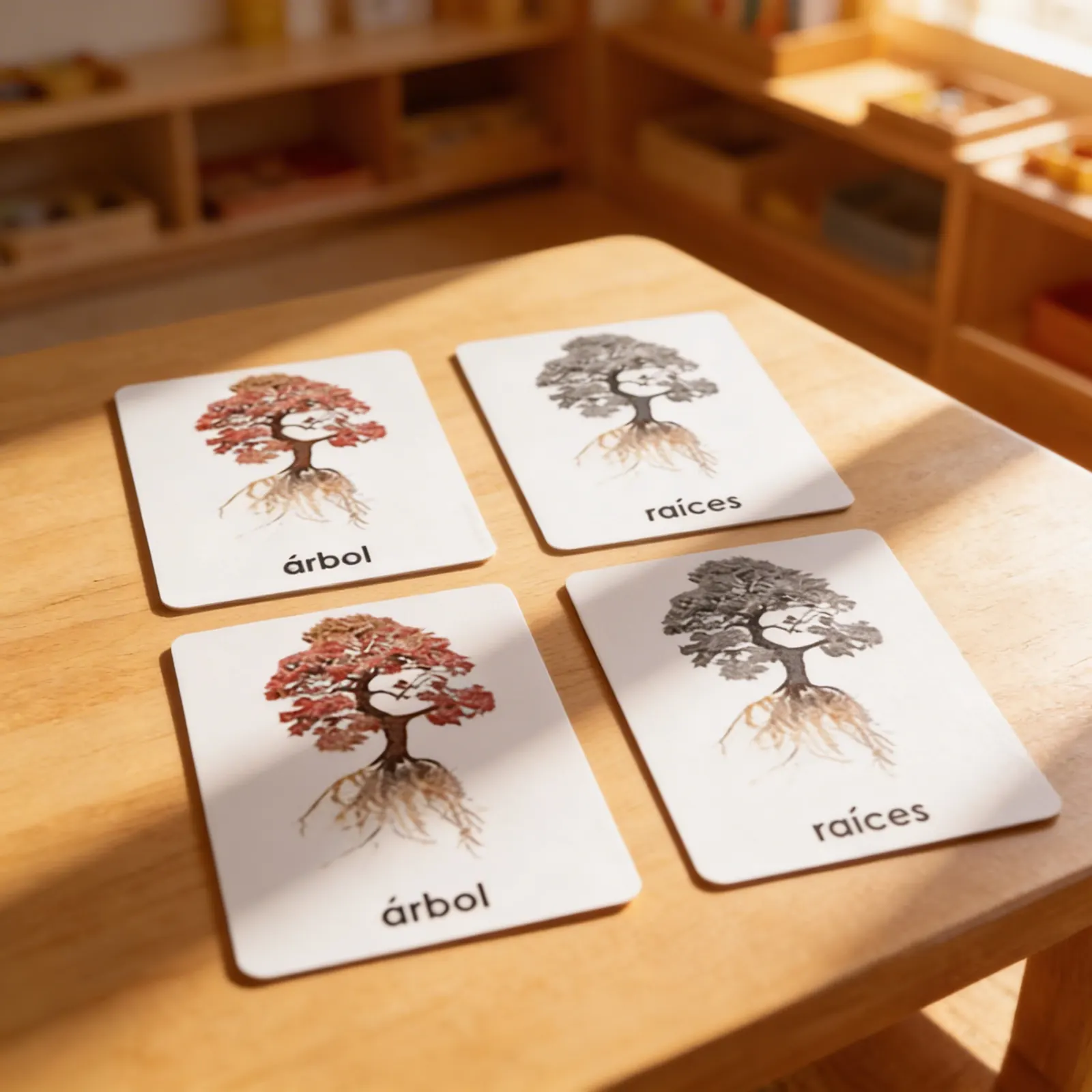
Parts of the Tree in a child's hands
Partes Del Árbol, the parts of a tree in Spanish. A tree is the largest thing a child can walk up to and touch, and naming its parts is the botany work with the longest reach: roots that cannot be seen, a trunk that can be measured with both arms, a crown that has to be looked up at. The cards are in Spanish. Real photograph, control chart and labels. Card stock, full colour, pre cut with rounded corners.
Language Development
Builds Spanish vocabulary through visual association and repetition of botanical terms.
Visual Discrimination
Develops observation skills by matching identical images and recognizing tree components.
Scientific Understanding
Introduces botanical concepts and classification, preparing for advanced nature studies.
Reading Preparation
Supports early literacy through matching written labels to corresponding images.
How to present it
Place the control cards (picture with label) in a column on the left side of the work mat. Stack the picture cards face down in the upper right corner and the label cards in the lower right corner.
- 1Show the child how to select one control card and name the tree part in Spanish: 'raíz'
- 2Turn over one picture card and compare it to the control cards, placing matches to the right
- 3Continue matching all picture cards to their corresponding control cards
- 4Begin matching label cards by reading each one and finding its picture pair
- 5Invite the child to check their work using the control cards as reference
3 tips for parents
- Practice Spanish tree vocabulary during neighborhood walks, pointing out 'las hojas' or 'el tronco'
- Create a family tree book with photos of different trees labeled in Spanish
- Visit local parks to collect fallen leaves and match them to the 'hoja' card at home

If you are not sure it suits your child, we answer in person.
Norbert Kovalčín, founder of Faborino · write to him
There is no review here yet. We will ask you for one after you buy. Write the first review
What's in the Box
- Control Cards: Approx. 6 cards with image and label
- Picture Cards: Matching images without labels
- Label Cards: Spanish vocabulary labels
Size and material
| Packaging | 15 × 15 × 1 cm |
| Card Material | Heavy cardstock |
| Finish | Laminated protective coating |
| Recommended Age | 3-6 years |
Care
Wipe with damp cloth, dry immediately
Frequently Asked Questions
What tree parts are included in these Spanish nomenclature cards?
The cards typically include essential tree parts such as raíz (root), tronco (trunk), rama (branch), hoja (leaf), flor (flower), fruto (fruit), corteza (bark), and copa (crown), providing comprehensive botanical vocabulary for young learners.
How do 3-part nomenclature cards work in Montessori education?
These cards consist of three components: a picture card with label, a picture card without label, and a separate label card. Children match the unlabeled picture to the labeled one, then add the separate label, reinforcing visual recognition and reading skills.
What age is appropriate for introducing tree anatomy cards?
Children aged 3-6 can successfully work with these cards. Younger children focus on matching and vocabulary, while older children can explore more complex concepts like tree functions and seasonal changes.
Can non-Spanish speaking children use these materials?
Yes, these cards are excellent for Spanish language learners, bilingual education, or introducing scientific vocabulary in Spanish. The clear illustrations support comprehension regardless of primary language.
How do these cards support the Montessori cultural curriculum?
They integrate botany studies with language development, supporting the Montessori approach to interconnected learning. Children develop scientific classification skills while building Spanish vocabulary and understanding of the natural world.
Product safety
Manufacturer: Nienhuis Montessori, Anders Celsiusstraat 15, 7442 PB Nijverdal, Netherlands
Parts of the Tree