
Patterns For Square Root
The first photo is the maker's own. The other shots are illustrative.
Inv. no. NIE-013401
- Maker
- Nienhuis Montessori, since 1929
- Approval
- AMI
- Primary Material
- Laminated cardboard
- Surface
- Paper with protective lamination
- EAN
- 8719924007263
Final price incl. VAT. Delivery €5.90, €113.10 to go for free delivery.
Advice, warranty and returns are handled by us.
Why it costs €35.90
Behind the price of the original are things you can check yourself.
AMI approval
The material is approved by the Association Montessori Internationale (AMI). Nienhuis has made Montessori materials since 1929.
A verifiable original
The EAN 8719924007263 is on the box. It is the maker's number, not ours.
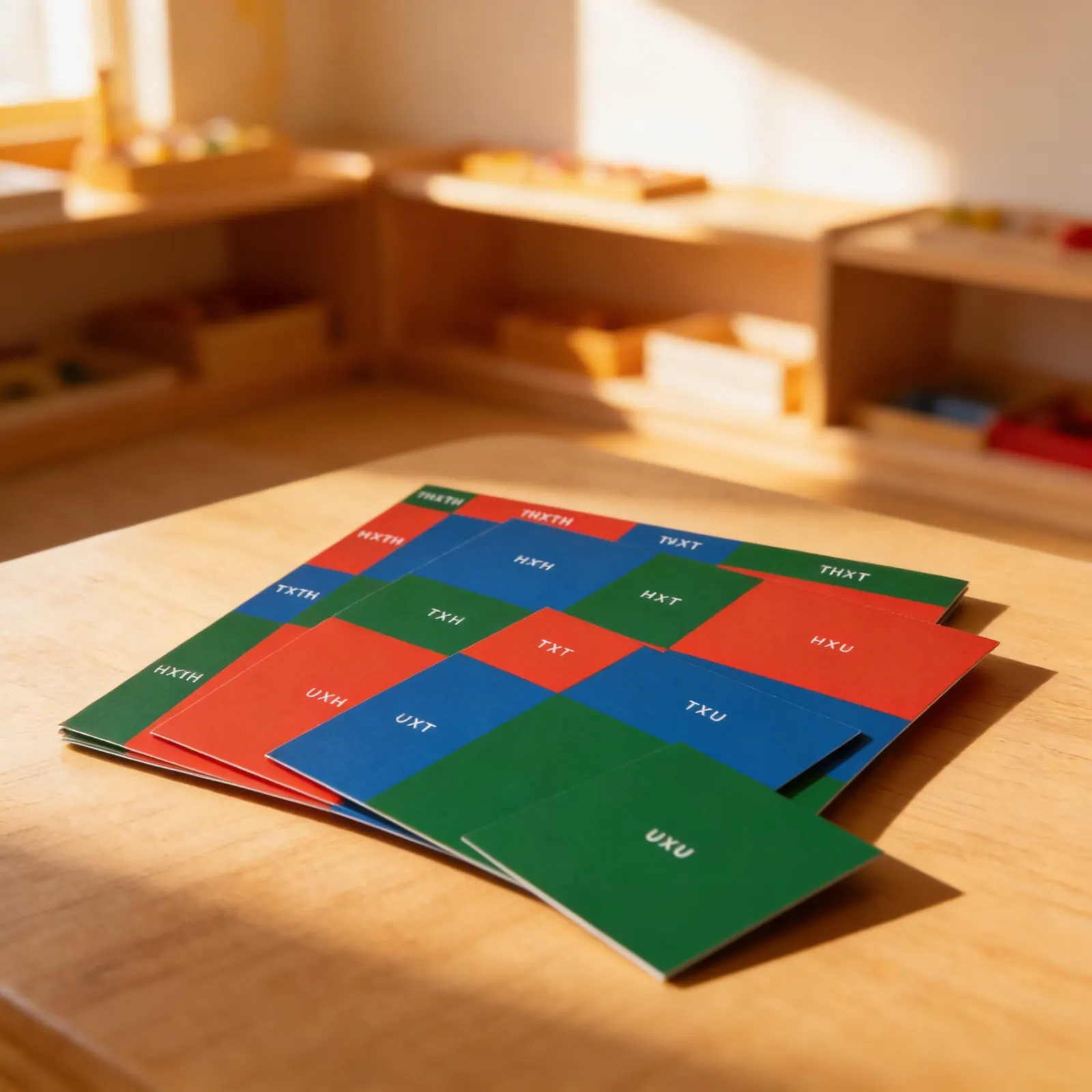
Patterns For Square Root in a child's hands
This innovative Patterns for Square Root material helps children visualize and understand the algebraic components of square root calculations through color-coded rectangular sections. The large board features algebraic expressions (T×H, H×U) arranged in a square formation, allowing students to physically manipulate and comprehend the mathematical relationships underlying square root operations in advanced Montessori mathematics work.
Abstract Mathematical Thinking
Bridges concrete manipulation to abstract algebraic concepts through visual representation of square root components.
Pattern Recognition
Color-coding helps children identify mathematical patterns and relationships in complex calculations.
Algebraic Reasoning
Introduction to algebraic notation (T×H, H×U) prepares students for advanced mathematical concepts.
Problem-Solving Skills
Systematic approach to square root calculations develops logical thinking and mathematical precision.
How to present it
Place the Patterns for Square Root board on a mat. Arrange the color-coded rectangular sections nearby, sorted by their algebraic labels (T×H, H×U). Have paper and pencil ready for recording discoveries.
- 1Begin with a perfect square number like 144. Use the rectangular sections to build a square on the board, starting with the largest pieces
- 2Identify the algebraic components: T×T (tens squared), T×H (tens × units), H×U (units × units)
- 3Rearrange the sections to form a square, noting how (10+2)² equals the sum of all components
- 4Work backwards from the square formation to find the square root
- 5Record the algebraic expression and its geometric representation on paper
3 tips for parents
- Your child's work with this board may look like play, but they're discovering profound algebraic relationships
- Avoid rushing to numerical calculations - the geometric understanding must come first
- When your child shares discoveries, ask 'How did you figure that out?' rather than confirming right/wrong

If you are not sure it suits your child, we answer in person.
Norbert Kovalčín, founder of Faborino · write to him
There is no review here yet. We will ask you for one after you buy. Write the first review
What's in the Box
- Pattern Board: Large square with color-coded algebraic sections
- Green Square Tiles: For completing square root calculations
Size and material
| Packaging | 25 × 25 × 1 cm |
| Primary Material | Laminated cardboard |
| Surface | Paper with protective lamination |
| Recommended Age | 6-12 years |
Care
Wipe with slightly damp cloth, avoid excess moisture
Frequently Asked Questions
What age is the Patterns for Square Root material designed for?
This material is designed for children ages 6-12 who have already mastered basic mathematical operations and are ready for advanced work with square roots and algebraic thinking in the Montessori mathematics curriculum.
How does this material help children understand square roots?
The color-coded rectangular sections and algebraic expressions (T×H, H×U) allow children to physically manipulate pieces to visualize the mathematical relationships in square root calculations, making abstract algebraic concepts concrete and comprehensible.
What prerequisites should a child have before using this material?
Children should have experience with multiplication, division, basic squaring concepts, and ideally some familiarity with the Montessori bead materials and peg board for square root before progressing to this algebraic representation.
What does the T×H and H×U notation represent?
These algebraic expressions represent Tens × Hundreds and Hundreds × Units, showing how numbers break down into place value components when calculating square roots, helping children understand the systematic process of finding square roots of larger numbers.
How does this material differ from traditional square root teaching methods?
Unlike abstract numerical approaches, this Montessori material provides a visual, hands-on way to understand the algebraic process of square root calculation through physical manipulation of color-coded sections, making the mathematical relationships tangible and memorable.
Product safety
Manufacturer: Nienhuis Montessori, Anders Celsiusstraat 15, 7442 PB Nijverdal, Netherlands
Patterns For Square Root