
Phonetic Flash Cards
The first photo is the maker's own. The other shots are illustrative.
Inv. no. NIE-563300
- Maker
- Nienhuis Montessori, since 1929
- Approval
- AMI
- Card Material
- Laminated cardstock
- Finish
- Glossy protective lamination
- EAN
- 8719924030025
Final price incl. VAT. Delivery €5.90, €91.10 to go for free delivery.
Advice, warranty and returns are handled by us.
Why it costs €57.90
Behind the price of the original are things you can check yourself.
AMI approval
The material is approved by the Association Montessori Internationale (AMI). Nienhuis has made Montessori materials since 1929.
A verifiable original
The EAN 8719924030025 is on the box. It is the maker's number, not ours.
Phonetic Flash Cards in a child's hands
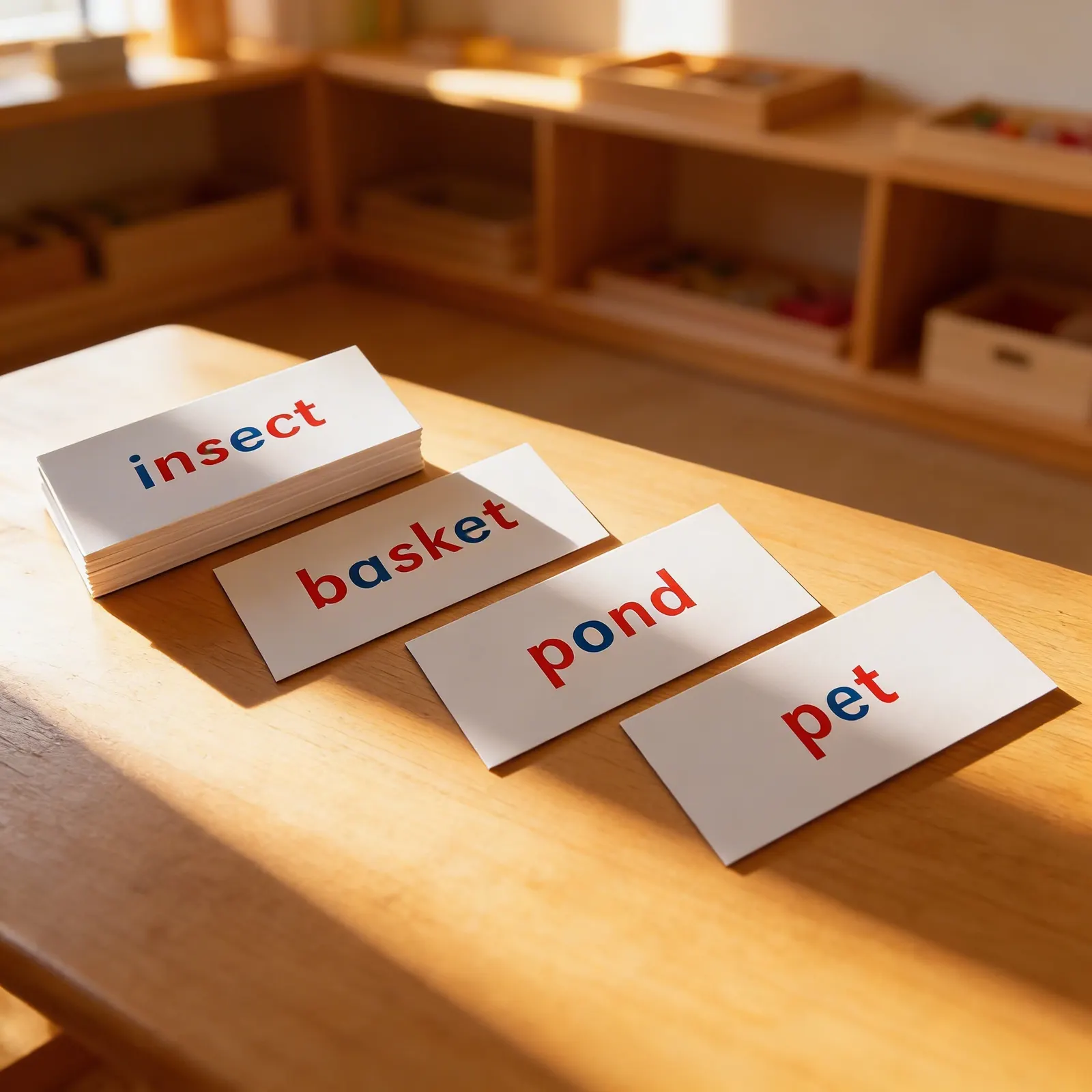
Supporting literacy development, these Phonetic Flash Cards support early reading development through color-coded letter recognition, following Montessori language principles. The laminated cardstock cards feature clear sans-serif typography with strategic color coding to distinguish vowels and consonants, helping children decode phonetic patterns. Each durable card provides tactile and visual input for building fundamental reading skills.
Phonemic Awareness
Color coding helps children identify and distinguish vowel and consonant sounds, building essential pre-reading skills.
Visual Discrimination
Clear typography and consistent formatting develop visual tracking and letter recognition abilities.
Reading Preparation
Systematic presentation of phonetic elements supports the transition from sandpaper letters to reading.
Independent Learning
Self-correcting color system allows children to work autonomously with phonetic patterns.
How to present it
Arrange phonetic cards in a basket on a low shelf. Select 5-6 cards with sounds the child knows from sandpaper letter work. Place cards face-down on a mat.
- 1Turn over one card and clearly pronounce its phonetic sound (not letter name)
- 2Invite the child to trace the letter while repeating the sound
- 3Once familiar with individual sounds, select 3 cards to build a CVC word
- 4Sound out each card slowly, then blend sounds together
3 tips for parents
- Practice pure phonetic sounds at home, avoid adding 'uh' to consonants
- Point out initial sounds in everyday objects using the same phonetic approach
- Create simple games like phonetic sound hunts around the house

If you are not sure it suits your child, we answer in person.
Norbert Kovalčín, founder of Faborino · write to him
There is no review here yet. We will ask you for one after you buy. Write the first review
What's in the Box
- Phonetic Flash Cards: Approx. 4 color-coded letter cards
Size and material
| Packaging | 16 × 9 × 3 cm |
| Card Material | Laminated cardstock |
| Finish | Glossy protective lamination |
| Recommended Age | 3-6 years |
Care
Wipe with damp cloth, dry immediately
Frequently Asked Questions
What makes these flash cards specifically Montessori-aligned?
These cards follow Montessori language principles by using color coding (typically blue for vowels, red for consonants), clear sans-serif fonts, and presenting letters in lowercase first. They support the phonetic approach to reading, where children learn letter sounds before names, matching the Montessori method of teaching reading through phonetic awareness.
How does the color coding system help children learn to read?
The strategic color coding helps children visually distinguish between vowels and consonants, making it easier to identify phonetic patterns and blend sounds. This visual differentiation supports pattern recognition and helps children understand the structure of words, accelerating their ability to decode new words independently.
What is the recommended progression for using these cards with 3-6 year olds?
Start with simple three-letter phonetic words (CVC pattern like 'cat'), introducing 3-4 cards at a time. Progress to words with consonant blends, then introduce silent 'e' patterns. For advanced learners, move to multi-syllable phonetic words. Always ensure the child knows the individual letter sounds before attempting to blend words.
How durable are the laminated cards for classroom use?
The laminated cardstock construction makes these cards highly durable for repeated handling by young children. They resist tears, spills, and bending, maintaining their quality through years of classroom use. The lamination also allows for easy cleaning with a damp cloth, ensuring hygiene in shared learning environments.
Can these cards be used alongside other Montessori language materials?
Yes, these cards complement sandpaper letters, moveable alphabet, and object boxes perfectly. Use them after sandpaper letters for reinforcement, alongside the moveable alphabet for word building practice, and with object boxes for vocabulary expansion. They serve as an excellent bridge between tactile letter learning and independent reading.
Product safety
Manufacturer: Nienhuis Montessori, Anders Celsiusstraat 15, 7442 PB Nijverdal, Netherlands
Phonetic Flash Cards