
Phonetic Reading Cards
The first photos are the maker's own. The other shots are illustrative.
Inv. no. NIE-563500
- Maker
- Nienhuis Montessori, since 1929
- Approval
- AMI
- Cards
- Cardstock
- EAN
- 8719924030049
Final price incl. VAT. Delivery €5.90, €93.10 to go for free delivery.
Advice, warranty and returns are handled by us.
Why it costs €55.90
Behind the price of the original are things you can check yourself.
AMI approval
The material is approved by the Association Montessori Internationale (AMI). Nienhuis has made Montessori materials since 1929.
A verifiable original
The EAN 8719924030049 is on the box. It is the maker's number, not ours.
Phonetic Reading Cards in a child's hands
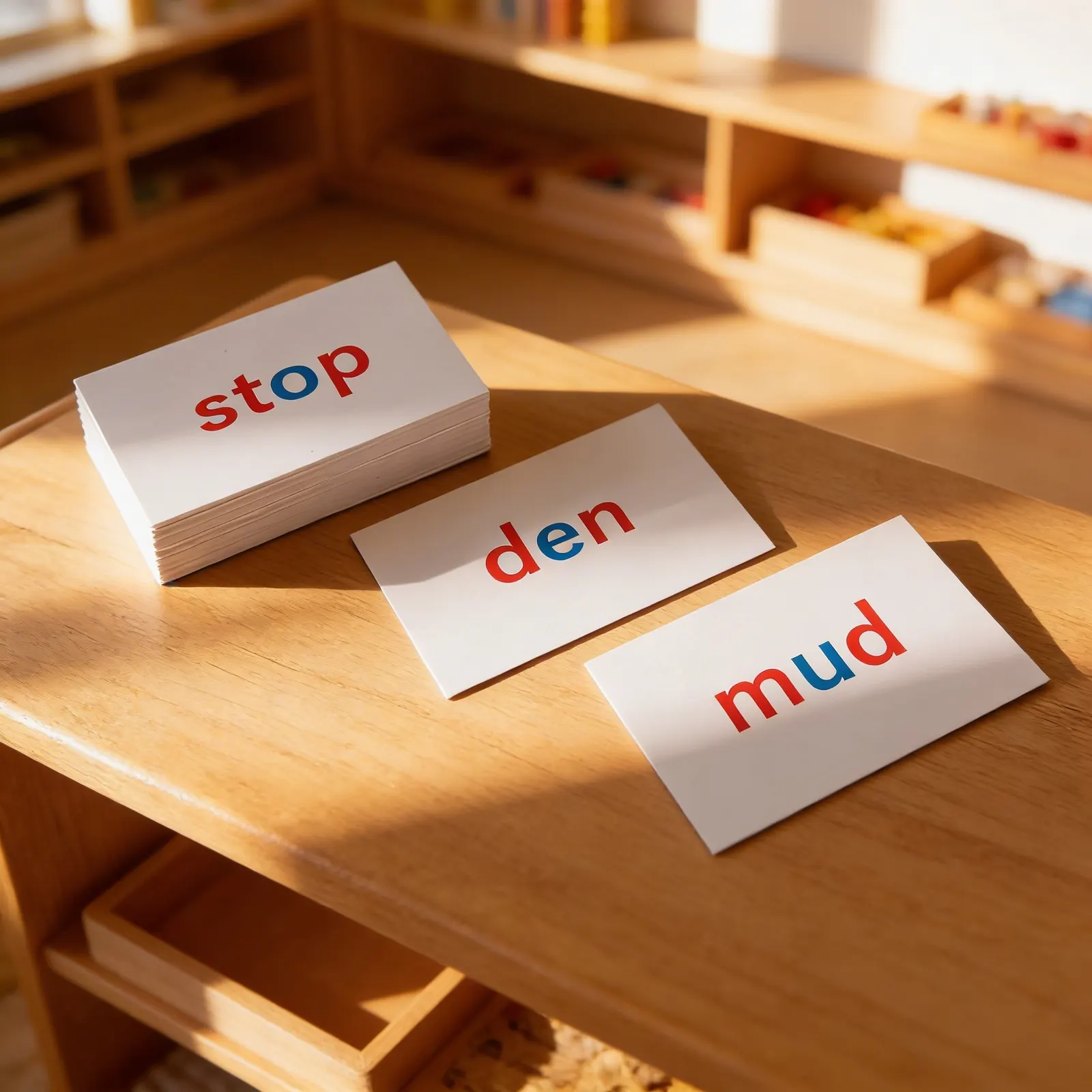
The Phonetic Reading Cards are a set of 85 cards for beginning phonetic reading. One phonetic word is printed on each card, isolated from any other text. The consonants are printed in red and the vowels in blue, so the two kinds of letters can be told apart at a glance. The child reads one card at a time, with nothing else beside the word, and the colouring is the same on every card. The cards are made of cardstock, and the pack measures 11 × 7 × 3 cm. For children aged 3 to 6.
Phonemic Awareness
Color-coding helps children isolate and blend individual sounds, building the foundation for reading fluency.
Visual Discrimination
Consistent color patterns train the eye to recognize vowel and consonant positions in words.
Independence
Self-correcting format enables children to practice reading skills without constant adult supervision.
How to present it
Arrange cards face-down in a basket. Select 5-6 cards featuring words the child can sound out based on their sandpaper letter knowledge. Place on a mat with ample space for laying out words.
- 1Present one card, pointing to each letter while slowly sounding out: 'c-a-t... cat'
- 2Invite the child to trace under each letter with their finger while repeating the sounds
- 3Have child select a new card and attempt sounding out independently
- 4Create groups of rhyming words using the cards (cat, bat, mat)
3 tips for parents
- Practice only 5-10 minutes daily to maintain enthusiasm and focus
- Celebrate effort in sounding out rather than speed of reading
- Create a 'word hunt' game finding CVC words in everyday environments

If you are not sure it suits your child, we answer in person.
Norbert Kovalčín, founder of Faborino · write to him
There is no review here yet. We will ask you for one after you buy. Write the first review
What's in the Box
- Phonetic Reading Cards: 85 cards, one phonetic word on each
- Color-coded format: consonants in red, vowels in blue
Size and material
| Packaging | 11 × 7 × 3 cm |
| Cards | Cardstock |
| Recommended Age | 3-6 years |
Frequently Asked Questions
How does the red and blue color-coding system help children learn to read?
On these cards the consonants are printed in red and the vowels in blue, which creates a visual distinction that helps children tell the two kinds of letters apart quickly. This reduces cognitive load during decoding, allowing children to focus on blending sounds rather than identifying letter categories, making the reading process more intuitive.
When should my child start using these cards, and what skills should they have first?
Children typically begin around age 4-4.5, after mastering individual letter sounds with sandpaper letters and demonstrating readiness through moveable alphabet work. They should recognize all lowercase letters, know their phonetic sounds (not letter names), and show interest in blending sounds together.
How many cards are included and how are they organized for progression?
The set contains 85 cards with one phonetic word on each card.
Can these cards be used at home or are they designed specifically for classroom use?
These cards can be used at home as well as in the classroom. Parents should present 3-5 words at a time, allowing children to sound out each letter before blending. Store completed words separately and review regularly, following the child's pace without pressure.
Product safety
Manufacturer: Nienhuis Montessori, Anders Celsiusstraat 15, 7442 PB Nijverdal, Netherlands
Phonetic Reading Cards