
Plant CellParts in 3D Illustrations
The first photo is the maker's own. The other shots are illustrative.
Inv. no. NIE-ELC4015
- Maker
- Nienhuis Montessori, since 1929
- Construction
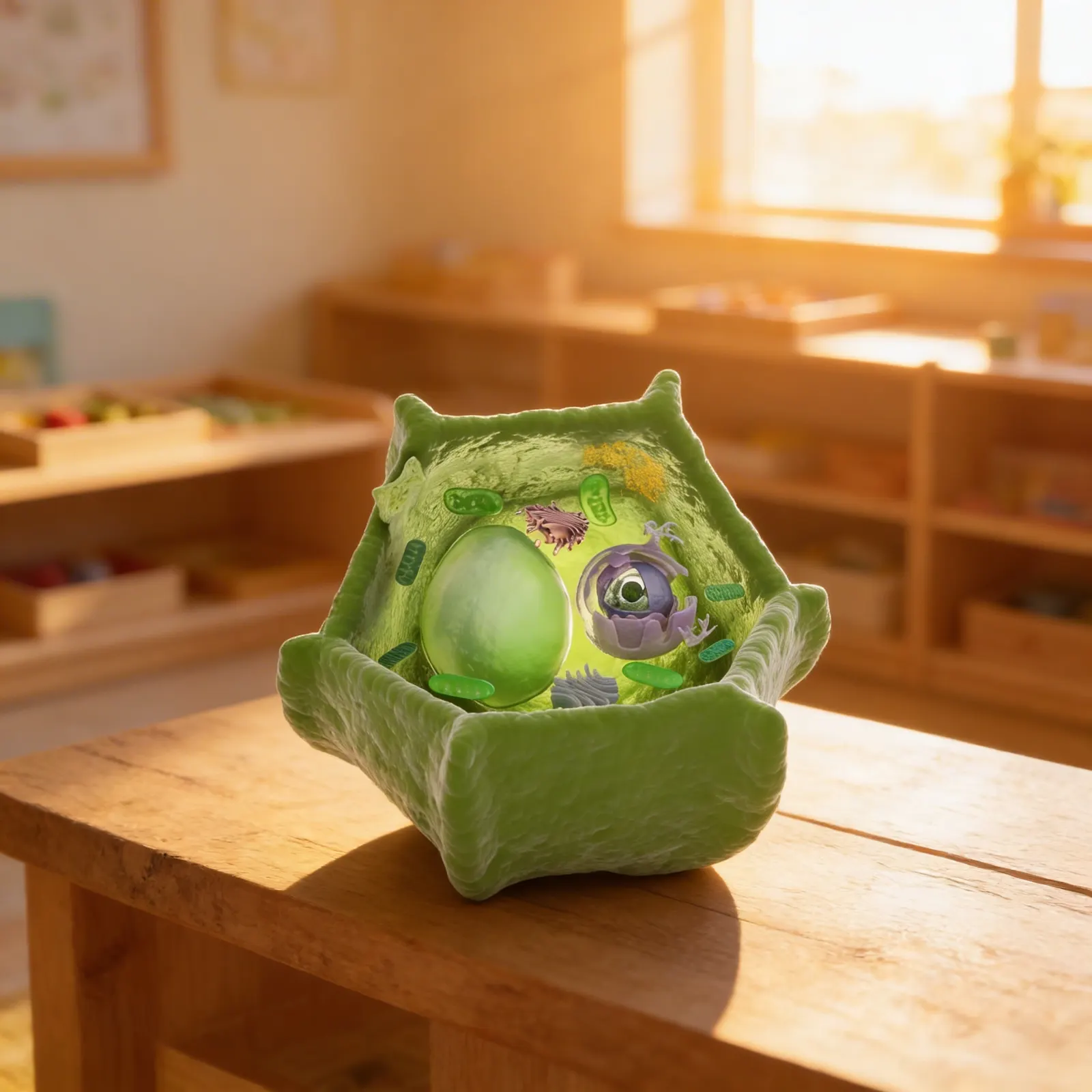
- Soft foam with plastic organelle details
- Surface
- Textured fabric covering
- EAN
- 8719924043988
Final price incl. VAT.
This material is no longer made
The manufacturer has withdrawn it, so we cannot order it in. The page stays here because the material itself is still worth knowing about.
Would you buy it if we could source it or make it ourselves? Enough people saying yes is what makes the attempt worth it.
Plant Cell in a child's hands
The plant cell in three dimensional illustrations, with each part named. Set beside the animal cell it does something neither does alone: the parts that appear in both and the parts that appear in only one are the whole argument for why plants and animals are different kingdoms, and a child can see that by laying the two sets side by side. Cards rather than a model. Durable plastic with rounded corners. In English. The animal cell set is a separate item.
Scientific Understanding
Introduces fundamental concepts of plant biology and cellular structure through concrete, manipulable materials.
Vocabulary Development
Builds scientific vocabulary as children learn names and functions of organelles like vacuole, nucleus, and chloroplasts.
Sensorial Learning
Soft foam construction provides safe tactile exploration while the large scale makes abstract concepts concrete.
Visual Discrimination
Develops ability to identify and differentiate cellular components through color and shape recognition.
How to present it
Place the Plant Cell model on a tray with a magnifying glass and simple nomenclature cards showing cell parts. Set on a low shelf at child's eye level.
- 1Invite the child to carry the tray to their mat and examine the model freely
- 2Point to the outer boundary and say 'cell wall,' tracing it with your finger
- 3Open the cutaway section to reveal internal structures, naming each as you touch it
- 4Offer the child a turn to find and name each part
- 5Match nomenclature cards to corresponding organelles on the model
3 tips for parents
- When preparing salad together, mention that lettuce leaves are made of plant cells like the model
- Support vocabulary development by using scientific terms naturally: 'The chloroplasts make leaves green'
- Visit a garden center to observe different plant types while discussing their cellular similarities

If you are not sure it suits your child, we answer in person.
Norbert Kovalčín, founder of Faborino · write to him
There is no review here yet. We will ask you for one after you buy. Write the first review
What's in the Box
- Plant Cell Model: 3D cutaway model with removable section
Size and material
| Packaging | 28 × 22 × 2 cm |
| Construction | Soft foam with plastic organelle details |
| Surface | Textured fabric covering |
| Recommended Age | 6-12 years |
Care
Wipe with damp cloth, air dry completely
Frequently Asked Questions
Is this plant cell model appropriate for 3-6 year olds?
Yes, the soft foam construction and large size (20×15×20 cm) make it safe and easy for young children to handle. The tactile design allows concrete exploration of abstract concepts, perfect for the Montessori approach to early science education.
What organelles are visible in this model?
The cutaway design reveals key plant cell structures including the central vacuole, nucleus with nucleolus, and multiple chloroplasts. These prominently featured organelles help children identify the main components that make plant cells unique.
How durable is the foam material for classroom use?
The soft foam construction is designed for repeated handling by young children. It's lightweight yet sturdy enough for daily classroom exploration, though gentle care is recommended to preserve the detailed organelle features.
Can children see inside the cell without taking it apart?
Yes, the cutaway design allows children to view the internal structure without disassembly. One side is open, revealing the 3D arrangement of organelles while keeping the model intact for easy handling and storage.
How does this support early biology learning?
This hands-on model introduces fundamental biology concepts through sensorial exploration. Children can feel, examine, and discuss cell structures, building vocabulary and understanding of living things while developing their scientific observation skills.
Product safety
Manufacturer: Nienhuis Montessori, Anders Celsiusstraat 15, 7442 PB Nijverdal, Netherlands
Plant Cell