
Plant Cell Nomenclature Cards
The first photo is the maker's own. The other shots are illustrative.
Inv. no. NIE-020801
- Maker
- Nienhuis Montessori, since 1929
- Approval
- AMI
- Cards
- Premium cardstock with protective coating
- Storage Box
- Natural wood with dividers
- EAN
- 8719924055196
Final price incl. VAT. Delivery €5.90, €82.10 to go for free delivery.
Advice, warranty and returns are handled by us.
Why it costs €66.90
Behind the price of the original are things you can check yourself.
AMI approval
The material is approved by the Association Montessori Internationale (AMI). Nienhuis has made Montessori materials since 1929.
A verifiable original
The EAN 8719924055196 is on the box. It is the maker's number, not ours.
Plant Cell Nomenclature Cards in a child's hands
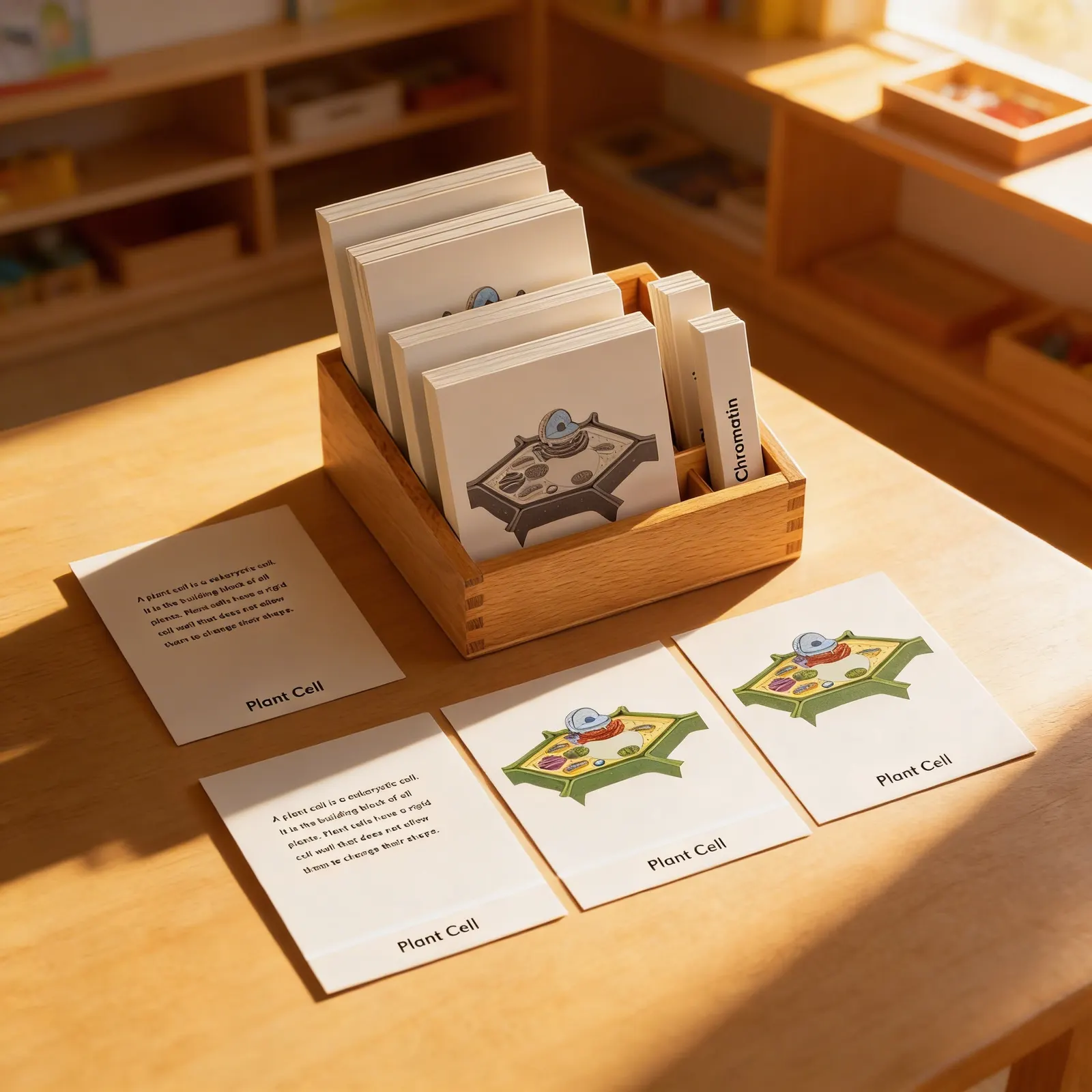
Connecting children to the living world, these Plant Cell Nomenclature Cards provide a systematic introduction to cellular biology through beautifully illustrated diagrams with color-coded components. Each card features clear labeling of plant cell structures, supporting the child's development of scientific vocabulary and understanding of living organisms. The wooden storage box with dividers ensures organized presentation and careful handling of this essential biology material.
Scientific Vocabulary
Introduces precise terminology for plant cell structures, building a foundation for future biology studies.
Visual Discrimination
Color-coded components help children identify and differentiate between cellular structures.
Classification Skills
Matching and sorting activities develop the child's ability to categorize and organize information.
Reading Preparation
Label reading and matching supports emerging literacy skills through meaningful context.
How to present it
Remove cards from wooden storage box and arrange on a neutral mat. Separate picture cards from label cards if using three-part format. Have a real plant specimen nearby for connection to concrete experience.
- 1Begin with the whole plant cell card, allowing the child to observe all components together
- 2Introduce one cellular structure at a time, starting with the most visible like chloroplasts
- 3Match picture cards with corresponding labels, pronouncing each term clearly
- 4Compare different organelles using the color coding to highlight distinctions
- 5Create a complete plant cell layout using all component cards together
3 tips for parents
- Look for cellular structures in everyday experiences, like the stringy cellulose in celery
- Support vocabulary development by using scientific terms during plant observations
- Visit botanical gardens or science museums with microscope exhibits to reinforce learning

If you are not sure it suits your child, we answer in person.
Norbert Kovalčín, founder of Faborino · write to him
There is no review here yet. We will ask you for one after you buy. Write the first review
What's in the Box
- Nomenclature Cards: Complete set showing plant cell components
- Wooden Storage Box: With dividers for organized storage
- Control Cards: For self-correction and matching activities
Size and material
| Packaging | 17 × 17 × 12 cm |
| Cards | Premium cardstock with protective coating |
| Storage Box | Natural wood with dividers |
| Recommended Age | 6-12 years |
Care
Wipe cards with slightly damp cloth; clean box with dry cloth
Frequently Asked Questions
How can 3-6 year olds understand plant cell structures?
The cards present simplified, color-coded diagrams focusing on basic components like cell wall, nucleus, and chloroplasts. Children absorb the vocabulary and visual patterns through repetition and matching activities, building foundational knowledge for later detailed study.
What plant cell parts are included in this set?
The cards typically feature essential structures including cell wall, cell membrane, nucleus, chloroplasts, vacuole, cytoplasm, and mitochondria. Each component is distinctly colored and clearly labeled for easy identification.
How do these cards differ from regular flashcards?
Montessori nomenclature cards follow a three-part format: picture with label, picture without label, and label only. This allows for multiple learning activities including matching, memory work, and reading practice, progressing from concrete to abstract understanding.
What activities can children do with these cards?
Children can match labeled to unlabeled cards, create three-part layouts, use cards for vocabulary lessons, trace or copy labels, compare with real microscope images, and create their own plant cell drawings using the cards as reference.
Why introduce cellular biology at such a young age?
Early exposure to scientific concepts builds vocabulary, satisfies children's natural curiosity about living things, and creates mental frameworks for understanding life processes. The visual and tactile nature of the cards makes abstract concepts accessible to young learners.
Product safety
Manufacturer: Nienhuis Montessori, Anders Celsiusstraat 15, 7442 PB Nijverdal, Netherlands
Plant Cell Nomenclature Cards