
Plant Physiology: 18 Impressionistic Charts
Made by Nienhuis Montessori · shipped by Heutink International (Netherlands) About the maker
Plant physiology in eighteen impressionistic charts, covering the internal workings of a plant: what moves through it, what it makes and how the parts do their jobs. Impressionistic means the chart is built to leave an image rather than a definition, which is how this age remembers anything at all. It is a set of charts, not a model, so it goes on a wall or a table rather than on a shelf. Durable plastic. Sold as one set.
“The child is both a hope and a promise for mankind.”
The Plant Physiology model perfectly embodies Montessori's emphasis on concrete learning experiences that prepare the mind for abstract concepts. By presenting a complete botanical specimen in transparent resin, this material honors the child's innate curiosity about the natural world while providing clear, unobstructed observation opportunities. The three-dimensional presentation allows children to examine plant structures from multiple angles, fostering the development of visual discrimination skills essential for scientific thinking.
- Develop visual discrimination skills through detailed observation of plant structures
- Build foundational botanical vocabulary including roots, trunk, branches, leaves, seeds
- Understand the concept of plant growth cycles and life processes
- Strengthen scientific thinking through systematic observation and comparison
Read More
This material reflects Montessori's belief that young children learn best through sensorial exploration of real objects rather than abstract representations. The inclusion of authentic seeds and fruits alongside the complete tree structure creates natural opportunities for classification, comparison, and understanding of botanical relationships. The crystal-clear encasement protects delicate specimens while maintaining their integrity for repeated examination, supporting the Montessori principle of materials that remain beautiful and functional over time. This model serves as a bridge between the child's immediate sensorial experience and future abstract botanical studies.
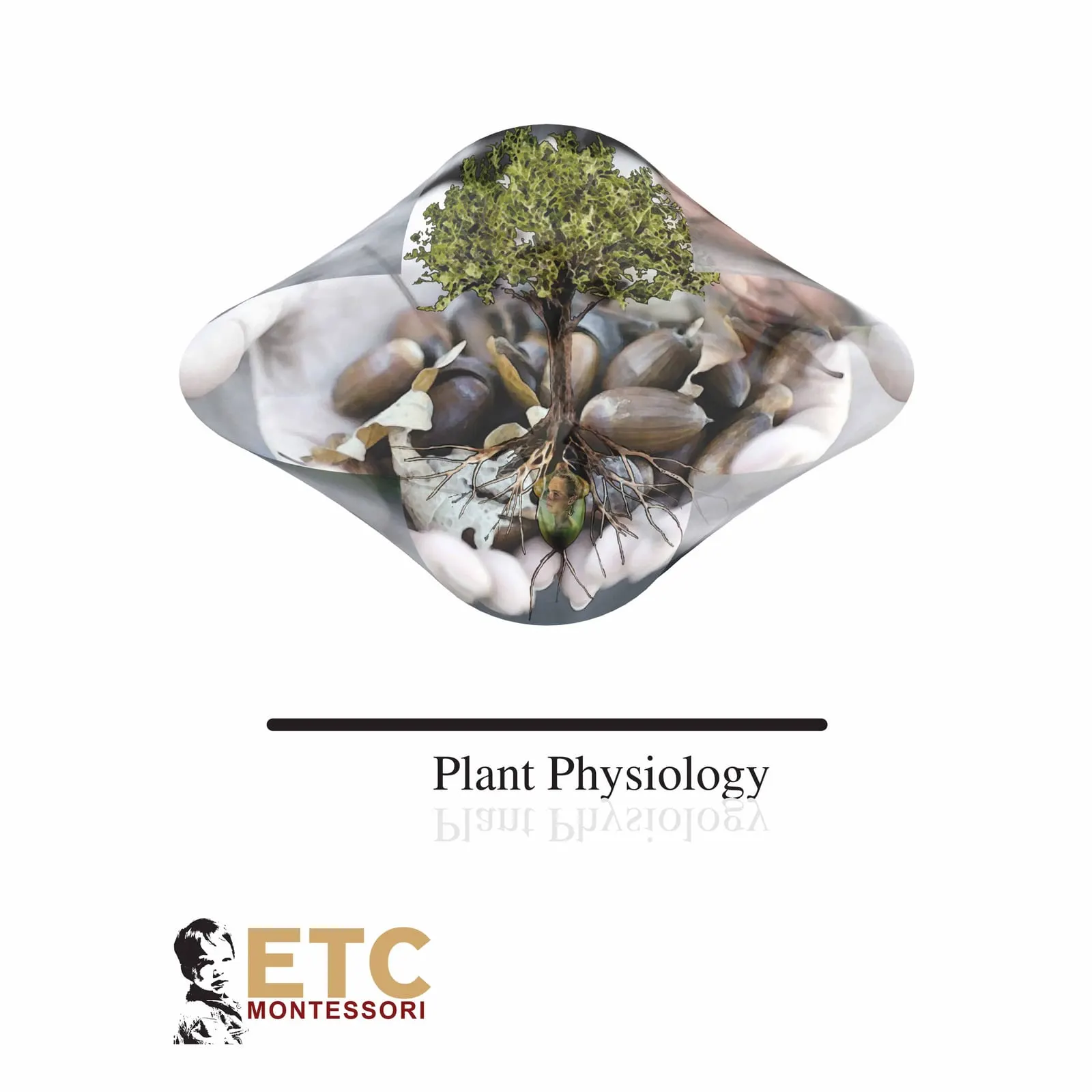
How to present it
Follow the Montessori method of presentation for optimal child development.
Place the Plant Physiology model on a low table or shelf at the child's eye level with good natural lighting. Ensure the workspace is uncluttered to maintain focus on the specimen.
- 1
Invite the child to carefully carry the model to their workspace, demonstrating proper handling with both hands
Model reverence for the material by moving slowly and speaking softly about the 'special tree inside' - 2
Begin observation at the base, pointing out the root system and discussing how roots help plants grow
Use simple, concrete language like 'These are the roots that drink water from the soil' - 3
Move upward to examine the trunk and branches, encouraging the child to trace these structures with their finger on the outside of the resin
Ask open-ended questions like 'What do you notice about how the branches get smaller?' - 4
Explore the seeds and fruits at the base, making connections between these specimens and the tree above
Allow plenty of time for independent discovery before offering additional information
Every Child Is a Little Creator

Heritage
Since 1929

In classrooms
Around the world

European brands
Nienhuis, GAM, Educo

Plant Physiology: 18 Impressionistic Charts
