
Plastic Bridge For The Snake Game
The first photo is the maker's own. The other shots are illustrative.
Inv. no. NIE-00900010
- Maker
- Nienhuis Montessori, since 1929
- Approval
- AMI
- Construction
- Molded plastic
- EAN
- 8719924005207
Final price incl. VAT. Delivery €5.90, €145.10 to go for free delivery.
Advice, warranty and returns are handled by us.
Why it costs €3.90
Behind the price of the original are things you can check yourself.
AMI approval
The material is approved by the Association Montessori Internationale (AMI). Nienhuis has made Montessori materials since 1929.
A verifiable original
The EAN 8719924005207 is on the box. It is the maker's number, not ours.
Plastic Bridge For The Snake Game in a child's hands
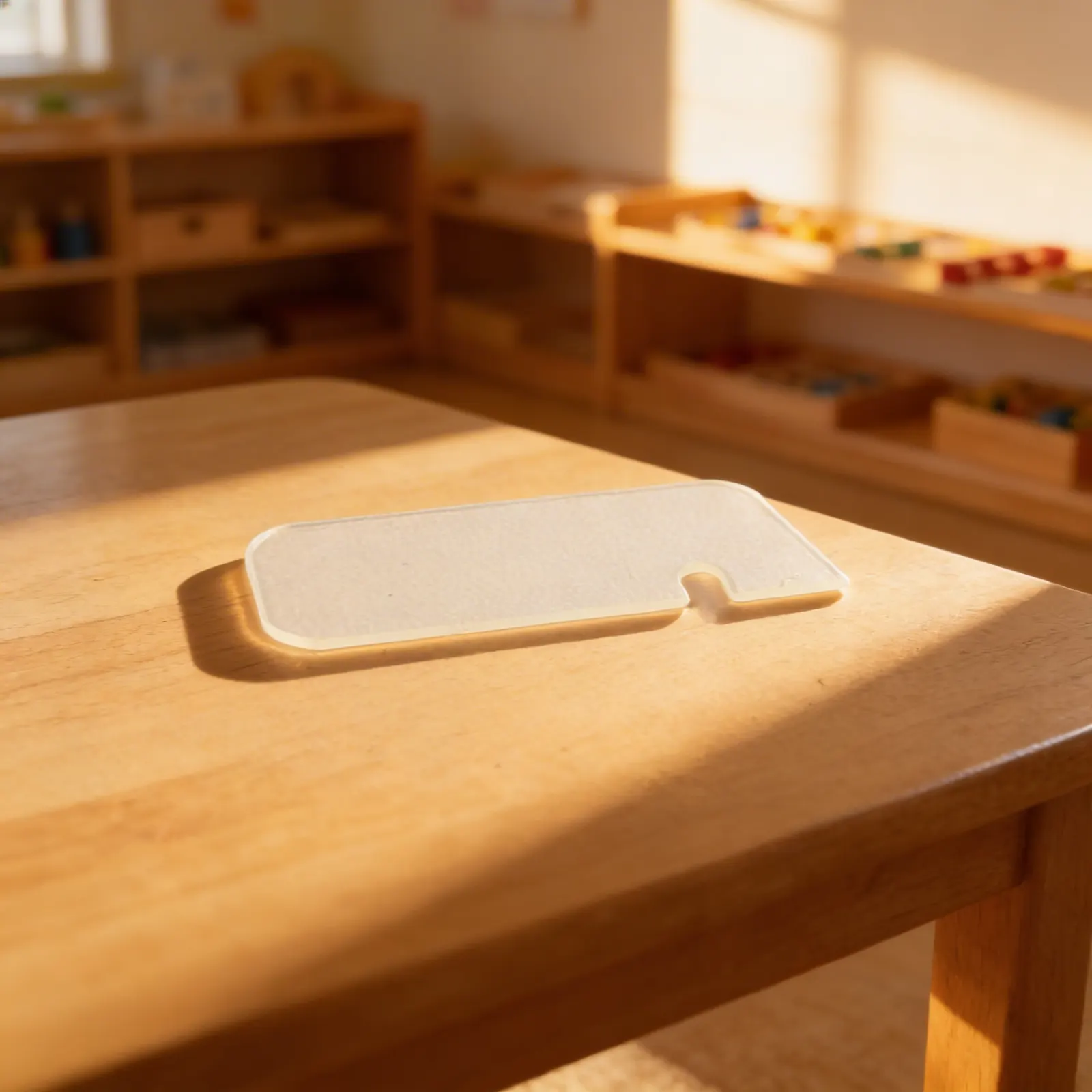
The plastic bridge for the snake game, sold on its own. In the snake game a child counts along a line of coloured bead bars and swaps each ten for a golden bar, and the bridge is what marks the place where a ten ended in the middle of a bar. Without it the count has to be held in the head, and holding a count in the head is exactly what this material was built to make unnecessary. The snake game and its beads are separate items.
Mathematical Understanding
Supports concrete manipulation of number concepts during Snake Game activities, helping children visualize mathematical operations.
Organization Skills
Teaches systematic arrangement of materials, promoting orderly thinking and procedural understanding.
Visual Discrimination
The bridge creates clear boundaries that help children distinguish between different stages of their mathematical work.
Fine Motor Control
Precise placement of bead bars over and around the bridge refines hand movements and coordination.
How to present it
Place the plastic bridge at the center of the work mat. Arrange colored bead bars (1-9) on the left side and golden ten bars with exchange beads on the right side.
- 1Begin with a simple addition snake using 5-6 colored bead bars laid end to end
- 2Count the first segment up to 10, then lift those bars over the bridge
- 3Replace the counted bars with one golden ten bar on the right side
- 4Continue counting and exchanging until the entire snake is converted
- 5Count the final result using tens and remaining units
3 tips for parents
- The bridge helps children see math as a physical process rather than abstract symbols
- Notice how your child uses the bridge to organize their mathematical thinking
- This simple tool builds the foundation for understanding place value in larger numbers

If you are not sure it suits your child, we answer in person.
Norbert Kovalčín, founder of Faborino · write to him
There is no review here yet. We will ask you for one after you buy. Write the first review
What's in the Box
- Plastic Bridge: Single molded piece
Size and material
| Packaging | 13 × 9 × 0 cm |
| Construction | Molded plastic |
| Recommended Age | 3-6 years |
Care
Wipe with damp cloth and mild soap
Frequently Asked Questions
What is the purpose of the plastic bridge in the Snake Game?
The plastic bridge serves as a visual and physical separator in the Montessori Snake Game, helping children organize bead bars during addition and subtraction exercises. It marks the transition point in mathematical operations, making it easier for children to see and understand number relationships.
Is this bridge compatible with all Montessori bead materials?
Yes, this bridge is designed to work with standard Montessori colored bead bars and golden bead bars used in the Snake Game. Its raised platform design accommodates the typical dimensions of Montessori math beads from various manufacturers.
How durable is this plastic bridge for classroom use?
The bridge is made from durable plastic specifically designed for repeated classroom use. It can withstand daily handling by young children and is easy to clean with a damp cloth, making it ideal for busy Montessori environments.
At what age should children start using the bridge in Snake Game activities?
Children typically begin using the Snake Game bridge around ages 4-5, once they have mastered basic counting and are ready for more complex addition work. However, some advanced 3-year-olds may be ready to use it with teacher guidance.
Can multiple bridges be used in one Snake Game exercise?
Yes, multiple bridges can be beneficial for longer mathematical operations or when working with larger numbers. Using several bridges helps children break down complex problems into manageable segments and better visualize the mathematical process.
Product safety
Manufacturer: Nienhuis Montessori, Anders Celsiusstraat 15, 7442 PB Nijverdal, Netherlands
Plastic Bridge For The Snake Game