
Power of Three Cube: Cubic Relationships & Exponential Growth
Made by Nienhuis Montessori · shipped by Heutink International (Netherlands) About the maker
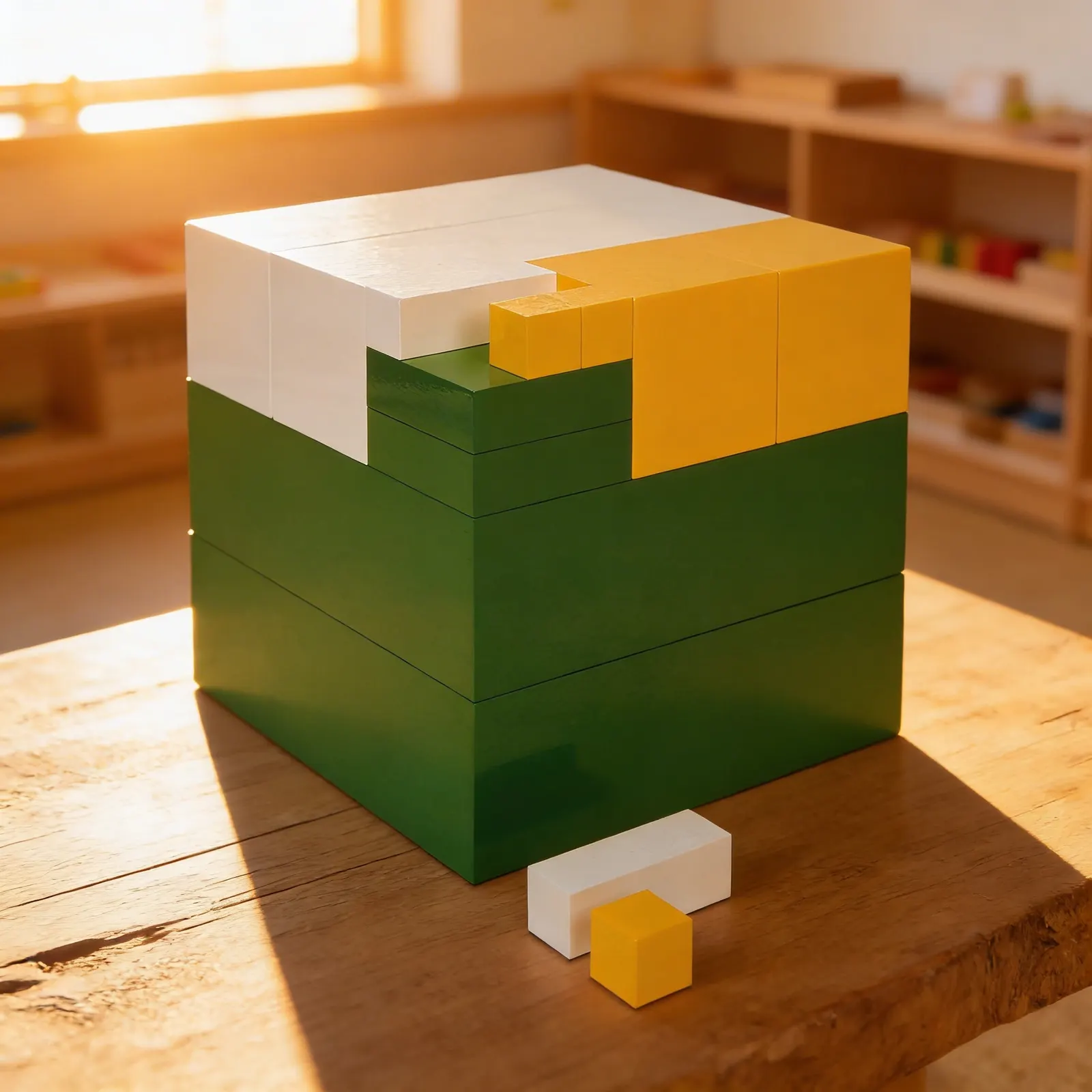
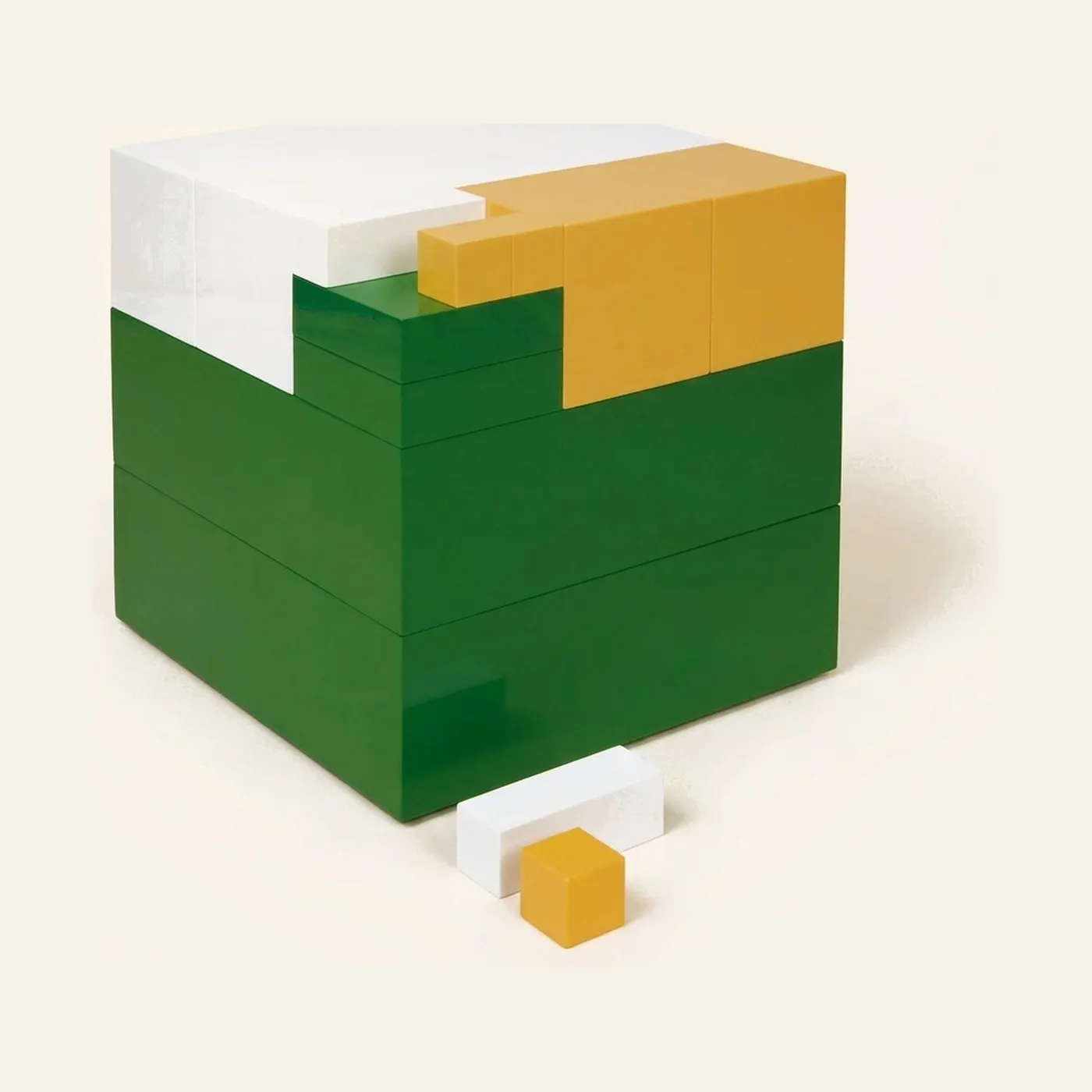
A cube that comes apart into its own component cubes and prisms, so the power of three stops being an exponent and becomes something a child can take to pieces on a mat and put back together. The pieces only reassemble one way, which means the material corrects the child rather than the adult doing it. Handling the parts is the groundwork for later algebra, where the same decomposition is written down instead of built. Hardwood with non toxic paint, for ages 6 to 12.
“The hands are the instruments of man's intelligence.”
The Power of Three Cube exemplifies Montessori's belief that mathematical concepts should be introduced through concrete, manipulable materials before abstract understanding.
- Understanding cubic relationships and exponential growth patterns
- Development of spatial reasoning and three-dimensional visualization skills
- Foundation building for algebraic thinking and mathematical formulas
- Enhancement of fine motor control through precise manipulation
Read More
This material honors the child's natural progression from concrete to abstract thinking by making the invisible concept of cubing numbers tangible and visually compelling. The self-correcting nature of the interlocking design allows children to work independently, fostering intrinsic motivation and confidence. Each cube's precise proportions and color-coding support the Montessori principle of isolation of difficulty, helping children focus on one mathematical relationship at a time. The material's beautiful craftsmanship reflects Montessori's emphasis on providing children with aesthetically pleasing tools that inspire respect and careful handling. By allowing children to physically construct and deconstruct cubic relationships, this material transforms abstract algebraic thinking into a sensorial experience, perfectly aligning with Montessori's understanding that the hand teaches the mind.
How to present it
Follow the Montessori method of presentation for optimal child development.
Place the Power of Three Cube on a neutral work mat in a quiet area. Ensure all pieces are organized by size and color. Have the child sit comfortably with easy access to all components.
- 1
Begin with the 1³ cube, inviting the child to hold and examine it, noting its perfect cube shape
Allow plenty of time for sensorial exploration before introducing mathematical concepts - 2
Introduce the 2³ cube, showing how it can be built using eight 1³ cubes arranged in a 2x2x2 pattern
Let the child discover the relationship through hands-on construction rather than verbal explanation - 3
Progress systematically through 3³, 4³, and 5³, having the child build each cube and observe the growing pattern
Use the color-coding to help children track their progress and maintain organization - 4
Challenge the child to predict what 6³ will look like before building it, encouraging mathematical reasoning
Celebrate discoveries and allow for multiple attempts without correction
Every Child Is a Little Creator

Heritage
Since 1929

In classrooms
Around the world

European brands
Nienhuis, GAM, Educo

AMI approved
To the association standard
Power of Three Cube: Cubic Relationships & Exponential Growth
