
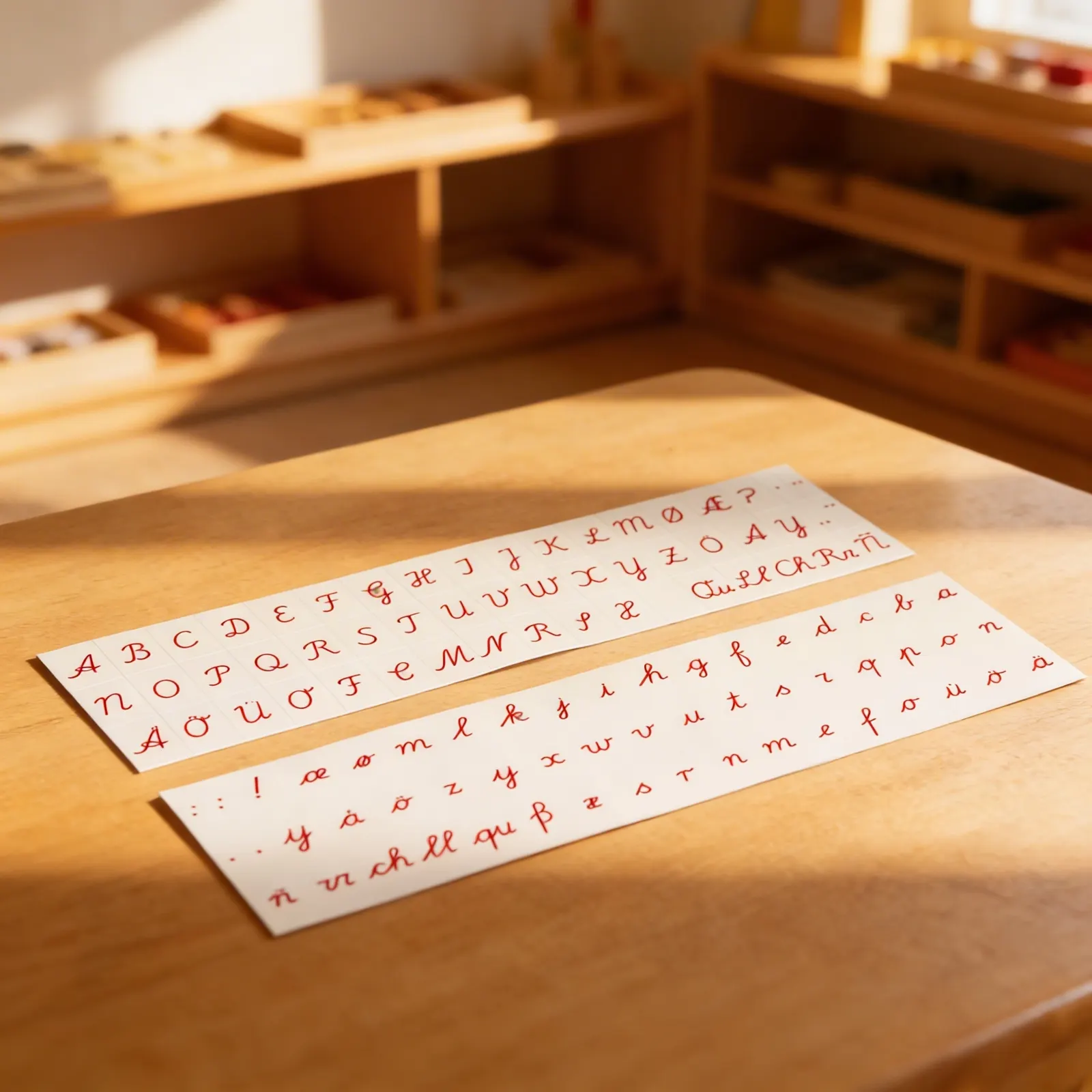
Printed AlphabetInternational Cursive - Red
The first photo is the maker's own. The other shots are illustrative.
Inv. no. NIE-0061X2
- Maker
- Nienhuis Montessori, since 1929
- Approval
- AMI
- Primary Material
- Cardstock
- Printing
- Red ink on white background
- EAN
- 8719924003920
Final price incl. VAT. Delivery €5.90, €84.10 to go for free delivery.
Advice, warranty and returns are handled by us.
Why it costs €64.90
Behind the price of the original are things you can check yourself.
AMI approval
The material is approved by the Association Montessori Internationale (AMI). Nienhuis has made Montessori materials since 1929.
A verifiable original
The EAN 8719924003920 is on the box. It is the maker's number, not ours.
Printed Alphabet in a child's hands
A full alphabet in red, twenty four of every letter, printed lower case on one side and upper case on the other. The two sides are the point: a child composing a sentence reaches the end, needs a capital at the front, and finds it by turning over the letter already in their hand rather than hunting through a second set. Capitalisation stops being a rule imposed afterwards and becomes part of laying the sentence out. Plastic, for ages 3 to 6.
Cursive Recognition
Builds visual familiarity with cursive letter forms before writing practice begins.
Letter-Sound Association
Supports phonetic learning by connecting cursive symbols to sounds.
Writing Preparation
Prepares the child's visual memory for cursive writing movements.
Sequencing Skills
Develops understanding of alphabetical order through card arrangement activities.
How to present it
Lay out 3-4 cursive letter cards on a mat, starting with letters from the child's name. Ensure good lighting and position cards at child's eye level when seated.
- 1Present one lowercase cursive card, tracing the letter shape with your finger while naming it
- 2Invite the child to trace the red cursive letter with their finger
- 3Play 'find the letter' games using objects that begin with presented letters
- 4Introduce the matching uppercase card once lowercase is recognized
- 5Create simple matching exercises pairing uppercase and lowercase cards
3 tips for parents
- Point out cursive letters in environmental print like restaurant signs or greeting cards
- Create letter hunts using the cards to find matching letters in books or magazines
- Practice air-writing the cursive forms together before attempting pencil work

If you are not sure it suits your child, we answer in person.
Norbert Kovalčín, founder of Faborino · write to him
There is no review here yet. We will ask you for one after you buy. Write the first review
What's in the Box
- Alphabet Cards: Approx. 26 cards with cursive letters
- Format: International cursive style in red
Size and material
| Packaging | 31 × 10 × 1 cm |
| Primary Material | Cardstock |
| Printing | Red ink on white background |
| Recommended Age | 3-6 years |
Care
Wipe with dry cloth; avoid moisture
Frequently Asked Questions
What is included in the International Cursive Printed Alphabet set?
The set includes cardstock cards featuring both lowercase and uppercase letters printed in red international cursive style on white backgrounds. Each letter is clearly displayed to support visual recognition and cursive letter formation learning.
How does this material support Montessori writing preparation?
Following Montessori principles, these cards allow children to visually study cursive letter shapes before attempting to write them. This visual recognition phase is crucial for developing muscle memory and understanding letter formation patterns without the pressure of perfecting pencil control.
What age group is this alphabet set designed for?
This material is designed for children ages 3-6 years, aligning with the sensitive period for writing preparation in Montessori education. Children typically begin visual letter recognition around age 3-4 before progressing to actual writing.
Why are the letters printed in red on white cardstock?
The high contrast of red letters on white background makes the letter shapes clearly visible and helps children focus on the formation details. Red is traditionally used in Montessori materials as it naturally draws the child's attention and aids in visual discrimination.
How can teachers and parents use these alphabet cards effectively?
Use the cards for letter recognition games, tracing activities with fingers, matching exercises, and as visual references during writing practice. They can be displayed at child height, used for three-period lessons, or incorporated into language activities like sound games and word building.
Product safety
Manufacturer: Nienhuis Montessori, Anders Celsiusstraat 15, 7442 PB Nijverdal, Netherlands
Printed Alphabet