
Printed Arrows100 / 1000 Bead Chains
The first photo is the maker's own. The other shots are illustrative.
Inv. no. NIE-0079B0
- Maker
- Nienhuis Montessori, since 1929
- Approval
- AMI
- Arrows
- Printed cardstock
- Storage
- Clear acrylic containers
- EAN
- 8719924004507
Final price incl. VAT. Delivery €5.90, €119.10 to go for free delivery.
Advice, warranty and returns are handled by us.
Why it costs €29.90
Behind the price of the original are things you can check yourself.
AMI approval
The material is approved by the Association Montessori Internationale (AMI). Nienhuis has made Montessori materials since 1929.
A verifiable original
The EAN 8719924004507 is on the box. It is the maker's number, not ours.
Printed Arrows in a child's hands
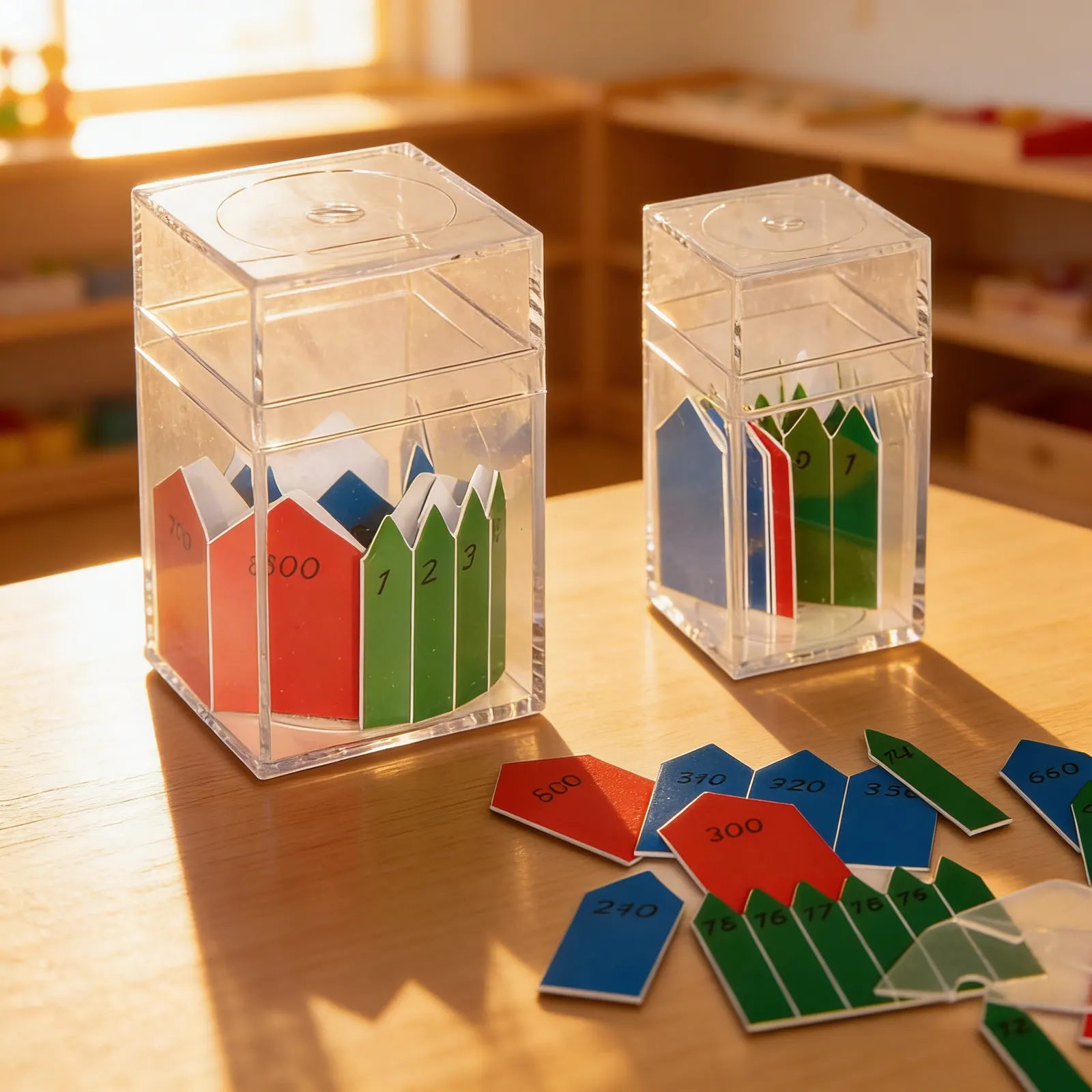
Two sets of colour coded plastic arrows for the hundred and thousand chains, with two plastic storage boxes. The long chains are counted on the floor across several metres, and an arrow left at each stopping point is the only record of how far the counting reached. Decimal system colours mean an arrow says which hierarchy it marks without being read. Two boxes keep the two chains' arrows from mixing, which they otherwise do within a week. Chains sold separately. Plastic, for ages 3 to 12.
Mathematical Patterns
Supports recognition of skip counting patterns and multiples through visual marking of bead chain segments.
Sequential Thinking
Develops understanding of number sequences and the relationship between units, tens, and hundreds.
Visual Organization
Color-coding system helps children categorize and identify different numerical values systematically.
Abstract Preparation
Bridges concrete bead chain work with abstract number concepts through labeled identification.
How to present it
Lay out the 100 bead chain on a long mat. Place the container of color-coded arrows beside the chain. Ensure adequate floor space for the full extension of the chain.
- 1Begin counting the 100 chain by tens, placing the corresponding arrow at each tenth bead
- 2Read each arrow number aloud as you place it: '10, 20, 30...'
- 3Count the entire chain by ones, verifying arrow placement at multiples of ten
- 4Repeat the process with the 1000 chain, placing arrows at every hundredth bead
3 tips for parents
- Practice skip counting during everyday activities like climbing stairs or setting the table
- Point out number patterns on calendars, clocks, and measuring tools
- Celebrate when your child recognizes multiples of ten in house numbers or prices

If you are not sure it suits your child, we answer in person.
Norbert Kovalčín, founder of Faborino · write to him
There is no review here yet. We will ask you for one after you buy. Write the first review
What's in the Box
- 100 Chain Arrow Set: Color-coded labels for multiples
- 1000 Chain Arrow Set: Color-coded labels for multiples
- Storage Containers: Clear acrylic with lids
Size and material
| Packaging | 30 × 3 × 4 cm |
| Arrows | Printed cardstock |
| Storage | Clear acrylic containers |
| Recommended Age | 3-6 years |
Care
Wipe containers with damp cloth; handle arrows with care
Frequently Asked Questions
What is included with the Printed Arrows for 100/1000 bead chains?
The set includes color-coded numbered arrow labels specifically designed for the 100 and 1000 bead chains, organized in clear acrylic containers. The arrows are printed with numbers marking each multiple for systematic skip counting exercises.
How do these arrows support mathematical learning?
The arrows help children visualize and mark multiples while skip counting, reinforcing number patterns and the decimal system structure. They provide concrete support for understanding linear counting sequences and prepare children for multiplication concepts.
Do I need to purchase the bead chains separately?
Yes, the 100 and 1000 bead chains are sold separately. These printed arrows are designed as support material to accompany the bead chain work and enhance the learning experience through visual marking of number sequences.
What age group benefits most from this material?
Children ages 3-6 typically work with this material, though it's most beneficial when the child has been introduced to linear counting and shows readiness for skip counting activities. The material grows with the child's mathematical understanding.
How are the arrows organized for classroom use?
The arrows are systematically arranged in clear acrylic containers, with separate compartments for different number sequences. This organization allows children to independently access the correct arrows and promotes orderly work habits while maintaining the prepared environment.
Product safety
Manufacturer: Nienhuis Montessori, Anders Celsiusstraat 15, 7442 PB Nijverdal, Netherlands
Printed Arrows