
Printed NumeralsInternational Version (Nienhuis)
The first photo is the maker's own. The other shots are illustrative.
Inv. no. NIE-003320
- Maker
- Nienhuis Montessori, since 1929
- Approval
- AMI
- Base Material
- Natural wood
- Numerals
- Red printed ink
- EAN
- 8719924001834
Final price incl. VAT. Delivery €5.90, €133.10 to go for free delivery.
Advice, warranty and returns are handled by us.
Why it costs €15.90
Behind the price of the original are things you can check yourself.
AMI approval
The material is approved by the Association Montessori Internationale (AMI). Nienhuis has made Montessori materials since 1929.
A verifiable original
The EAN 8719924001834 is on the box. It is the maker's number, not ours.
Printed Numerals in a child's hands
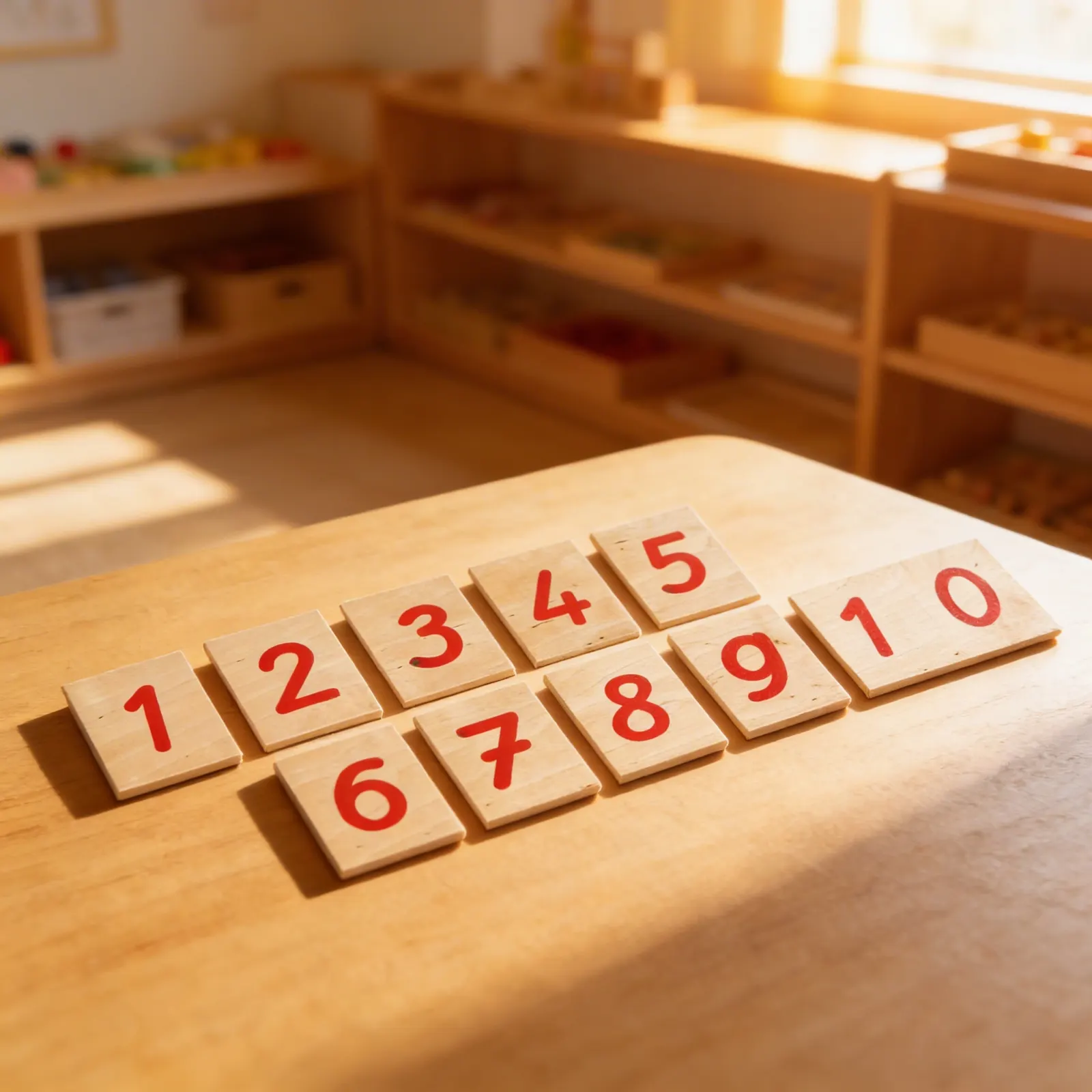
Wooden tablets with the numerals one to ten printed in red, used beside the Number Rods so that a quantity and its symbol arrive together. That pairing is the whole exercise: the child has already built and compared the rods, and this is the moment the written sign gets attached to something they can already feel the length of. This is the international version, and a US version of the same material is a separate item. The Number Rods are sold separately. Wood.
Number Recognition
Clear red numerals on contrasting wood background support visual discrimination and numeral identification from 1-10.
Mathematical Foundation
Manipulative tiles allow children to physically arrange numbers, building understanding of sequence, quantity, and numerical order.
Fine Motor Development
Grasping and positioning the 5×5 cm tiles refines pincer grip and hand-eye coordination essential for writing preparation.
Abstract to Concrete Learning
Physical tiles bridge the gap between concrete counting materials and abstract written numerals.
How to present it
Place the wooden numeral tiles in a basket on a tray. Choose a work mat in a quiet area with good lighting. Initially present only numerals 1-3, gradually introducing more as the child gains confidence.
- 1Introduce three tiles (1, 2, 3) using the three-period lesson. Place tile 1 on the mat: 'This is one.' Trace the numeral with two fingers
- 2Mix the three tiles and ask the child to identify: 'Can you show me two?' Allow the child to point or hand you the tile
- 3Point to each tile randomly and ask: 'What is this?' Wait for the child to name each numeral
- 4Once 1-3 are mastered, introduce 4-6, then 7-9, and finally 0, following the same three-period process
- 5Create games: arrange tiles in sequence, match to quantity cards, or play 'find the missing number'
3 tips for parents
- Point out numerals in daily life, house numbers, clock faces, price tags, connecting to the wooden tiles at school
- Avoid drilling or testing; instead, play casual games like 'I spy the number 4' during walks
- Support school work by using similar clear, simple numerals when writing numbers at home

If you are not sure it suits your child, we answer in person.
Norbert Kovalčín, founder of Faborino · write to him
There is no review here yet. We will ask you for one after you buy. Write the first review
What's in the Box
- Wooden number tiles: 10 pieces numbered 1-10
Size and material
| Packaging | 10 × 7 × 3 cm |
| Base Material | Natural wood |
| Numerals | Red printed ink |
| Finish | Smooth sanded surface |
| Recommended Age | 3-6 years |
Care
Wipe with slightly damp cloth, dry immediately
Frequently Asked Questions
What numbers are included in the Printed Numerals set?
The set typically includes numerals 0-9, with some sets offering additional tiles for numbers 10-20 or multiple sets of 0-9 for expanded activities. Each numeral is clearly printed in red on smooth wooden tiles.
How do these numerals support early math development?
These tiles help children recognize written numbers, understand number sequences, practice counting, and begin associating quantities with symbols. They're essential for matching activities, number ordering, and introducing basic arithmetic concepts.
What size are the wooden numeral tiles?
Each tile measures 5×5 cm (approximately 2×2 inches), making them perfectly sized for small hands to grasp and manipulate easily while being large enough for clear visibility during lessons.
Can these be used with other Montessori math materials?
Yes, these numerals complement many Montessori materials including number rods, spindle boxes, cards and counters, and the golden bead material. They're versatile tools for labeling quantities and reinforcing number recognition.
What activities can children do with these numeral tiles?
Children can sequence numbers 0-9, match numerals to quantities, create teen and larger numbers, play memory games, practice number formation by tracing, and use them for simple addition and subtraction exercises.
Product safety
Manufacturer: Nienhuis Montessori, Anders Celsiusstraat 15, 7442 PB Nijverdal, Netherlands
Printed Numerals