
Problem SlipsSubtraction Working Charts
The first photo is the maker's own. The other shots are illustrative.
Inv. no. NIE-559534
- Maker
- Nienhuis Montessori, since 1929
- Approval
- AMI
- Storage Boxes
- Clear acrylic with lids
- Problem Cards
- Durable cardstock
- EAN
- 8719924029777
Final price incl. VAT. Delivery €5.90, €79.10 to go for free delivery.
Advice, warranty and returns are handled by us.
Why it costs €69.90
Behind the price of the original are things you can check yourself.
AMI approval
The material is approved by the Association Montessori Internationale (AMI). Nienhuis has made Montessori materials since 1929.
A verifiable original
The EAN 8719924029777 is on the box. It is the maker's number, not ours.
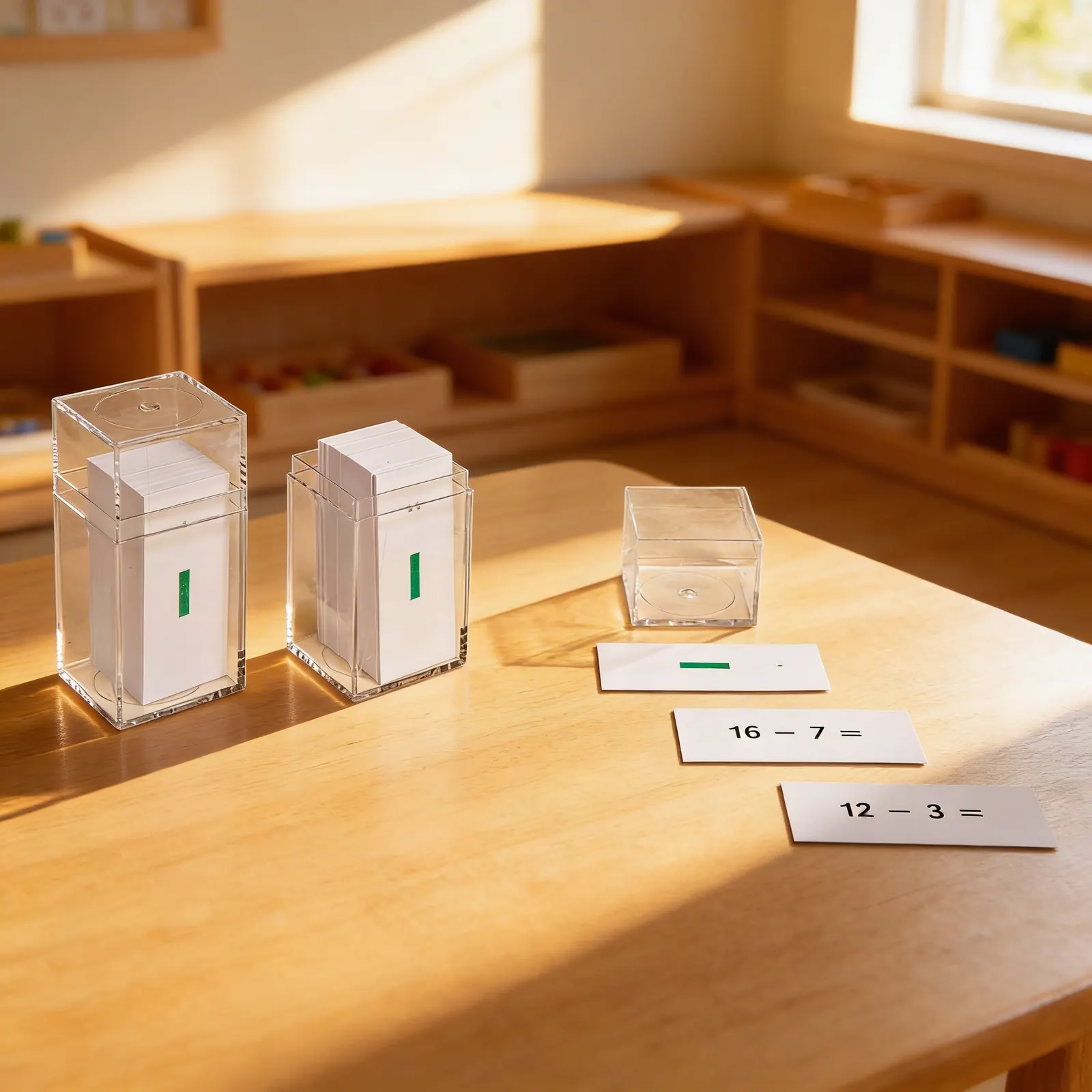
Problem Slips in a child's hands
Two sets of colour coded slips carrying the unit subtraction equations, one set for each of the two subtraction working charts, each in its own plastic box. A child working the charts needs a supply of problems, and a slip drawn at random is a different thing from a page worked top to bottom: there is no order to lean on, so each combination has to be known rather than remembered from its neighbour. Working charts sold separately. Acrylic and cardstock, for ages 3 to 12.
Mathematical Memory
Systematic practice helps children internalize subtraction facts through repetition and self-correction.
Abstract Thinking
Transitions children from concrete materials to abstract number relationships and mental calculation.
Independence
Clear organization allows children to select, work through, and return materials autonomously.
Sequential Learning
Green indicators guide progression through increasingly complex subtraction combinations.
How to present it
Place the two acrylic boxes containing problem slips on a table mat. Have the Subtraction Working Chart and corresponding answer tiles ready nearby. Ensure the workspace is organized with a small container for completed slips.
- 1Select the first problem slip from the box, noting the green line indicator
- 2Read the subtraction problem aloud, then solve using the working chart if needed
- 3Record or place the answer using tiles or writing materials
- 4Check the answer using the control chart before moving to the next slip
- 5Continue through the sequence, placing completed slips in the designated container
3 tips for parents
- Practice subtraction in daily life (8 cookies minus 3 eaten equals 5 left) to reinforce concepts
- Celebrate accuracy over speed, mathematical confidence develops through correct practice
- Create simple subtraction stories using your child's interests to make practice engaging

If you are not sure it suits your child, we answer in person.
Norbert Kovalčín, founder of Faborino · write to him
There is no review here yet. We will ask you for one after you buy. Write the first review
What's in the Box
- Acrylic Storage Boxes: 2 clear boxes with lids
- Subtraction Problem Cards: Complete set with green indicators
Size and material
| Packaging | 8 × 7 × 4 cm |
| Storage Boxes | Clear acrylic with lids |
| Problem Cards | Durable cardstock |
| Recommended Age | 4-6 years |
Care
Wipe boxes with damp cloth; keep cards dry
Frequently Asked Questions
What are the green line indicators on these problem slips?
The green line indicators are visual guides that help children understand where to place their fingers or markers when working through subtraction problems on the working charts. They provide a systematic approach to solving equations and help children develop proper mathematical habits.
How do these problem slips complement the Subtraction Working Charts?
These problem slips work in conjunction with Montessori Subtraction Working Charts (sold separately). Children select a slip, find the corresponding equation on their working chart, and use the chart to discover the answer, creating a hands-on, self-correcting learning experience.
What is the progression of difficulty in these problem slips?
The slips are organized systematically, starting with simple subtraction facts (like 9-1) and progressing to more complex equations. This gradual progression allows children to build confidence while mastering all subtraction combinations from 18-1 through 18-9.
How do the clear acrylic storage boxes support the learning process?
The two clear acrylic boxes keep the problem slips organized and visible, allowing children to independently select and return materials. This promotes order, responsibility, and helps children see their progress as they work through different sets of equations.
When should children begin using these subtraction problem slips?
Children typically begin using these problem slips after they have worked extensively with concrete subtraction materials like the subtraction strip board and have been introduced to the subtraction working charts. This usually occurs around ages 4.5-6, though readiness varies by child.
Product safety
Manufacturer: Nienhuis Montessori, Anders Celsiusstraat 15, 7442 PB Nijverdal, Netherlands
Problem Slips