
Puzzle MapSwitzerland
The first photo is the maker's own. The other shots are illustrative.
Inv. no. NIE-0175D0
- Maker
- Nienhuis Montessori, since 1929
- Approval
- AMI
- Primary Material
- Painted wood
- Base Material
- Wood composite
- EAN
- 8719924008208
€177.90
Final price incl. VAT. Free delivery.
✓ In Stock. Delivery in 5 to 9 working days.
1
30 daysto return
Advicebefore and after
Invoicefor companies
Advice, warranty and returns are handled by us.
The original
Why it costs €177.90
Behind the price of the original are things you can check yourself.
AMI approval
The material is approved by the Association Montessori Internationale (AMI). Nienhuis has made Montessori materials since 1929.
A verifiable original
The EAN 8719924008208 is on the box. It is the maker's number, not ours.
What the child does
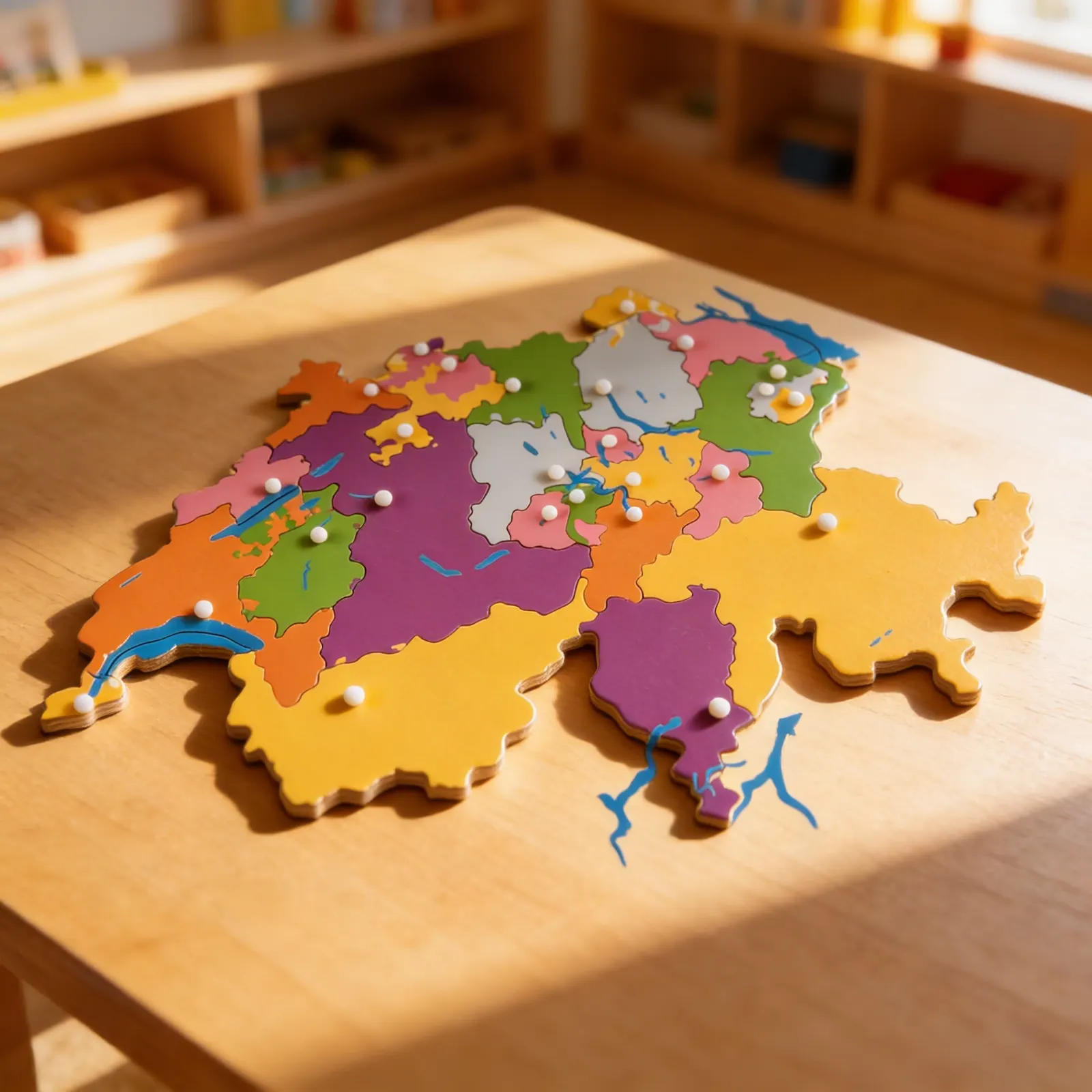
Puzzle Map in a child's hands
A hallmark of Montessori craftsmanship, this wooden puzzle map sparks curiosity about Switzerland's political geography through sensory investigation. Each canton is represented by a distinct colored puzzle piece with a knob handle, empowering children to build spatial awareness while learning about Swiss regional divisions. The map features Switzerland's characteristic shape with blue water features representing major lakes and neighboring boundaries.
Geographic Awareness
Children develop spatial understanding of Switzerland's political divisions and regional relationships through hands-on manipulation.
Fine Motor Control
Grasping knob handles and fitting pieces precisely strengthens pincer grip and hand-eye coordination.
Visual Discrimination
Matching shapes and distinguishing between different colored cantons enhances perceptual skills.
Cultural Understanding
Introduces concepts of political boundaries and regional diversity within a country.
Activity Guide
How to present it
Place the puzzle map on a work mat at the child's table. Have a small basket nearby for holding removed pieces. Ensure good lighting to distinguish canton colors clearly.
- 1Invite the child to remove one canton piece using the knob, starting with a larger, distinctively shaped canton
- 2Name the canton as you remove it, then place it beside the map frame
- 3Trace the empty space with your finger, then trace the puzzle piece's outline
- 4Carefully return the piece to its place, demonstrating how to align edges
- 5Continue with 2-3 more cantons, then invite the child to try
3 tips for parents
- Point out Swiss elements in daily life - chocolate packaging, watches, or cheese labels often show origin cantons
- Look at Switzerland on a globe or world map to show its location relative to your country
- Share photos or stories of Swiss landmarks, connecting them to specific cantons on the puzzle
From the same makerNienhuis
Accessories
Why it is in our selection
If you are not sure it suits your child, we answer in person.
Norbert Kovalčín, founder of Faborino · write to him
There is no review here yet. We will ask you for one after you buy. Write the first review
Details
What's in the Box
- Wooden puzzle base: 40×35×1 cm with canton outlines
- Canton puzzle pieces: Approx. 26 pieces with knob handles
Size and material
| Packaging | 62 × 50 × 3 cm |
| Primary Material | Painted wood |
| Base Material | Wood composite |
| Handles | Wooden knobs |
| Recommended Age | 3-6 years |
Care
| Cleaning | Wipe with slightly damp cloth, dry immediately |
| Storage | Store flat in dry area away from direct sunlight |
Frequently Asked Questions
What are the dimensions of the Switzerland puzzle map?
This premium wooden puzzle map typically measures approximately 50cm x 35cm, making it ideal for individual work on a table or floor mat. The substantial size allows children to clearly see and manipulate each canton piece while developing their understanding of Switzerland's geography.
How many pieces does this Switzerland puzzle contain?
The puzzle features 26 individual pieces, one for each Swiss canton. Each piece is uniquely shaped to represent its actual geographical boundaries and includes a small knob handle sized perfectly for young children's pincer grip development.
Is this puzzle suitable for children who don't speak German, French, or Italian?
Yes, this puzzle is ideal for all children regardless of language. The color-coded canton system allows children to match pieces visually, making it perfect for developing spatial awareness and geographic understanding through hands-on manipulation rather than language-based learning.
What skills does this Switzerland map puzzle develop?
This material develops multiple skills including fine motor control, spatial reasoning, visual discrimination, and geographic awareness. Children also practice problem-solving, develop cultural appreciation, and build concentration while learning to recognize Switzerland's political divisions through sensorial exploration.
How should I present this puzzle map to a 3-year-old?
Begin by showing how to carry the puzzle with two hands to a work mat. Demonstrate removing pieces slowly from east to west, placing them in order. Initially, work with just a few cantons, gradually increasing complexity. Always emphasize gentle handling and returning pieces to their correct positions.
Product safety
Manufacturer: Nienhuis Montessori, Anders Celsiusstraat 15, 7442 PB Nijverdal, Netherlands
Puzzle Map
€177.90