
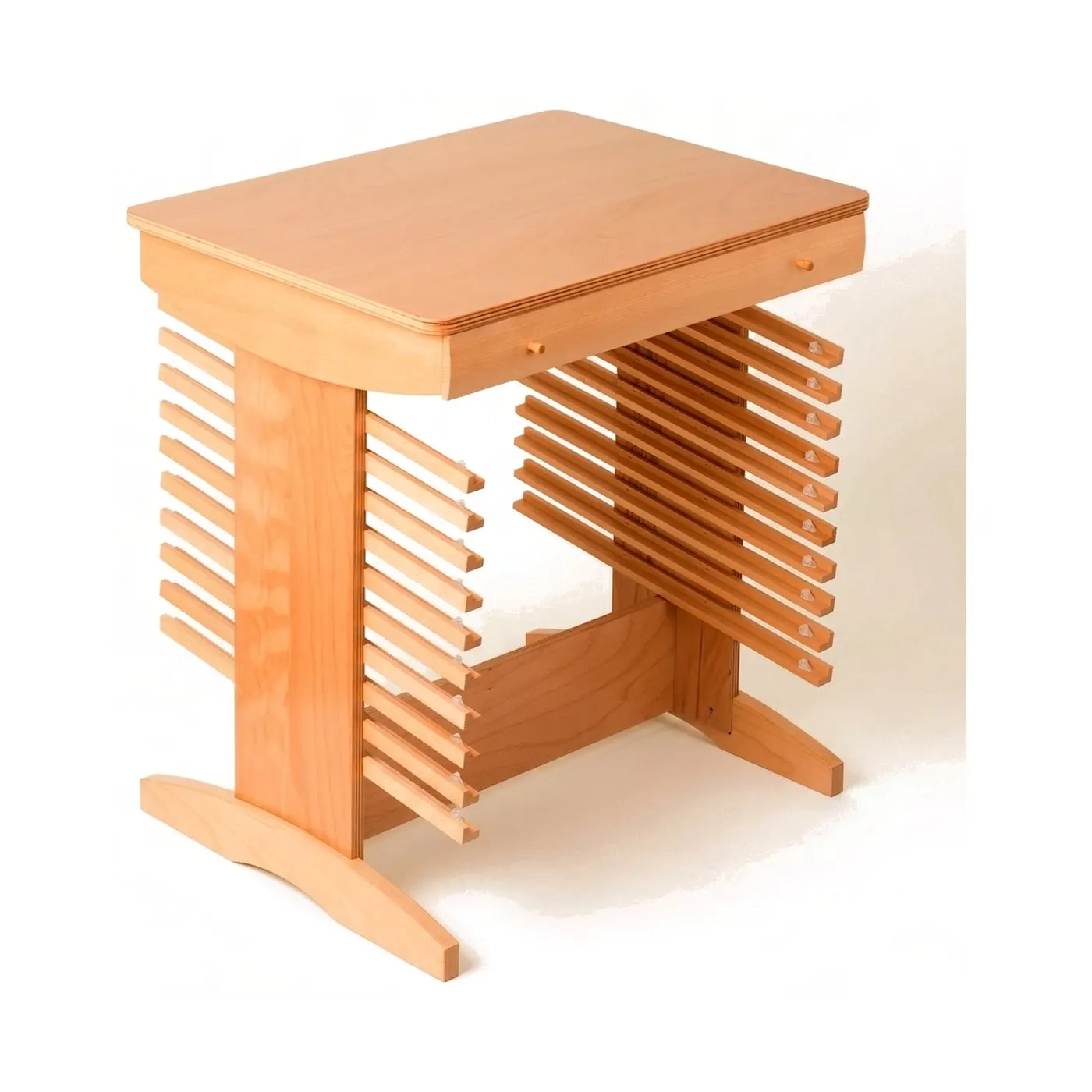
Puzzle MapWorld Parts - Asia View
The first photos are the maker's own. The other shots are illustrative.
Inv. no. NIE-017706
- Maker
- Nienhuis Montessori, since 1929
- Approval
- AMI
- Primary Material
- Wood
- Finish
- Paint
- EAN
- 8719924009618
€141.90
Final price incl. VAT. Delivery €5.90, €7.10 to go for free delivery.
✓ In Stock. Delivery in 5 to 9 working days.
1
30 daysto return
Advicebefore and after
Invoicefor companies
Advice, warranty and returns are handled by us.
The original
Why it costs €141.90
Behind the price of the original are things you can check yourself.
AMI approval
The material is approved by the Association Montessori Internationale (AMI). Nienhuis has made Montessori materials since 1929.
A verifiable original
The EAN 8719924009618 is on the box. It is the maker's number, not ours.
What the child does
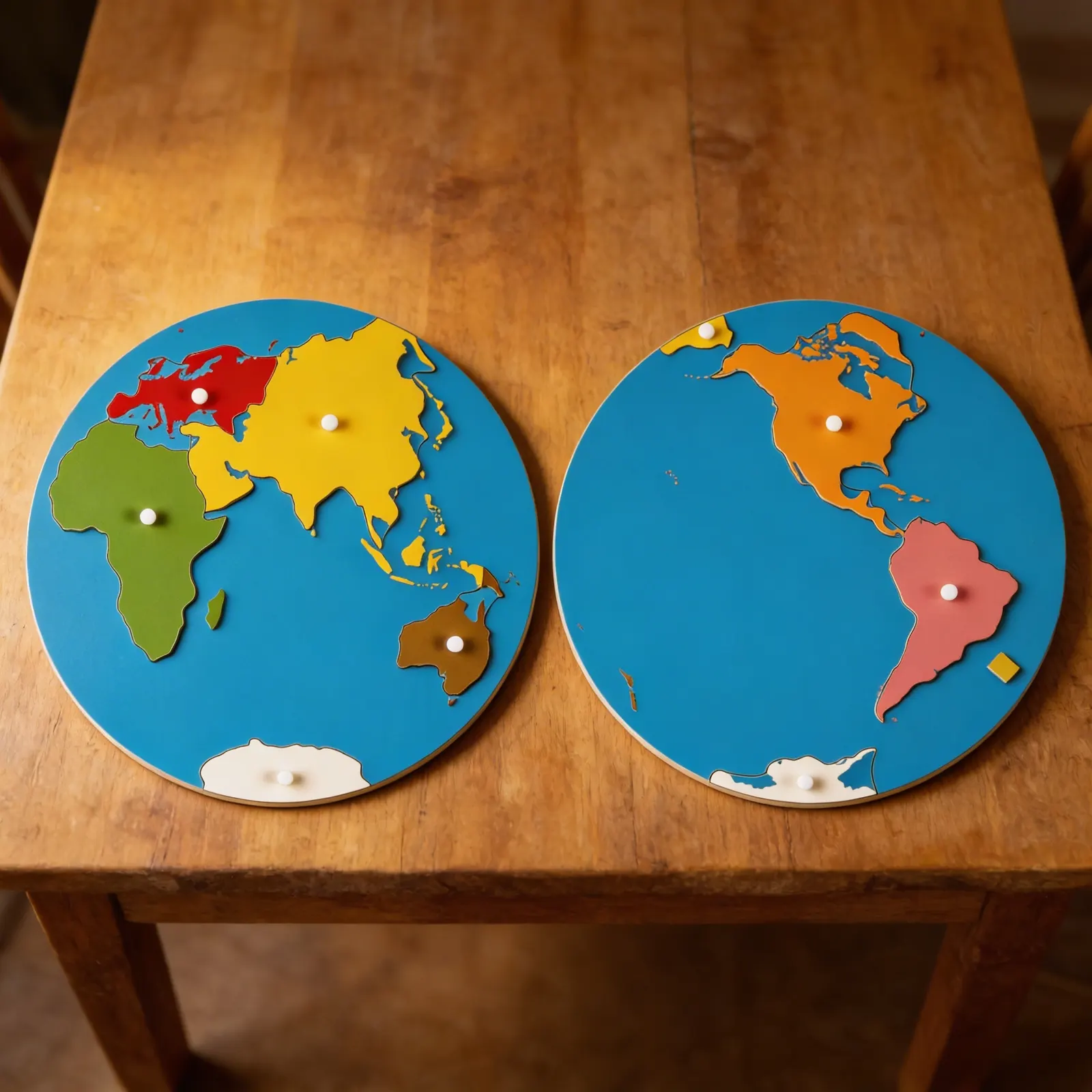
Puzzle Map in a child's hands
The world map oriented on Asia, which is a different object from the Atlantic-centred map most children meet first. Seeing the Pacific whole, and Europe pushed to the edge, is the quickest way to show that a map has a point of view. Includes a plastic circle for tracing the hemispheres, so the child can draw the division rather than be told where it falls. Worked alongside the standard world map, the pair does something neither does alone. Wood with paint, for ages 3 to 6.
Geographic Awareness
Introduces continents, oceans, and Earth's spherical nature through hands-on exploration of two hemisphere views.
Fine Motor Control
Knob handles on each piece develop pincer grip and hand-eye coordination essential for writing preparation.
Spatial Intelligence
Understanding how flat maps represent our spherical Earth builds advanced spatial reasoning skills.
Cultural Perspective
Asia-centric view broadens geographic understanding beyond traditional Western-centered maps.
Activity Guide
How to present it
Place the map on a table mat. Set both hemisphere frames side by side. Remove all continent pieces and arrange them on a tray to the right of the frames.
- 1Introduce the material by showing how Earth is divided into two halves
- 2Begin with the Asia-centered hemisphere, identifying and placing Asia first
- 3Add surrounding continents one at a time, naming each
- 4Complete the second hemisphere with remaining continents
- 5Remove pieces randomly and invite the child to replace them
3 tips for parents
- Look at photos or videos from different continents to make the puzzle pieces meaningful
- When reading stories, locate the setting on the puzzle map together
- Display a world map at home that shows your family's heritage countries
From the same makerNienhuis
Accessories
Why it is in our selection
If you are not sure it suits your child, we answer in person.
Norbert Kovalčín, founder of Faborino · write to him
There is no review here yet. We will ask you for one after you buy. Write the first review
Details
What's in the Box
- Wooden puzzle base: with two hemisphere recesses
- Approx. 14 continent pieces: with knob handles
- Two complete hemisphere puzzles: Asia-centric view
Size and material
| Packaging | 62 × 50 × 3 cm |
| Primary Material | Wood |
| Finish | Paint |
| Recommended Age | 3-6 years |
Care
Wipe with slightly damp cloth, dry immediately
Frequently Asked Questions
What makes this Asia-centric world map different from traditional Montessori puzzle maps?
This unique puzzle features two circular hemispheres with Asia positioned centrally, offering children a different perspective of the world than Western-centric maps. It helps develop global awareness by showing how the world looks from different viewpoints while maintaining the Montessori color-coding system for continents.
How does the dual-hemisphere design help children understand Earth's spherical nature?
The two circular puzzles represent Earth's hemispheres, helping children grasp that our planet is a sphere rather than flat. By manipulating both circles, children see how continents wrap around the globe and connect, building a more accurate mental model of Earth's three-dimensional structure.
What skills do children develop while working with this puzzle map?
Children develop fine motor skills through knobbed pieces, spatial awareness by fitting continents together, geographical knowledge by learning continent names and positions, cultural appreciation through the Asia-centric perspective, and cognitive skills by understanding different map projections and Earth's spherical nature.
Is this puzzle suitable for children who haven't learned traditional world maps yet?
Yes, this puzzle is ideal for introducing world geography to young children. Starting with an Asia-centric view helps prevent Western-centric bias and promotes a more inclusive understanding of global geography. The color-coded continents and knobbed pieces make it accessible for ages 3-6 regardless of prior geography knowledge.
How can parents and teachers extend learning activities with this puzzle?
Extensions include discussing countries within each continent, exploring cultural elements from Asia and other regions, comparing this view with traditional maps, creating art projects about different continents, studying animals from various regions, and using a globe to show how the flat puzzle represents the spherical Earth.
Product safety
Manufacturer: Nienhuis Montessori, Anders Celsiusstraat 15, 7442 PB Nijverdal, Netherlands
Puzzle Map
€141.90