
Puzzle WordsLanguage Reading Activity
The first photo is the maker's own. The other shots are illustrative.
Inv. no. NIE-564800
- Maker
- Nienhuis Montessori, since 1929
- Approval
- AMI
- Primary Material
- Heavy-duty cardboard
- Printing
- Black ink on white surface
- EAN
- 8719924030100
Final price incl. VAT. Delivery €5.90, €110.10 to go for free delivery.
Advice, warranty and returns are handled by us.
Why it costs €38.90
Behind the price of the original are things you can check yourself.
AMI approval
The material is approved by the Association Montessori Internationale (AMI). Nienhuis has made Montessori materials since 1929.
A verifiable original
The EAN 8719924030100 is on the box. It is the maker's number, not ours.
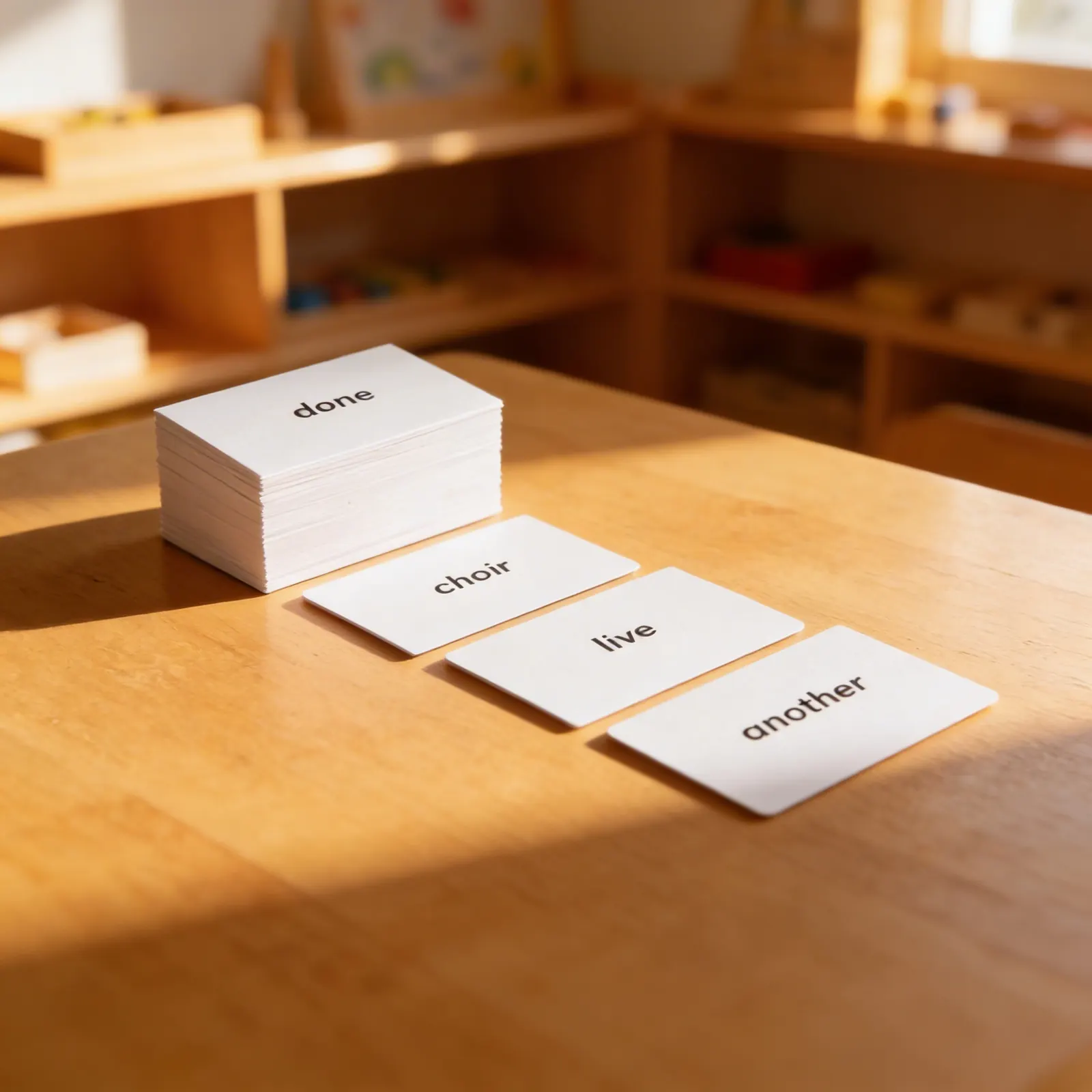
Puzzle Words in a child's hands
A hundred and twenty two sight words on white card stock, the words that do not follow the rules and therefore have to be known by sight. Every phonetic material a child has met so far rewards sounding out, and these are the words that punish it: said, one, come, were. Keeping them in a separate stack is honest about that, and it stops a child concluding that their decoding has failed when it has simply met an exception. Card stock, for ages 3 to 6.
Word Building Skills
Children learn to segment and blend sounds by physically connecting word parts, reinforcing phonemic awareness through tactile experience.
Self-Correction
Puzzle pieces only fit correctly when the word is properly formed, allowing independent error detection and correction.
Reading Readiness
Hands-on word construction bridges the gap between letter recognition and whole-word reading through active participation.
Fine Motor Control
Manipulating and connecting puzzle pieces strengthens pincer grip and hand-eye coordination needed for writing.
How to present it
Place 3-4 complete puzzle sets on a tray. Start with simple three-letter CVC words (consonant-vowel-consonant). Arrange puzzle pieces mixed but organized by word on the work surface.
- 1Invite the child to examine one complete puzzle. Point to each segment while slowly sounding out the letter
- 2Separate the puzzle pieces and demonstrate reconnecting them while voicing each sound
- 3Mix the pieces of one word and invite the child to reassemble, offering the beginning sound as a clue
- 4Once comfortable, introduce 2-3 puzzles simultaneously for sorting and assembly challenge
3 tips for parents
- Keep sessions short - 2-3 words at a time maintains interest and focus
- Celebrate the physical 'click' of correct assembly rather than just reading success
- Let your child teach you by mixing up pieces for you to solve

If you are not sure it suits your child, we answer in person.
Norbert Kovalčín, founder of Faborino · write to him
There is no review here yet. We will ask you for one after you buy. Write the first review
What's in the Box
- Word Puzzle Sets: Approx. 4 three-part word puzzles
- Storage Box: Compact cardboard container
Size and material
| Packaging | 7 × 5 × 4 cm |
| Primary Material | Heavy-duty cardboard |
| Printing | Black ink on white surface |
| Recommended Age | 3-6 years |
Care
| Cleaning | Wipe with dry cloth only |
| Storage | Keep in provided box to prevent piece loss |
Frequently Asked Questions
What age group is best suited for these Puzzle Words?
These puzzles are designed for children ages 3-6 who are beginning to explore letter recognition and early reading. They work particularly well for children who have mastered letter sounds and are ready to blend sounds into words.
How do the self-correcting puzzles work?
Each word is divided into three puzzle pieces that only fit together when correctly assembled. This built-in control of error allows children to work independently and recognize mistakes immediately, building confidence through successful word formation.
What types of words are included in this set?
The set typically includes simple three-letter phonetic words (CVC pattern) that children can sound out easily, such as 'cat,' 'dog,' 'sun,' and 'hat.' These foundational words help children understand blending sounds to form complete words.
How does this material support Montessori language development?
These puzzles bridge the gap between individual letter recognition and reading whole words. The hands-on manipulation reinforces the connection between spoken and written language while the self-correcting design encourages independent learning and problem-solving.
Can these puzzles be used alongside other reading materials?
Yes, these work excellently with sandpaper letters, moveable alphabets, and phonetic reading cards. They provide a tactile alternative to traditional reading practice and help reinforce word formation concepts through a different sensory experience.
Product safety
Manufacturer: Nienhuis Montessori, Anders Celsiusstraat 15, 7442 PB Nijverdal, Netherlands
Puzzle Words