
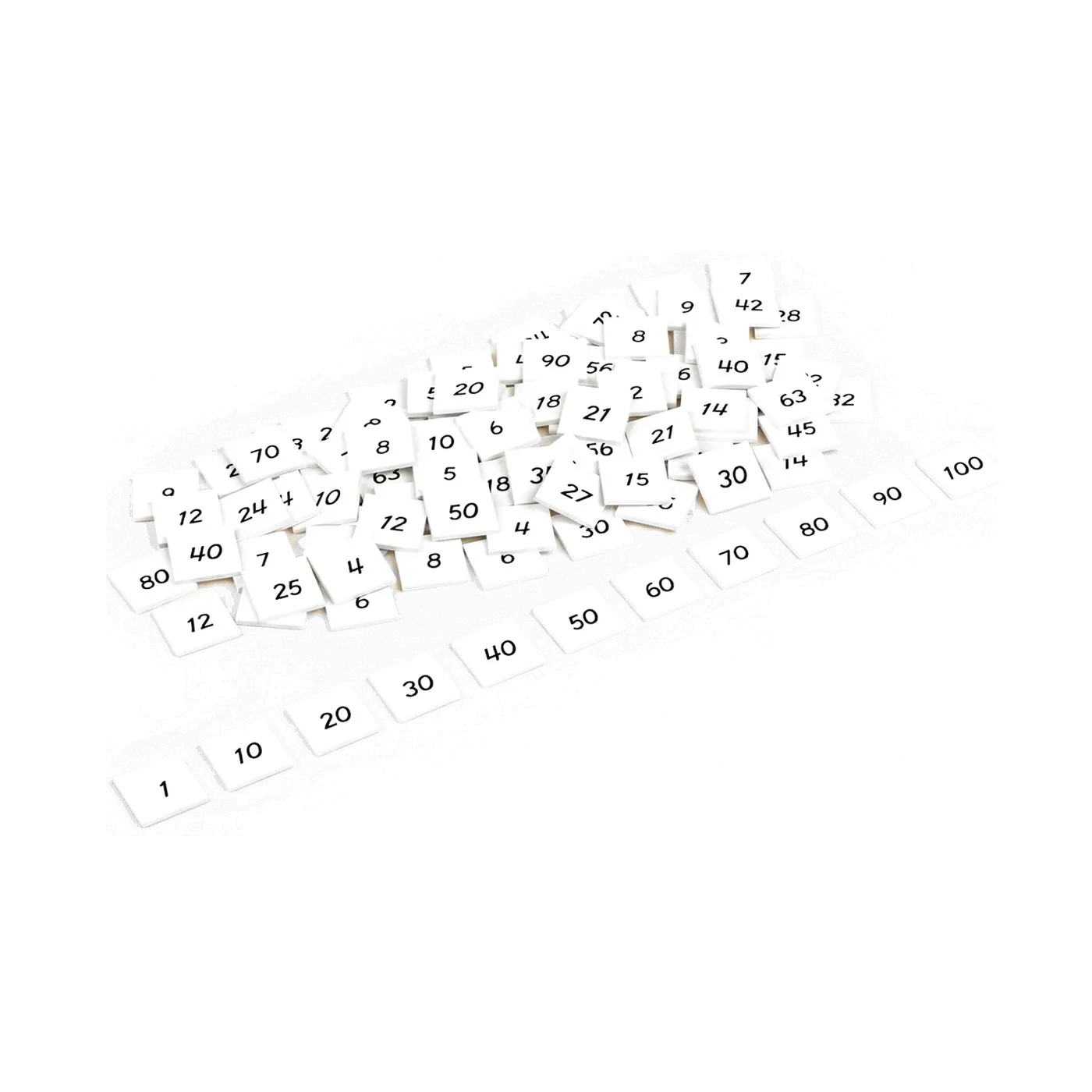
Pythagoras Board
The first photo is the maker's own. The other shots are illustrative.
Inv. no. NIE-018100
- Maker
- Nienhuis Montessori, since 1929
- Approval
- AMI
- Frame
- Solid wood construction
- Grid Surface
- Red fabric or felt
- EAN
- 8719924009731
€95.90
Final price incl. VAT. Delivery €5.90, €53.10 to go for free delivery.
✓ In Stock. Delivery in 5 to 9 working days.
1
30 daysto return
Advicebefore and after
Invoicefor companies
Advice, warranty and returns are handled by us.
The original
Why it costs €95.90
Behind the price of the original are things you can check yourself.
AMI approval
The material is approved by the Association Montessori Internationale (AMI). Nienhuis has made Montessori materials since 1929.
A verifiable original
The EAN 8719924009731 is on the box. It is the maker's number, not ours.
What the child does
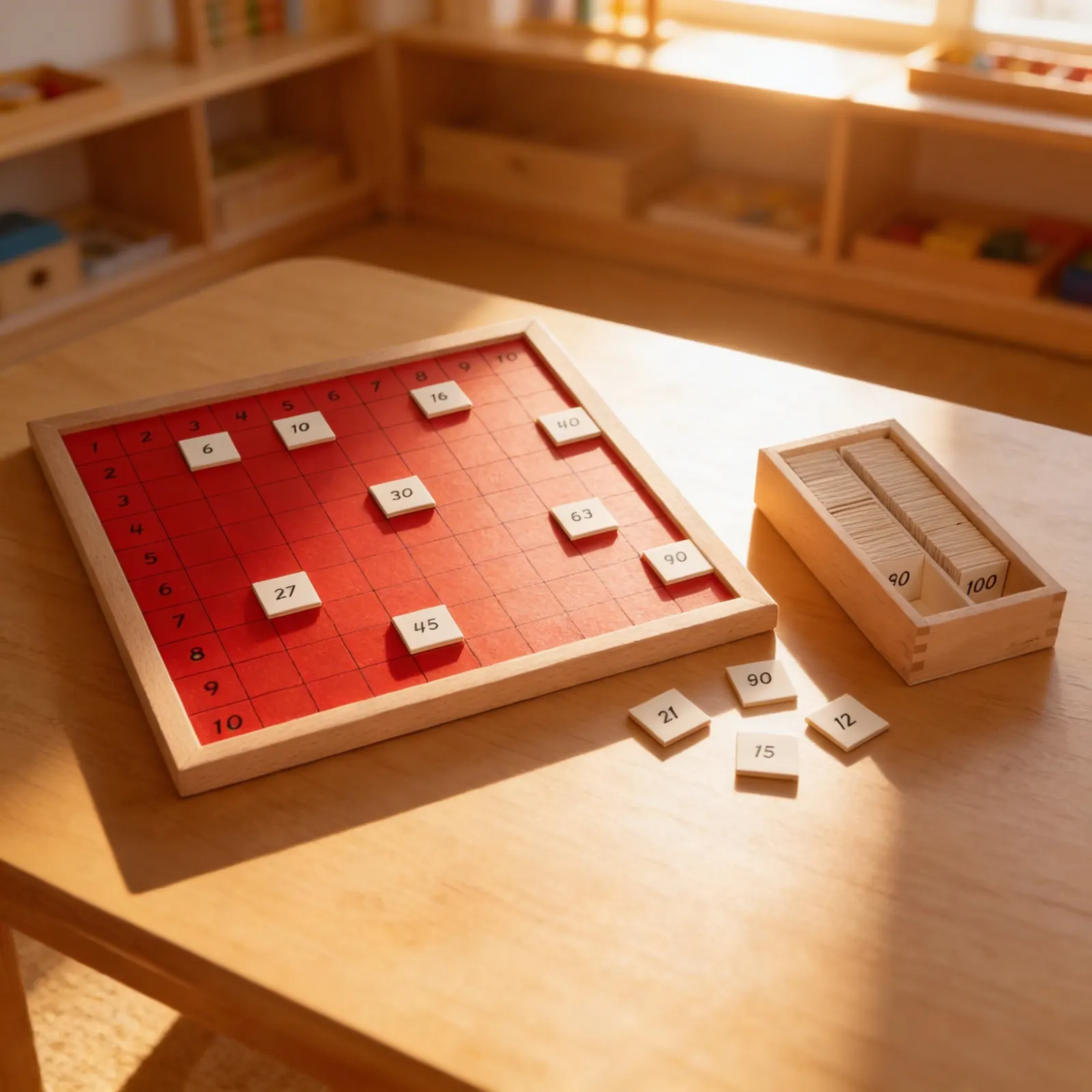
Pythagoras Board in a child's hands
The Pythagoras Board gives young learners a first look at multiplication patterns through active discovery. This elegant wooden board features a red fabric grid with coordinates from 1-10, giving children the chance to build the multiplication tables by placing number tiles at each intersection. The accompanying wooden storage box with organized compartments ensures all tiles remain properly sorted for repeated mathematical discoveries.
Multiplication Mastery
Children discover multiplication facts through systematic placement of tiles, building visual and kinesthetic memory of number relationships.
Pattern Recognition
The grid format reveals mathematical patterns like commutative property and square numbers through hands-on exploration.
Sequential Thinking
Working through the grid systematically develops logical thinking and understanding of mathematical progression.
Activity Guide
How to present it
Place the Pythagoras Board on a work mat with the wooden storage box beside it. Ensure all number tiles are sorted in their compartments.
- 1Begin with the ones: Take tiles marked '1' and place them along the first row and column
- 2Introduce twos: Place '2' tiles at coordinates (1,2) and (2,1), then continue the pattern
- 3Build complete rows: Work systematically through each multiplication family
- 4Explore patterns: Once complete, examine diagonal lines, symmetry, and number relationships
3 tips for parents
- Practice skip counting during daily routines to reinforce patterns discovered on the board
- Point out multiplication in real life: 'We need 3 plates for each of our 4 family members'
- Celebrate pattern discoveries rather than speed of completion
From the same makerNienhuis
Spare parts
Why it is in our selection
If you are not sure it suits your child, we answer in person.
Norbert Kovalčín, founder of Faborino · write to him
There is no review here yet. We will ask you for one after you buy. Write the first review
Details
What's in the Box
- Pythagoras Board: Wooden frame with red fabric grid (1-10 axes)
- Number Tiles: Approx. 100 wooden tiles with multiplication products
- Storage Box: Wooden box with divider compartments
Size and material
| Packaging | 34 × 34 × 7 cm |
| Frame | Solid wood construction |
| Grid Surface | Red fabric or felt |
| Number Tiles | Wooden tiles with printed numbers |
| Recommended Age | 6-12 years |
Care
Dust with dry cloth; spot clean fabric gently if needed
Frequently Asked Questions
What age is the Pythagoras Board most appropriate for?
While suitable for ages 3-6, this material is typically introduced around age 5-6 when children have mastered skip counting and are ready to explore multiplication patterns. Younger children can use it for number recognition and sequencing.
How does this board help children learn multiplication?
Children place numbered tiles at grid intersections to discover multiplication patterns visually and kinesthetically. For example, placing a tile at row 3, column 4 reveals that 3×4=12, helping them understand multiplication as repeated addition through hands-on exploration.
What's included with the Pythagoras Board?
The set includes a wooden board with red fabric grid marked 1-10 on both axes, 100 numbered tiles showing multiplication results, and a wooden storage box with organized compartments to keep tiles sorted by value.
How is this different from traditional multiplication tables?
Unlike memorization-based methods, the Pythagoras Board allows children to physically construct the multiplication table, discovering patterns like commutative property (3×4 = 4×3) and building deep conceptual understanding through sensorial experience.
What skills does the Pythagoras Board develop?
This material develops multiplication concept understanding, pattern recognition, visual-spatial skills, mathematical reasoning, and concentration. It also prepares children for more advanced mathematical concepts like square numbers and factoring.
Product safety
Manufacturer: Nienhuis Montessori, Anders Celsiusstraat 15, 7442 PB Nijverdal, Netherlands
Pythagoras Board
€95.90