
Same And Different
The first photo is the maker's own. The other shots are illustrative.
Inv. no. NIE-EC0649
- Maker
- Nienhuis Montessori, since 1929
- Material
- Durable plastic
- Finish
- Pre-cut with rounded corners
- EAN
- 8719924043230
Final price incl. VAT. Delivery €5.90, €109.10 to go for free delivery.
Advice, warranty and returns are handled by us.
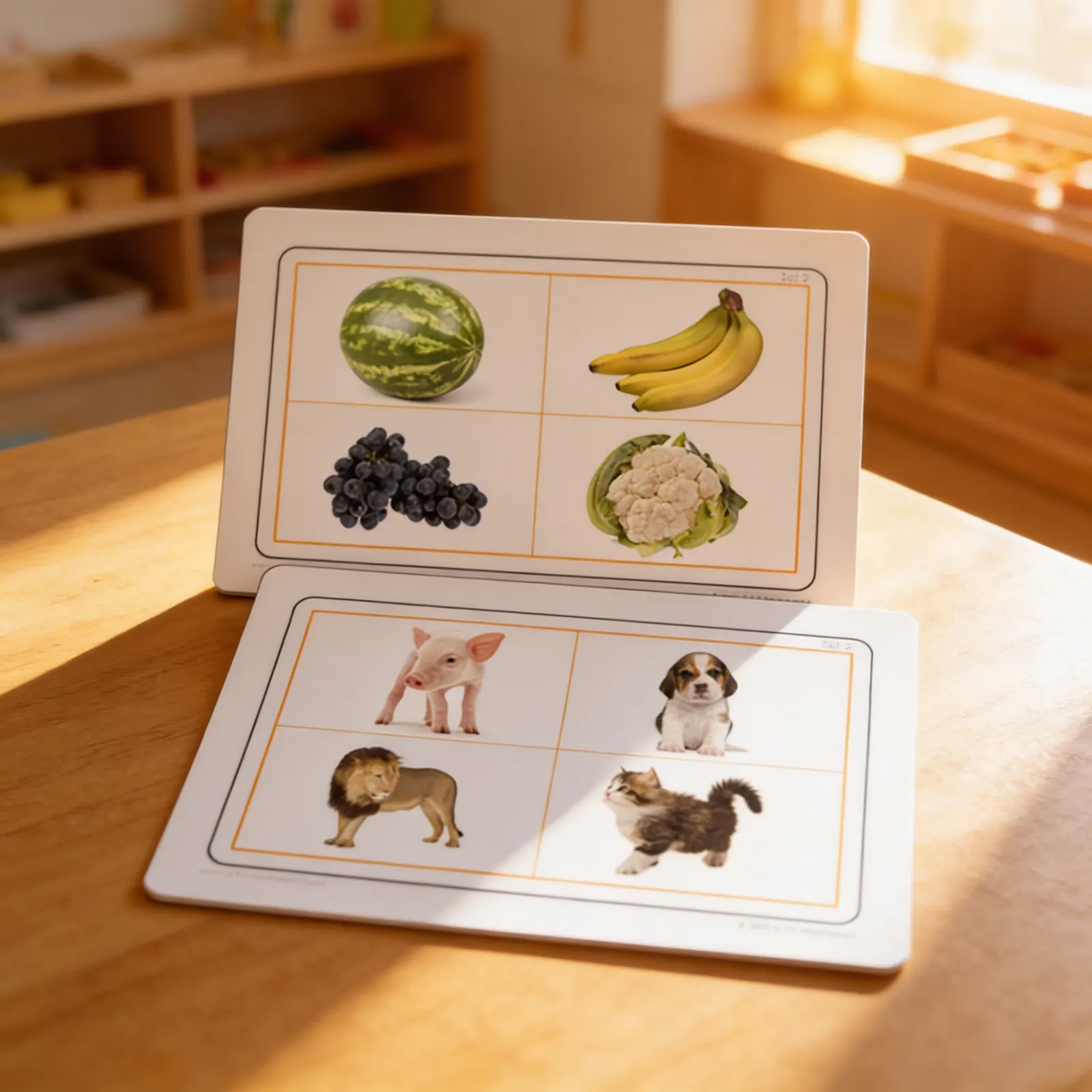
Same And Different in a child's hands
Same and different, with real photographs to sort. Classification rests on relations: before a child can say two things belong together they have to find the characteristic the two share, and this set is where that habit is built on pairs simple enough to argue about. It is the groundwork under every later sorting material, from the vertebrate classes to the six kingdoms. Durable plastic with rounded corners. In English.
Visual Discrimination
Strengthens the ability to identify similarities and differences between objects, preparing for reading and mathematical concepts.
Logical Thinking
Develops classification skills and category formation essential for scientific reasoning and problem-solving.
Language Development
Enriches vocabulary as children describe and discuss the attributes of different objects.
Concentration
Focused comparison activities build sustained attention and analytical thinking skills.
How to present it
Place the Same and Different cards in a basket on the shelf at child's eye level. Prepare a work mat or table space for sorting activities.
- 1Invite the child to bring the basket to a work mat. Select one category of cards to begin
- 2Lay out 4-6 cards from one category. Ask the child to look carefully at each image
- 3Model finding two cards that are the 'same' and place them together
- 4Continue sorting remaining cards into 'same' and 'different' groups
- 5Once sorted, review each group with the child, discussing their choices
3 tips for parents
- Practice same and different concepts during daily activities like sorting laundry or organizing toys
- Play 'spot the difference' games during walks or while reading books together
- Encourage your child to explain their sorting decisions to develop reasoning skills

If you are not sure it suits your child, we answer in person.
Norbert Kovalčín, founder of Faborino · write to him
There is no review here yet. We will ask you for one after you buy. Write the first review
What's in the Box
- Classification Cards: 2 cards with 4 images each
Size and material
| Packaging | 29 × 23 × 1 cm |
| Material | Durable plastic |
| Finish | Pre-cut with rounded corners |
| Recommended Age | 3-6 years |
Care
Wipe with slightly damp cloth, dry immediately
Frequently Asked Questions
What skills do these Same and Different cards develop?
These classification cards develop visual discrimination, logical thinking, comparative analysis, and cognitive reasoning skills. Children learn to identify similarities and differences between objects, which forms the foundation for mathematical concepts, scientific observation, and critical thinking abilities.
How many categories and cards are included in this set?
The set includes photographic sorting cards across four distinct categories. Each category contains multiple high-quality laminated cards featuring real-life objects that children can analyze and sort based on their similarities and differences.
What age group is this material designed for?
These Same and Different cards are designed for children ages 3-6 years. This age range aligns with the sensitive period for order and classification in Montessori education, when children naturally seek to categorize and understand relationships between objects.
How do children use these cards in the Montessori environment?
Children work independently or in small groups to sort the photographic cards, comparing objects within each category. They identify common attributes and differences, discuss their observations, and develop vocabulary while strengthening their analytical thinking skills through hands-on manipulation.
Are the cards durable for classroom use?
Yes, the cards are laminated for durability, making them suitable for repeated handling in busy Montessori classrooms. The lamination protects the photographic images from wear, spills, and frequent use by young children, ensuring long-lasting educational value.
Product safety
Manufacturer: Nienhuis Montessori, Anders Celsiusstraat 15, 7442 PB Nijverdal, Netherlands
Same And Different