
Sandpaper LettersSpanish Print - Supplement Set
The first photo is the maker's own. The other shots are illustrative.
Inv. no. NIE-005409
- Maker
- Nienhuis Montessori, since 1929
- Approval
- AMI
- Letter Surface
- Fine-grit sandpaper
- Card Base
- Sturdy cardboard
- EAN
- 8719924003227
Final price incl. VAT. Delivery €5.90, €128.10 to go for free delivery.
Advice, warranty and returns are handled by us.
Why it costs €20.90
Behind the price of the original are things you can check yourself.
AMI approval
The material is approved by the Association Montessori Internationale (AMI). Nienhuis has made Montessori materials since 1929.
A verifiable original
The EAN 8719924003227 is on the box. It is the maker's number, not ours.
Sandpaper Letters in a child's hands
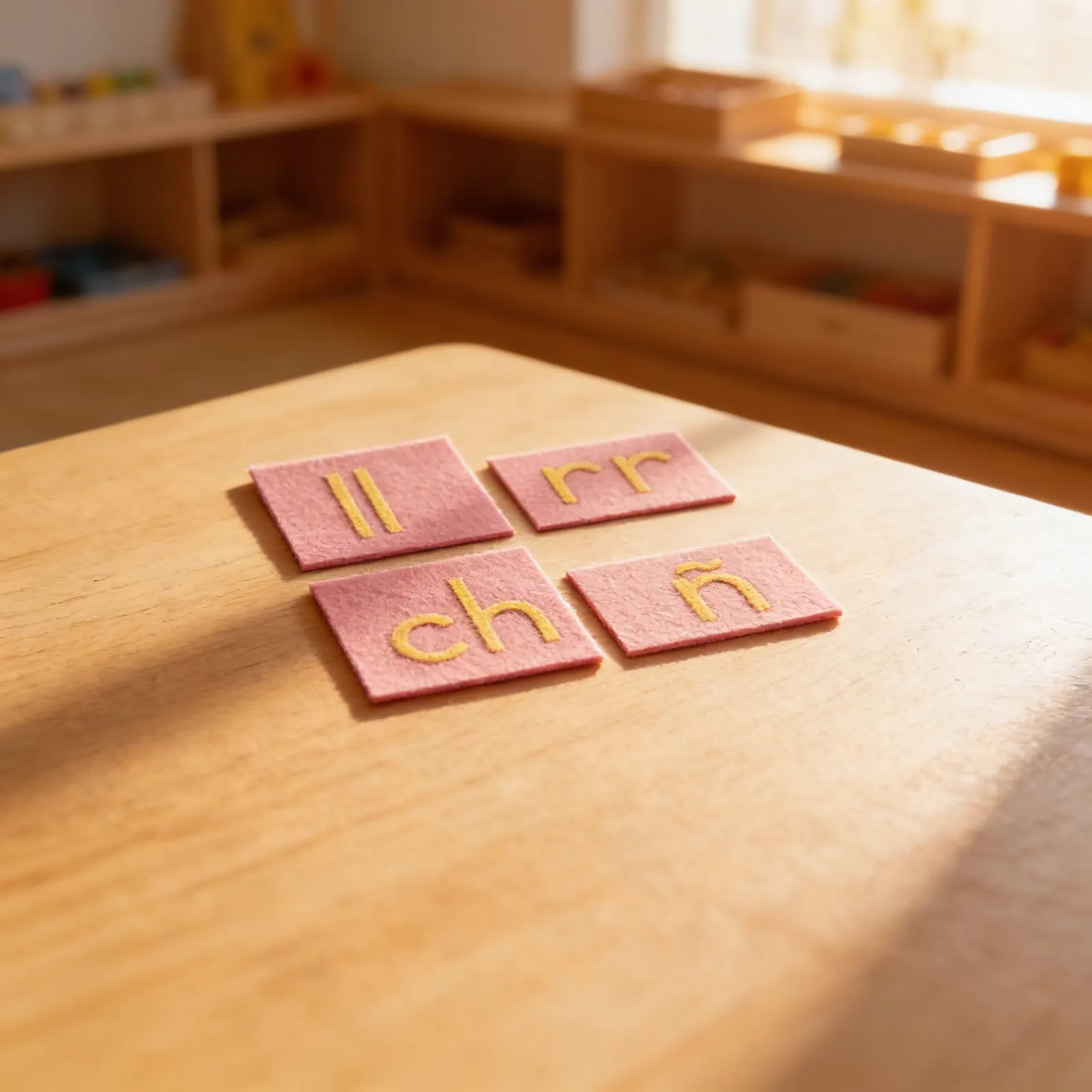
The four Spanish letters the international print set does not include: ll, rr, ch and ñ. It is a supplement, meant to be added to Sandpaper Letters: International Print, which is sold separately. Tracing is the whole of the exercise: the child follows the letter in the direction it is written, so the hand learns the movement before a pencil is involved at all, and the sound is given at the same moment as the shape. In the base set the consonants are mounted on pink boards and the vowels on blue.
Spanish Phonemic Awareness
Introduces unique Spanish sounds and letter combinations essential for proper pronunciation and spelling in Spanish language acquisition.
Tactile Memory Formation
The sandpaper texture engages touch receptors, creating stronger neural pathways for letter recognition and formation than visual learning alone.
Fine Motor Preparation
Tracing movements develop the precise finger control and muscle memory needed for future writing of these complex Spanish characters.
Visual-Tactile Integration
Combines sight and touch to reinforce letter recognition, supporting children who learn best through multi-sensory experiences.
How to present it
Place the four Spanish supplement cards on a mat. Have a tray of sand or salt nearby for the child to practice formations after tracing.
- 1Introduce one card at a time, starting with 'ñ'. Demonstrate tracing with your index and middle fingers while making its sound 'ny'
- 2Present 'ch' next, showing how two letters create one sound. Trace both letters in one continuous movement
- 3Introduce 'll', demonstrating its liquid sound distinct from English. Trace both letters as a unit
- 4Present 'rr' last, emphasizing the rolled sound. Let the child feel the double formation
3 tips for parents
- Practice Spanish words containing these letters during daily conversation
- Point out 'ñ' on Spanish keyboards and signage to reinforce its importance
- Read Spanish books together, letting your child identify these special letters

If you are not sure it suits your child, we answer in person.
Norbert Kovalčín, founder of Faborino · write to him
There is no review here yet. We will ask you for one after you buy. Write the first review
What's in the Box
- Sandpaper Letter Cards: Approx. 4 Spanish-specific characters
- Characters Included: 'll', 'rr', 'ch', and 'ñ'
Size and material
| Packaging | 20 × 20 × 2 cm |
| Letter Surface | Fine-grit sandpaper |
| Card Base | Sturdy cardboard |
| Recommended Age | 3-6 years |
Care
Gently wipe with dry cloth; avoid moisture
Frequently Asked Questions
What Spanish letters are included in this supplement set?
This supplement set includes four essential Spanish-specific characters: the double letters 'll' and 'rr', the digraph 'ch', and the letter 'ñ'. These are the unique Spanish letters not found in the standard alphabet that children need to master for complete Spanish literacy.
Do I need the regular Sandpaper Letters set before using this supplement?
Yes, this is a supplement set designed to complement the standard Spanish Sandpaper Letters. Children should already be familiar with the basic alphabet letters before introducing these special Spanish characters, as they represent more complex sounds and letter combinations.
Why are these letters on pink backgrounds with yellow sandpaper?
In Montessori language materials, pink backgrounds traditionally indicate consonants or consonant combinations. The yellow sandpaper provides strong visual and tactile contrast, helping children distinguish these special Spanish characters from single letters while maintaining consistency with Montessori color-coding principles.
At what point should I introduce these supplementary letters to my child?
Introduce these letters after your child has mastered most single letter sounds from the basic Spanish alphabet, typically around age 4-5. Begin with 'ñ' as it's a single character, then progress to the digraph 'ch', followed by the double letters 'll' and 'rr' which represent single sounds despite being two letters.
How do I teach the difference between single 'r' and double 'rr' sounds?
Start by having the child trace the single 'r' from the regular set, producing the soft tapped sound. Then introduce 'rr' with its distinctive rolled sound, emphasizing the stronger vibration. Practice with word pairs like 'pero/perro' and 'caro/carro' to help children hear and feel the difference through repetition and tactile tracing.
Product safety
Manufacturer: Nienhuis Montessori, Anders Celsiusstraat 15, 7442 PB Nijverdal, Netherlands
Sandpaper Letters