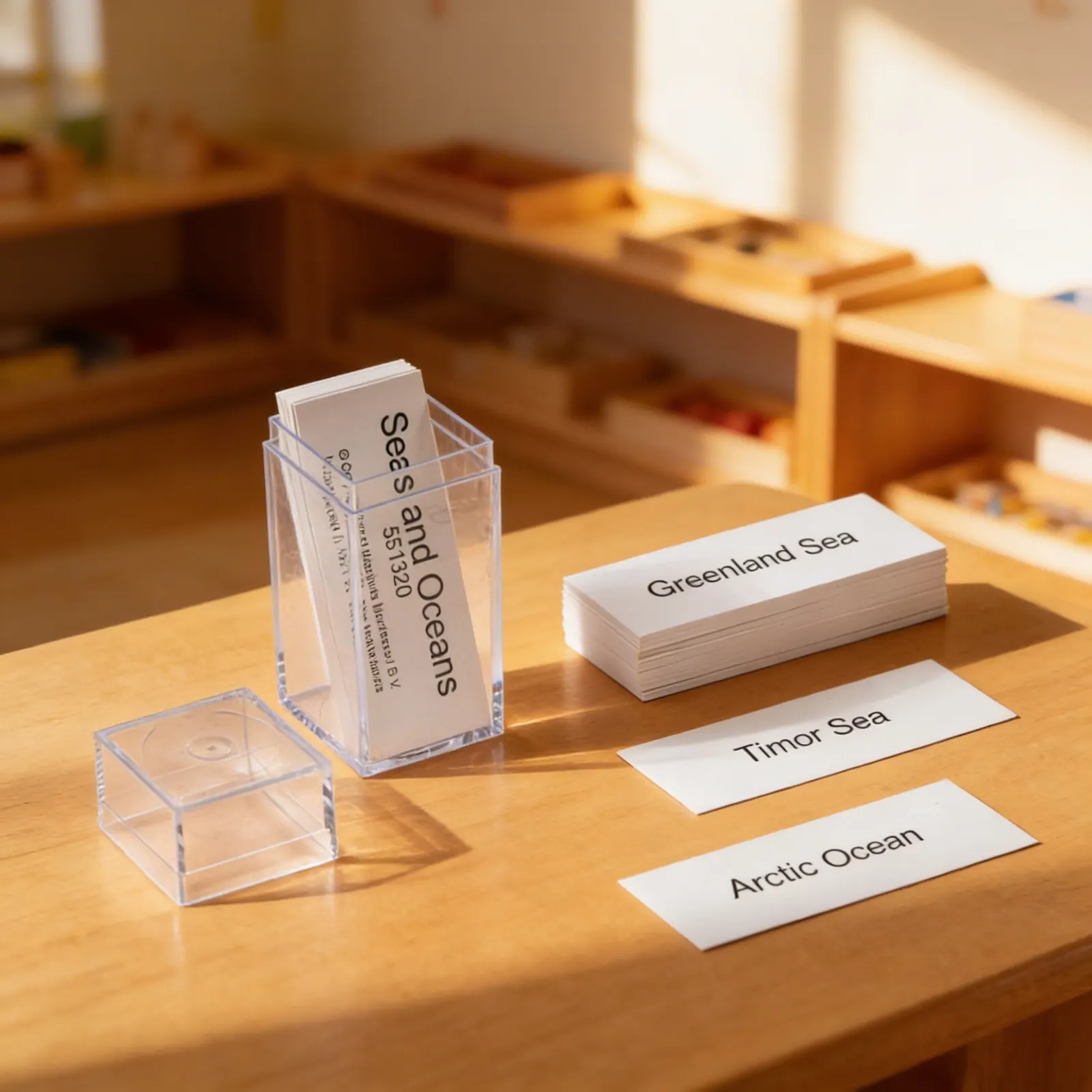
Seas And OceansLabels
The first photo is the maker's own. The other shots are illustrative.
Inv. no. NIE-551320
- Maker
- Nienhuis Montessori, since 1929
- Approval
- AMI
- Display Stand
- Clear acrylic plastic
- Label Cards
- Printed paper
- EAN
- 8719924046354
Final price incl. VAT. Delivery €5.90, €132.10 to go for free delivery.
Advice, warranty and returns are handled by us.
Why it costs €16.90
Behind the price of the original are things you can check yourself.
AMI approval
The material is approved by the Association Montessori Internationale (AMI). Nienhuis has made Montessori materials since 1929.
A verifiable original
The EAN 8719924046354 is on the box. It is the maker's number, not ours.
Seas And Oceans in a child's hands
The printed labels for the Seas and Oceans map, placed one at a time on the unlabeled control map and checked against the labeled one. Water names are the ones a child has read but almost never said aloud, which is exactly why the reading half of this work matters more here than on a map of countries. Check which of the two water maps you own before ordering, because the Oceans map has its own labels and the two do not swap. The maps are separate items.
Geography Knowledge
Introduces fundamental concepts of Earth's water bodies through concrete materials that children can manipulate and organize.
Reading Development
Supports early literacy through clear, readable labels that connect written words with geographical concepts.
Classification Skills
Encourages systematic thinking as children learn to distinguish between different types of water bodies.
Cultural Understanding
Builds foundation for global awareness by introducing the major seas and oceans that connect our continents.
How to present it
Place the acrylic holder on a geography shelf at child's eye level. Arrange label cards in the holder with clear visibility. Have a world map or globe nearby for reference. Ensure adequate lighting for reading the labels.
- 1Invite the child to explore the label cards, removing them one by one from the holder
- 2Present three labels using the three-period lesson: 'This is the Pacific Ocean'
- 3Place each label on or near its corresponding location on a floor map or table map
- 4Encourage the child to match all labels independently to map locations
- 5Return labels to the acrylic holder in an agreed-upon order
3 tips for parents
- Look for seas and oceans in books, documentaries, or maps at home to reinforce learning
- Share family travel experiences or photos related to specific water bodies
- During bath time, discuss how water in your home connects to Earth's water systems

If you are not sure it suits your child, we answer in person.
Norbert Kovalčín, founder of Faborino · write to him
There is no review here yet. We will ask you for one after you buy. Write the first review
What's in the Box
- Acrylic Card Holder: Clear display stand with base
- Label Cards: Approx. 4 nomenclature cards with sea/ocean names
Size and material
| Packaging | 9 × 7 × 4 cm |
| Display Stand | Clear acrylic plastic |
| Label Cards | Printed paper |
| Recommended Age | 3-6 years |
Care
Wipe acrylic holder with damp cloth; keep cards dry
Frequently Asked Questions
What seas and oceans are included in this label set?
This set includes labels for the world's major oceans (Pacific, Atlantic, Indian, Arctic, and Southern) as well as significant seas such as the Mediterranean, Caribbean, Baltic, and others. The cards cover the primary water bodies children learn about in elementary geography studies.
How does the acrylic holder work with these labels?
The transparent acrylic holder provides an elegant display system for the nomenclature cards, allowing children to clearly see and read each label. It keeps the cards organized and easily accessible while maintaining the aesthetic of the Montessori prepared environment.
What age group is this material most appropriate for?
These labels are designed for children ages 3-6, though they can continue to be useful in elementary classrooms. They align with the Montessori curriculum's introduction to geography and support children's growing understanding of Earth's water bodies.
How can these labels be used with other Montessori geography materials?
These labels work perfectly with puzzle maps, globe materials, and water-land form trays. Children can match the labels to locations on maps, use them for three-part card lessons, or incorporate them into research projects about different water bodies.
What skills do children develop using these nomenclature cards?
Children develop geography vocabulary, reading skills, and spatial awareness. They learn to identify and name major water bodies, understand their locations relative to continents, and build a foundation for more advanced geography studies.
Product safety
Manufacturer: Nienhuis Montessori, Anders Celsiusstraat 15, 7442 PB Nijverdal, Netherlands
Seas And Oceans