
Second Set Of Botany Cards
The first photo is the maker's own. The other shots are illustrative.
Inv. no. NIE-019600
- Maker
- Nienhuis Montessori, since 1929
- Approval
- AMI
- Cards
- Premium cardstock
- Protection
- Clear plastic sleeves
- EAN
- 8719924010409
Final price incl. VAT. Delivery €5.90, €13.10 to go for free delivery.
Advice, warranty and returns are handled by us.
Why it costs €135.90
Behind the price of the original are things you can check yourself.
AMI approval
The material is approved by the Association Montessori Internationale (AMI). Nienhuis has made Montessori materials since 1929.
A verifiable original
The EAN 8719924010409 is on the box. It is the maker's number, not ours.
Second Set Of Botany Cards in a child's hands
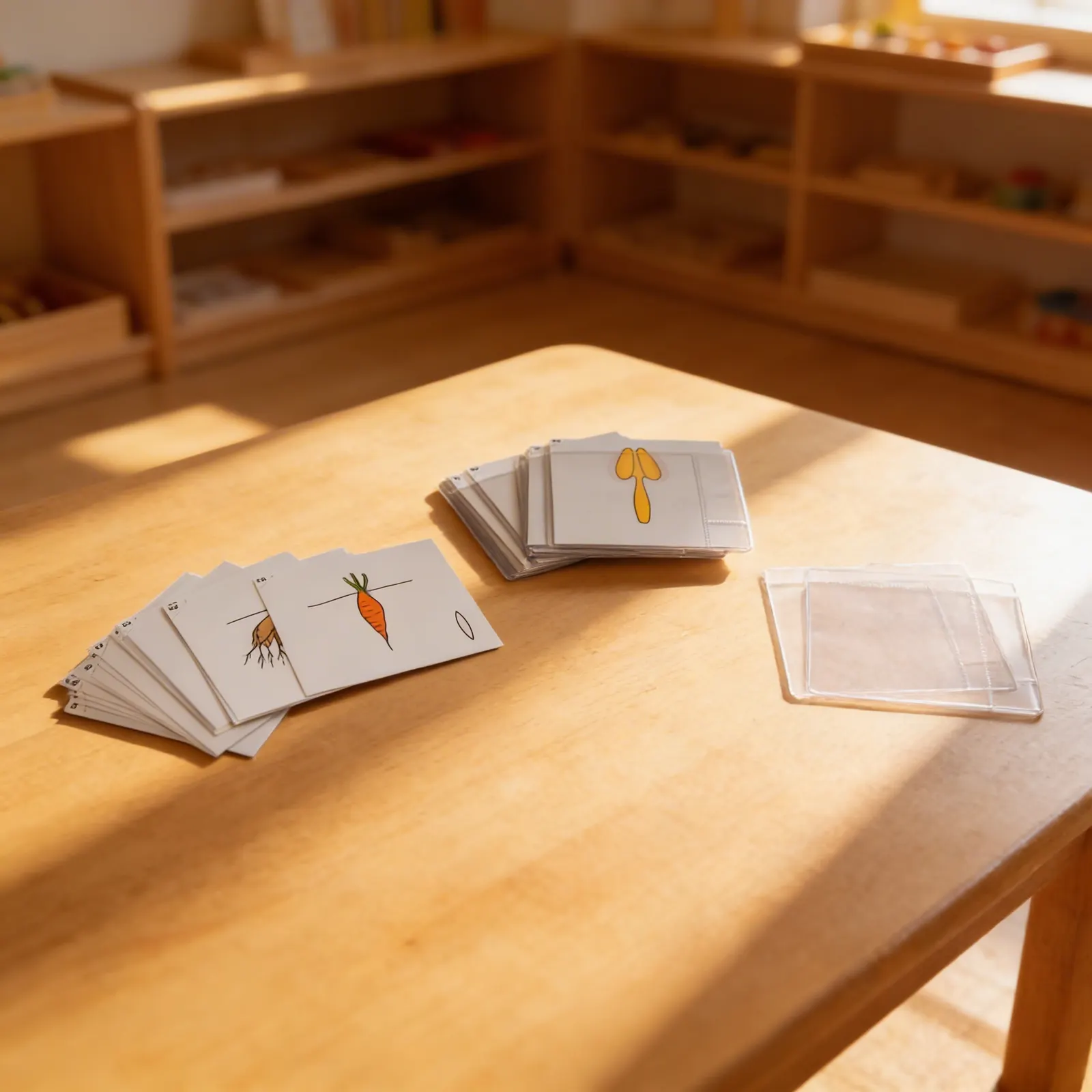
The second botany card set, covering roots, stems, leaves, flowers, fruits and seeds, and going further than the first into the parts of a bulb and the parts of a mushroom. Bulbs and mushrooms are worth their own cards because neither behaves like the plant a child has already learned: one hides its structure underground, the other is not a plant at all in the way the others are. Sorting them alongside the familiar parts is where classification starts to have edges. Cardstock, for ages 3 to 6.
Botanical Classification
Children learn to categorize and identify different plant types, developing scientific thinking and observation skills essential for biological studies.
Vocabulary Enrichment
Precise botanical terminology expands language skills while building a foundation for advanced plant studies and scientific nomenclature.
Visual Discrimination
Detailed illustrations help children recognize subtle differences between plant structures, enhancing perceptual skills and attention to detail.
Sequential Learning
Building upon the first set, children deepen their understanding of plant diversity and develop systematic approaches to learning.
How to present it
Arrange cards on a mat in three groups: root vegetables, fungi, and plant structures. Ensure good lighting for examining illustration details.
- 1Begin with root vegetables, presenting 3-4 cards showing carrots, turnips, and radishes
- 2Introduce vocabulary using three-period lesson: 'This is a taproot,' showing the carrot card
- 3Compare fungi cards, noting differences between mushrooms, bracket fungi, and molds
- 4Match plant structure cards to real specimens when available
- 5Create sorting games: 'grows underground' versus 'grows above ground'
3 tips for parents
- Visit farmers' markets to see root vegetable varieties matching the cards
- Start a mushroom observation journal during nature walks
- Cook with root vegetables while discussing their botanical names from the cards

If you are not sure it suits your child, we answer in person.
Norbert Kovalčín, founder of Faborino · write to him
There is no review here yet. We will ask you for one after you buy. Write the first review
What's in the Box
- Botanical nomenclature cards: Approx. 18 cards total
- Plant category sets: Including root vegetables, fungi, and plant structures
- Protective sleeves: Individual plastic sleeve for each card
Size and material
| Packaging | 14 × 14 × 5 cm |
| Cards | Premium cardstock |
| Protection | Clear plastic sleeves |
| Recommended Age | 6-12 years |
Care
Wipe plastic sleeves with damp cloth, keep cards dry
Frequently Asked Questions
What topics are covered in the Second Set of Botany Cards?
This set includes detailed illustrated nomenclature cards featuring root vegetables, fungi, and various plant structures, expanding upon basic botanical concepts to provide a more comprehensive understanding of plant diversity and morphology.
How do these cards differ from the First Set of Botany Cards?
The Second Set advances botanical learning by introducing more complex plant classifications including root vegetables and fungi, while the First Set typically covers basic plant parts like leaves, flowers, and trees. This set provides deeper exploration of plant structures and diversity.
Are the cards suitable for children who haven't used the First Set?
While children can use these cards independently, having experience with the First Set provides a helpful foundation. The Second Set builds upon basic botanical concepts, so familiarity with fundamental plant parts and vocabulary enhances the learning experience.
What makes these cards durable for classroom use?
Each card is protected in durable plastic sleeves, making them resistant to spills, frequent handling, and daily classroom use. This protective coating ensures the detailed illustrations remain clear and vibrant through years of hands-on learning activities.
How can these cards be integrated into the Montessori Biology curriculum?
These cards complement botany lessons through three-part card activities, matching exercises, and vocabulary building. They support classification work, enhance observation skills, and can be used alongside real specimens, nature walks, and gardening activities to create comprehensive botanical studies.
Product safety
Manufacturer: Nienhuis Montessori, Anders Celsiusstraat 15, 7442 PB Nijverdal, Netherlands
Second Set Of Botany Cards