
Set Of Blue Constructive Triangles
The first photo is the maker's own. The other shots are illustrative.
Inv. no. NIE-00490041
- Maker
- Nienhuis Montessori, since 1929
- Approval
- AMI
- Primary Material
- Duron
- EAN
- 8719924003005
Final price incl. VAT. Delivery €5.90, €100.10 to go for free delivery.
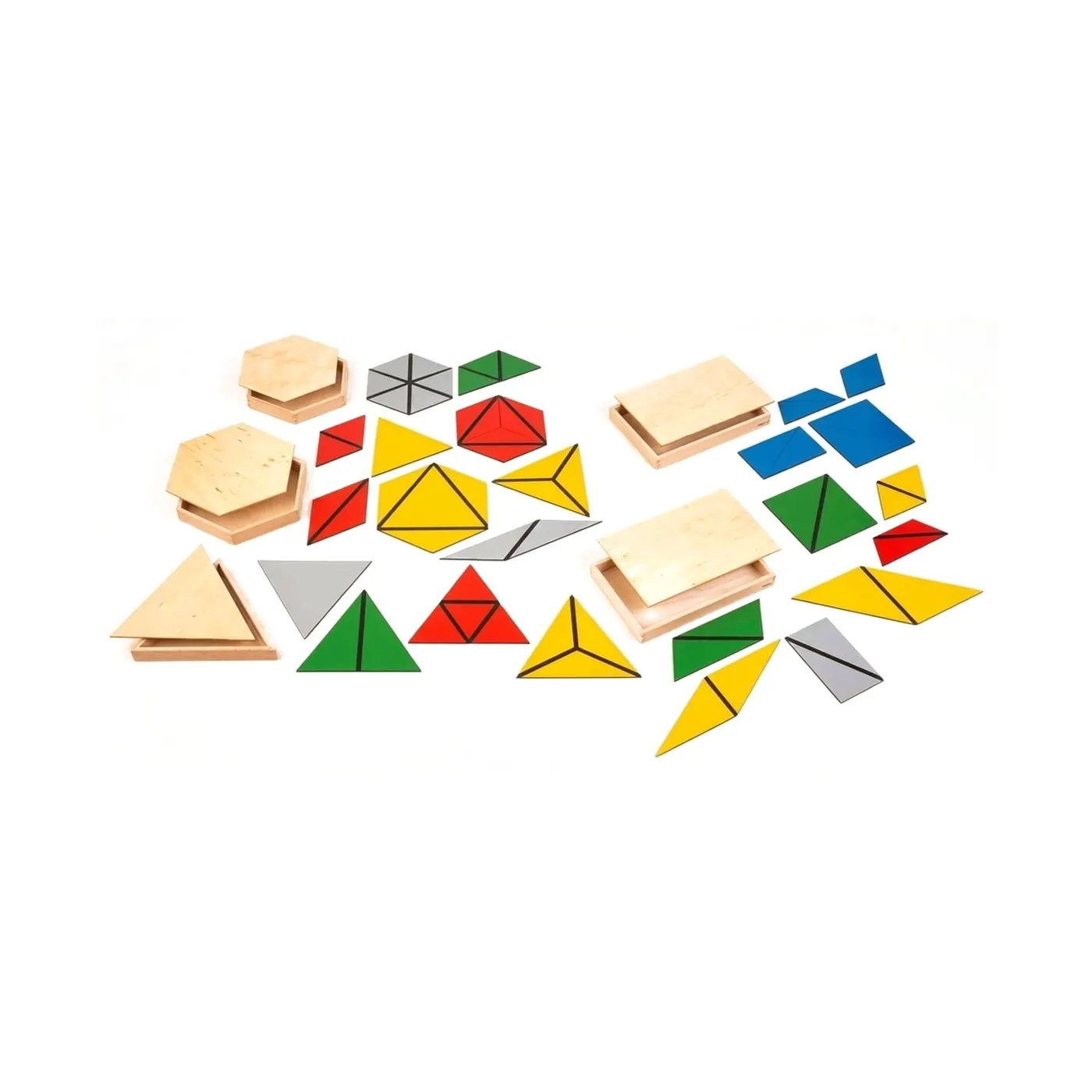 Constructive Triangles (Nienhuis) €339.90
Advice, warranty and returns are handled by us.
Why it costs €48.90
Behind the price of the original are things you can check yourself.
AMI approval
The material is approved by the Association Montessori Internationale (AMI). Nienhuis has made Montessori materials since 1929.
A verifiable original
The EAN 8719924003005 is on the box. It is the maker's number, not ours.
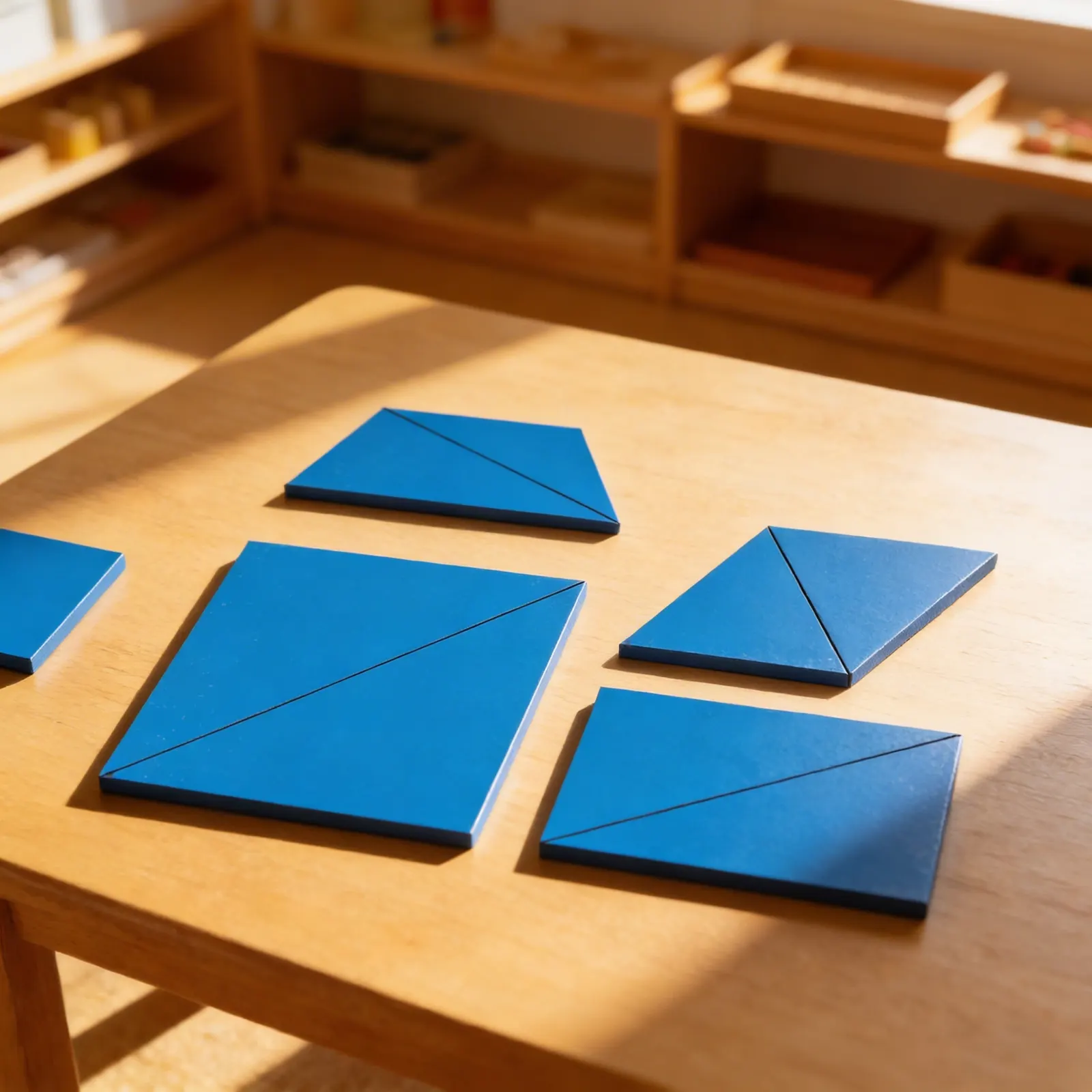
Set Of Blue Constructive Triangles in a child's hands
The Set of Blue Constructive Triangles is a Montessori set for visual discrimination in which every piece is blue. Constructive triangles are used to build flat shapes out of triangular parts, so the child fits the pieces together, takes them apart and tries again to see which shapes they form. With the whole set in one colour, the pieces are told apart by shape, not by colour. The manufacturer states the material as Duron, indoor use and a minimum age of 3 years.
Geometric Intelligence
Children discover how triangles combine to form various flat shapes, building foundational geometry concepts.
Visual Discrimination
Comparing and matching shapes refines the ability to perceive subtle differences in form and proportion.
Mathematical Preparation
Hands-on exploration of shape relationships prepares the mind for abstract mathematical thinking.
Problem-Solving Skills
Reconstructing shapes from their triangular components develops logical reasoning and spatial awareness.
How to present it
3 tips for parents
- Look for triangles in everyday objects, roof shapes, sandwich cuts, or folded napkins
- Use building blocks at home to explore how triangles create stable structures
- Avoid correcting 'mistakes', unconventional arrangements often lead to discoveries

If you are not sure it suits your child, we answer in person.
Norbert Kovalčín, founder of Faborino · write to him
There is no review here yet. We will ask you for one after you buy. Write the first review
What's in the Box
- Set of blue constructive triangles: Duron material
Size and material
| Packaging | 32 × 24 × 4 cm |
| Primary Material | Duron |
| Recommended Age | 3-6 years |
Care
Wipe with slightly damp cloth, dry immediately
Frequently Asked Questions
What shapes are included in the Blue Constructive Triangles set?
The set contains blue constructive triangles made of Duron. Children fit them together to build flat shapes.
What skills does this material develop?
This material develops visual discrimination, spatial awareness, problem-solving abilities, and geometric understanding. It strengthens the child's ability to analyze shapes, recognize patterns, and understand how complex forms are built from simpler components.
Should this be introduced before or after other Constructive Triangle boxes?
The Blue Constructive Triangles are typically introduced after the child has worked with the first rectangular box but before the triangular boxes. This progression allows children to build complexity gradually, moving from simple triangle combinations to understanding diagonal relationships.
How does this material prepare children for later mathematics?
By physically constructing and deconstructing geometric shapes, children develop a concrete understanding of concepts like congruence, symmetry, and diagonal bisection. This sensorial experience creates a strong foundation for abstract geometry, fractions, and area calculations in elementary years.
Product safety
Manufacturer: Nienhuis Montessori, Anders Celsiusstraat 15, 7442 PB Nijverdal, Netherlands
Set Of Blue Constructive Triangles